
Has Lucid Group (LCID) Fallen Enough To Look Reasonable After Recalls?
Lucid Group stock has seen a steep reset over the past five years, and current checks point to shares still screening as expensive rather than as a clear bargain. For anyone looking at Lucid Group today, the gap between the share price and the weak value score raises questions about how much of the long term electric vehicle story is already reflected in the stock.
- The share price has fallen about 98% over five years, which signals that investor expectations around Lucid Group have been heavily repriced.
- Recent news on leadership hires and planned entry into the French market may support hopes for stronger commercial execution, while the large recall affecting more than 27,000 vehicles highlights operational and reputational risks that can weigh on valuation.
- The value score is low, with Lucid Group screening as expensive on the broader checks, so the stock is not flagged as a clear bargain on this framework 0 of 6 tests passed.
The issue now is whether Lucid Group's current price leaves enough room for investors to be compensated for these execution and quality risks over time.
Broaden your watchlist beyond Lucid Group by scanning 33 high quality undervalued stocks that pair more grounded valuations with stronger fundamentals than this heavily repriced EV stock.
Does Lucid Group Look Pricey on Sales?
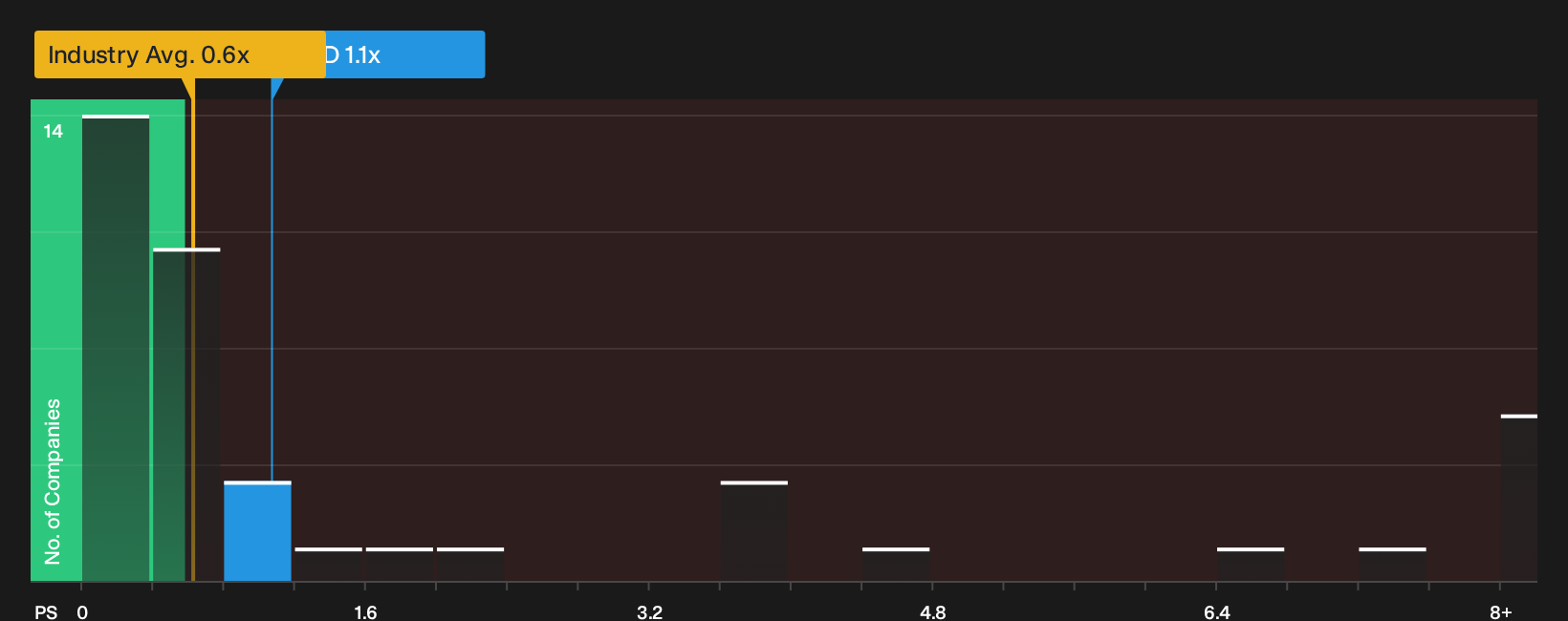
P/S is often the cleaner yardstick for Lucid Group because the business is still loss making, so earnings based metrics such as P/E do not carry much weight. On this measure, the stock trades at about 1.1x sales, compared with an Auto industry average P/S of roughly 0.6x and a peer group around 0.6x.
The fair P/S ratio from this framework is just 0.0x, which indicates that the model is heavily penalising Lucid Group for its ongoing cash burn, forecast free cash flow losses and execution risk. That gap is not a precise target; rather, it is a red flag that the valuation sits a long way above what this approach would usually assign to a company with similar fundamentals. Despite the large recall of 27,185 vehicles putting fresh attention on operational risk, the market is still pricing each dollar of Lucid Group revenue at a premium to both sector norms and this tighter fair value band.
On the P/S multiple, Lucid Group screens as overvalued, with the share price asking a higher price for each dollar of sales than this framework supports.
See what the numbers say about this price — find out in our valuation breakdown.
The Lucid Group Narrative: What Would Justify Today's Price?
Lucid Group's valuation puzzle only really makes sense once you spell out the stories that might justify it. Simply Wall St Narratives on the Community page do exactly that by linking the current share price to clear assumptions about future growth, margins and earnings power. Each scenario ties a specific fair value estimate to its own mix of potential catalysts and risks, so you can track over time which version of Lucid Group's path is actually unfolding.
One of the top community narratives on Lucid Group: 50% undervalued
"The upcoming launch of Lucid's midsized EV platform in late 2026 targets a much broader customer base with lower cost, high volume vehicles..."
Read one of the top narratives on Lucid Group
Do you think there's more to the story for Lucid Group? Head over to our Community to see what others are saying!
The Bottom Line
Lucid Group screens as overvalued on simple P/S checks, with the market still putting a premium on each dollar of revenue despite weak broader valuation flags. That premium only makes sense if investors believe the business can eventually translate its model line up and new markets into scale and better cash discipline. The bear case is that execution missteps, such as large recalls and ongoing losses, keep eroding confidence faster than the commercial story improves. The key issue from here is whether Lucid Group can prove its operating model works at volume before the market loses patience with paying for the promise.
This article by Simply Wall St is general in nature. We provide commentary based on historical data and analyst forecasts only using an unbiased methodology and our articles are not intended to be financial advice. It does not constitute a recommendation to buy or sell any stock, and does not take account of your objectives, or your financial situation. We aim to bring you long-term focused analysis driven by fundamental data. Note that our analysis may not factor in the latest price-sensitive company announcements or qualitative material. Simply Wall St has no position in any stocks mentioned.
Have feedback on this article? Concerned about the content? Get in touch with us directly. Alternatively, email editorial-team@simplywallst.com