
Regions Financial (RF) Stock Looks Like A Bargain Despite Its 90% Run
Regions Financial stock has posted a strong 3 year share price gain, yet the current Excess Returns intrinsic value estimate suggests the market price may still sit below what the business fundamentals imply. At the same time, traditional valuation checks present a more mixed picture, so the gap between what the model says and where the shares trade is worth unpacking.
- Regions Financial has returned about 89.9% over 3 years, which puts recent pullbacks into the context of a much stronger medium term run.
- Future returns can be supported if the bank converts earnings consistently into cash and keeps credit costs in check, while any deterioration in loan quality or capital strength may weigh on what investors are willing to pay.
- The broader valuation scorecard for Regions Financial is mixed rather than a clear bargain or obvious premium, with the stock scoring 4 out of 6 on value checks.
The issue now is whether the current discount to the Excess Returns intrinsic value estimate offers enough compensation for the risks in Regions Financial's banking model.
Spot similar opportunities by scanning our hand picked list of banks and financials on the 33 high quality undervalued stocks that currently screen as high quality yet potentially mispriced.Is Regions Financial a Bargain on Excess Returns?
The Excess Returns approach looks at how efficiently Regions Financial reinvests shareholders’ equity relative to the return investors require. For Regions Financial, the model uses a Book Value of $20.49 per share and a Stable EPS estimate of $2.91 per share, based on future return on equity forecasts from 13 analysts. With an Average Return on Equity of 13.05% and a Cost of Equity of $1.62 per share, the framework calculates an Excess Return of $1.30 per share, implying the bank is expected to earn more on its equity base than the model treats as the hurdle rate.
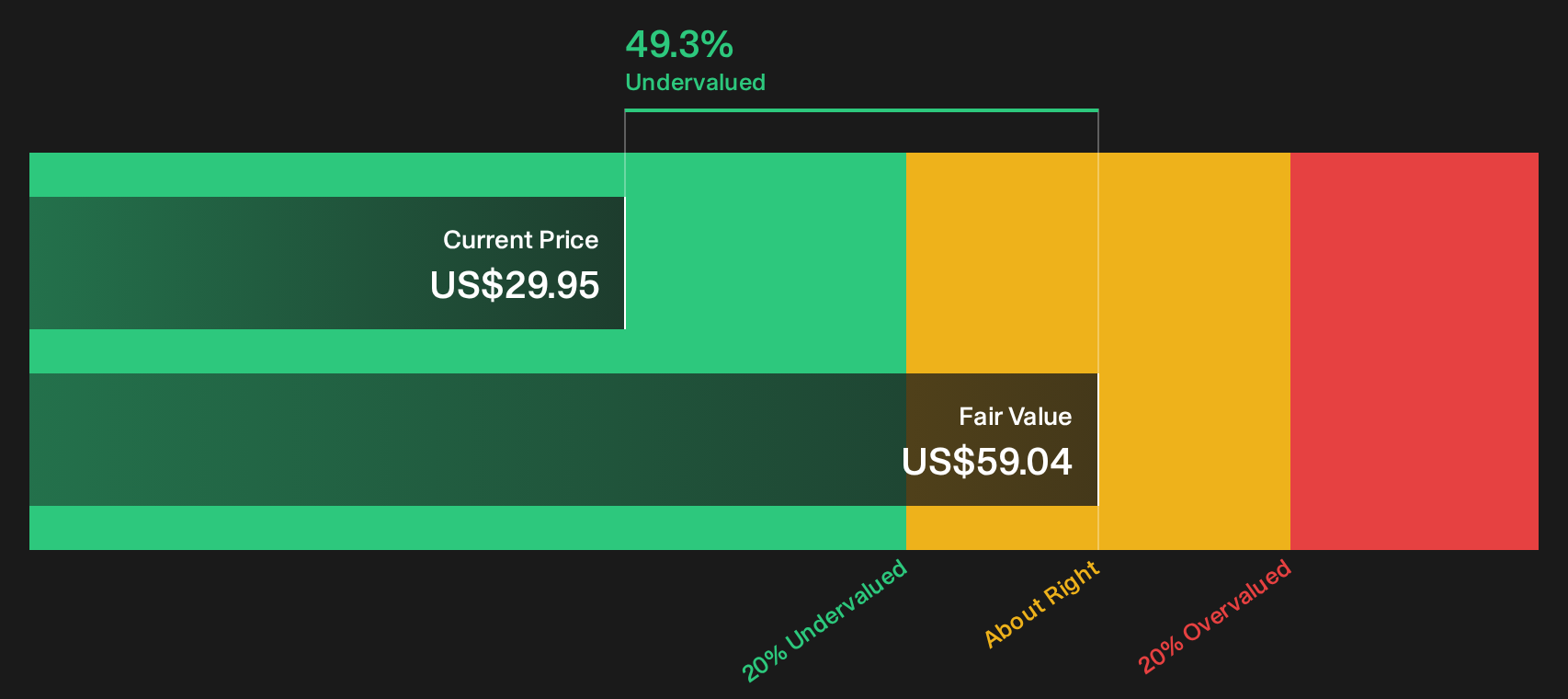
The model also uses a Stable Book Value of $22.33 per share, sourced from 11 analyst estimates, to project how those returns can compound over time. On that basis, the Excess Returns valuation points to an intrinsic value of about $59.04 per share, which implies the stock is 49.3% undervalued relative to the current market price.
On this Excess Returns view, Regions Financial appears undervalued compared with what its projected profitability on equity would justify.
Our Excess Returns analysis suggests Regions Financial is undervalued by 49.3%. Track this in your watchlist or portfolio, or discover 33 more high quality undervalued stocks.
Does Regions Financial Look Fairly Valued on Earnings?
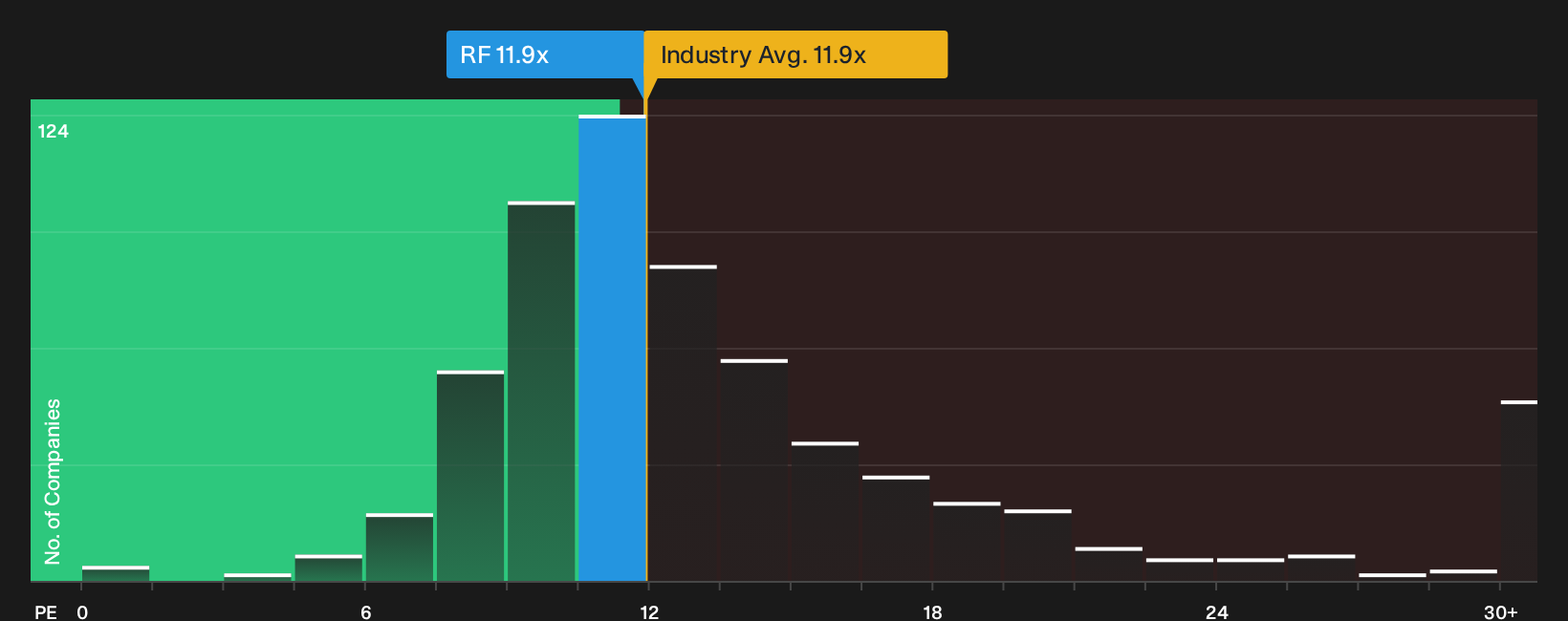
P/E is usually the cleanest way to compare banks, and Regions Financial is no exception because earnings tend to track the health of its loan book and fee income. On this measure, the stock trades at about 11.9x earnings, which is very close to the Banks industry average of roughly 11.9x and below the peer group on about 13.5x.
The valuation model suggests a fair P/E of about 13.0x for Regions Financial, based on its profile and risk characteristics. That is modestly above where the shares change hands today, so the current pricing lines up reasonably well with what the framework implies rather than pointing to an obvious discount or a steep premium.
Overall, Regions Financial appears roughly fairly valued on its P/E multiple.
See what the numbers say about this price — find out in our valuation breakdown.
The Regions Financial Narrative: What Would Justify Today's Price?
Simply Wall St Narratives step in where the headline valuation puzzle on Regions Financial leaves off. Each one lays out what would need to happen on earnings power, growth and profitability for the stock to be worth materially more or less than today’s price, and rather than relying on a single multiple or model output, they spell out the moving parts behind that fair value view so you can track those assumptions against future results on the Community page.
If you have a clear, number driven view on where Regions Financial's growth, margins and execution go from here, consider sharing a Narrative to set out your case in the Simply Wall St community. Add your voice, put your thesis on Regions Financial on record, and watch how it stacks up as fresh results emerge.
Do you think there's more to the story for Regions Financial? Head over to our Community to see what others are saying!
The Bottom Line
Regions Financial screens as undervalued on the Excess Returns intrinsic value estimate, while the P/E comparison suggests the shares are priced close to what peers command. That split reflects different lenses, with the intrinsic model leaning on how efficiently equity can be reinvested and the market multiple anchored in current sentiment and sector expectations. Broader valuation checks are mixed, so the discount only helps if earnings quality, credit costs and capital strength hold up. The crux is whether the bank can keep turning that equity base into reliable profits without a bump in risk, or whether the current gap simply reflects caution that proves justified.
This article by Simply Wall St is general in nature. We provide commentary based on historical data and analyst forecasts only using an unbiased methodology and our articles are not intended to be financial advice. It does not constitute a recommendation to buy or sell any stock, and does not take account of your objectives, or your financial situation. We aim to bring you long-term focused analysis driven by fundamental data. Note that our analysis may not factor in the latest price-sensitive company announcements or qualitative material. Simply Wall St has no position in any stocks mentioned.
Have feedback on this article? Concerned about the content? Get in touch with us directly. Alternatively, email editorial-team@simplywallst.com