
Tyler Technologies (TYL) Stock May Be 38% Undervalued As Nebraska Expands AI Rollout
Tyler Technologies is coming off a difficult stretch, with the share price down 39.4% over the past year, yet the valuation picture is split as an intrinsic value estimate based on Discounted Cash Flow (DCF) points to upside while market based multiples suggest the stock screens expensive.
- Over the past 12 months, Tyler Technologies has fallen 39.4%, which puts current pricing in the context of a prolonged reset in investor expectations.
- The statewide expansion of Tyler Technologies' AI enabled Resident AI Assistant in Nebraska can support confidence in long term cash generation, while execution risk around monetising AI tools at scale may cap how much value investors are willing to assign today.
- The broader valuation checks come through as a mixed picture rather than a clear bargain or clear overvaluation, with a value score of 4 that sits between cheap and expensive screens.
The stock's next move may depend on whether Tyler Technologies' current price reflects a cautious market multiple view or an opportunity relative to the intrinsic value estimate that suggests it trades at a discount.
Scan beyond Tyler Technologies and weigh it against hand picked peers using the 33 high quality undervalued stocks that combine solid cash flows with balance sheet strength.
Does Tyler Technologies Look Undervalued on Cash Flow?
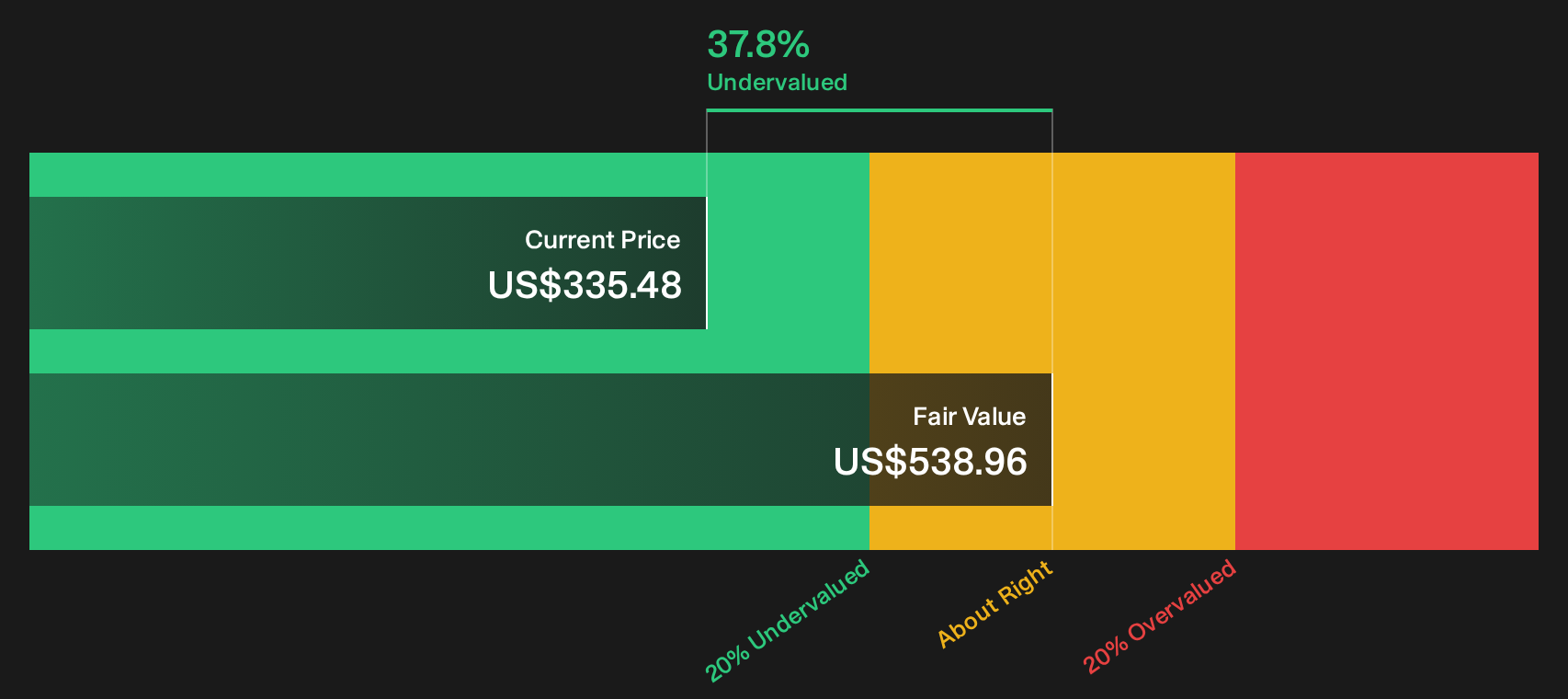
The Discounted Cash Flow (DCF) model here values Tyler Technologies on the cash it is expected to generate for shareholders over time. Latest twelve month free cash flow sits at about $686.9 million, and the projection path in the model assumes growing cash generation rather than a shrinking profile. On those inputs, the DCF framework lands on an estimated intrinsic value of about $539 per share.
Against the current market price, that implies the stock screens roughly 37.8% below this cash flow based estimate and therefore looks undervalued on this method. Nebraska’s statewide rollout of Tyler Technologies’ AI enabled Resident AI Assistant gives some real world backing to the idea that the product set can support those future cash flows, even if the share price is still treating that potential with caution.
On this DCF view, Tyler Technologies looks undervalued relative to what its projected cash flows would justify.
Our Discounted Cash Flow (DCF) analysis suggests Tyler Technologies is undervalued by 37.8%. Track this in your watchlist or portfolio, or discover 33 more high quality undervalued stocks.
Does Tyler Technologies Look Pricey on Earnings?
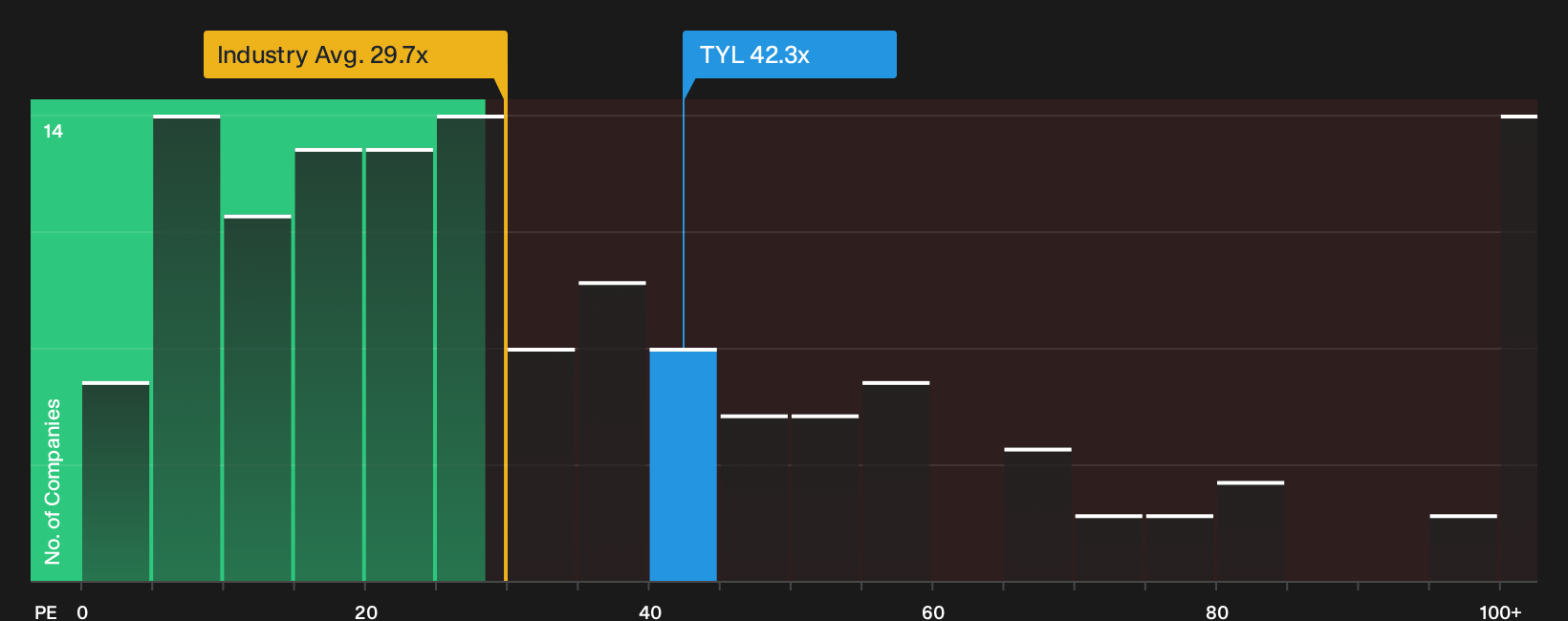
P/E works well for Tyler Technologies because earnings are a central part of how many investors look at established software platforms that already produce profits. On this lens, the stock trades on a P/E of about 42.3x, which is above the broader Software industry average of roughly 29.7x and below the peer group average near 50.9x.
The fair P/E ratio estimated for Tyler Technologies is about 30.7x, based on factors such as its sector, profitability profile, size and risk. Against that yardstick, the current multiple carries a clear premium. This indicates that the market is willing to pay more per dollar of earnings than this framework would suggest as a baseline.
On the P/E test, Tyler Technologies screens as overvalued relative to the fair multiple implied by its fundamentals and industry context.
See what the numbers say about this price — find out in our valuation breakdown.
The Tyler Technologies Narrative: What Would Justify Today's Price?
Simply Wall St Narratives for Tyler Technologies pick up where this valuation split leaves off by spelling out which paths for growth, profitability and earnings would need to play out for the stock to look meaningfully cheap or expensive at today’s level. Each scenario links its number to a specific view on how Tyler Technologies' revenue trajectory, margin profile and risk picture evolve, which you can revisit as fresh information comes through on the Community page.
Community views on Tyler Technologies could hardly be further apart, with one camp seeing plenty of runway and the other focused on whether the price already bakes that in.
Bull case: 23% undervalued
"Ongoing investment in AI-powered tools and automation, evident in product launches like the AI-driven Resident Assistant and enhanced budgeting solutions, caters to public sector labor challenges and the need for data-driven decision-making, enabling premium pricing, reducing customer churn, and unlocking scalable margin improvements over time…"
Read the full Bull Case to see why Tyler Technologies could be undervalued
Bear case: 131% overvalued
"The key risk is not competitive displacement but internal: capital allocation discipline (SBC at 24% of FCF, goodwill accumulation) and the pace of on-premises-to-cloud migration…"
Read the full Bear Case to see why Tyler Technologies could be overvalued
Do you think there's more to the story for Tyler Technologies? Head over to our Community to see what others are saying!
The Bottom Line
Tyler Technologies screens undervalued on a Discounted Cash Flow (DCF) view, with the intrinsic value estimate sitting well above the current share price, yet looks overvalued on earnings based on its P/E premium to sector norms. That split reflects two different anchors. The intrinsic value model leans on long term cash generation, while the market multiple view leans on how much growth and margin resilience investors are willing to pay for today. The crux from here is whether Tyler Technologies can translate its product rollout and AI efforts into cash flows that align with the DCF case, rather than the market correctly pricing execution and monetisation risk.
This article by Simply Wall St is general in nature. We provide commentary based on historical data and analyst forecasts only using an unbiased methodology and our articles are not intended to be financial advice. It does not constitute a recommendation to buy or sell any stock, and does not take account of your objectives, or your financial situation. We aim to bring you long-term focused analysis driven by fundamental data. Note that our analysis may not factor in the latest price-sensitive company announcements or qualitative material. Simply Wall St has no position in any stocks mentioned.
Have feedback on this article? Concerned about the content? Get in touch with us directly. Alternatively, email editorial-team@simplywallst.com