
Learn Why The Bull Case For Innodata Stock Could Change Following Record Revenue Growth
- Innodata reported its 12th consecutive quarter of year-over-year revenue growth and nearly doubled profitability, with recent results showing both higher sales and margin expansion despite ongoing customer concentration and competition risks.
- A long and short equity fund disclosed that Innodata was the largest detractor in its short portfolio in Q2 2026, then covered the position after strong operating performance challenged its thesis about the durability of the data services business model.
- We will now assess how Innodata's record revenue streak and improved profitability may reshape the investment narrative that existed before this news.
Scan how Innodata’s momentum compares with other AI data and infrastructure plays by reviewing our curated list of 89 AI infrastructure stocks before you decide where risk and concentration really fit your portfolio.
Innodata Investment Narrative Recap
To own Innodata, you need to believe its position in AI data services can turn sustained demand for high quality training and evaluation work into durable revenue and earnings, even as automation pressure builds. The short term swing factor is whether the current run of revenue growth and improving profitability can continue without relying even more heavily on a few large tech customers.
The biggest risk is still concentration. A contract change at a key client could hit both sales and margins quickly, given the spend on talent and tooling that is already in place. Recent results do not remove that risk, although they do show the business executing well while those exposures remain.
The most relevant recent datapoint is the long and short equity fund that called out Innodata as its largest detractor on the short side, then covered after the latest quarterly numbers. That update links directly to the current catalyst. Operational delivery forced a professional investor to exit a bearish position when revenue and margins held up better than expected.
For you, that episode highlights two things. First, execution risk around customer budgets and competition is very real, given how quickly a short thesis can be tested by one quarter. Second, strong reported growth and profitability can influence how much runway investors see for Innodata as it keeps investing in AI focused platforms, data tooling, and deeper client relationships.
Innodata Analyst Expectations In Context
Innodata's narrative projects US$618.6 million revenue and US$71.7 million earnings by 2029. That profile is built on analysts using 29.7% yearly revenue growth and an earnings increase of about US$32.4 million from US$39.3 million today.
Analysts are effectively arguing that Innodata can keep growing fast while absorbing some squeeze in margins. Revenue is modeled to climb quickly, yet profit margin is expected to drift from 13.9% to 11.6% over the next few years. For you, that combination points to a simple question: Are you comfortable with a story that leans more on scale than on fatter margins to drive future earnings?
Consensus numbers also imply that current profitability is roughly a midpoint between a wide range of outcomes. Forecast earnings of US$71.7 million by 2029 sit between bullish expectations of US$117.8 million and more cautious estimates of US$57.0 million. That spread tells you analyst conviction is not uniform. It signals that even within professional circles, there are very different views on how sticky Innodata's AI data work and client budgets will be.
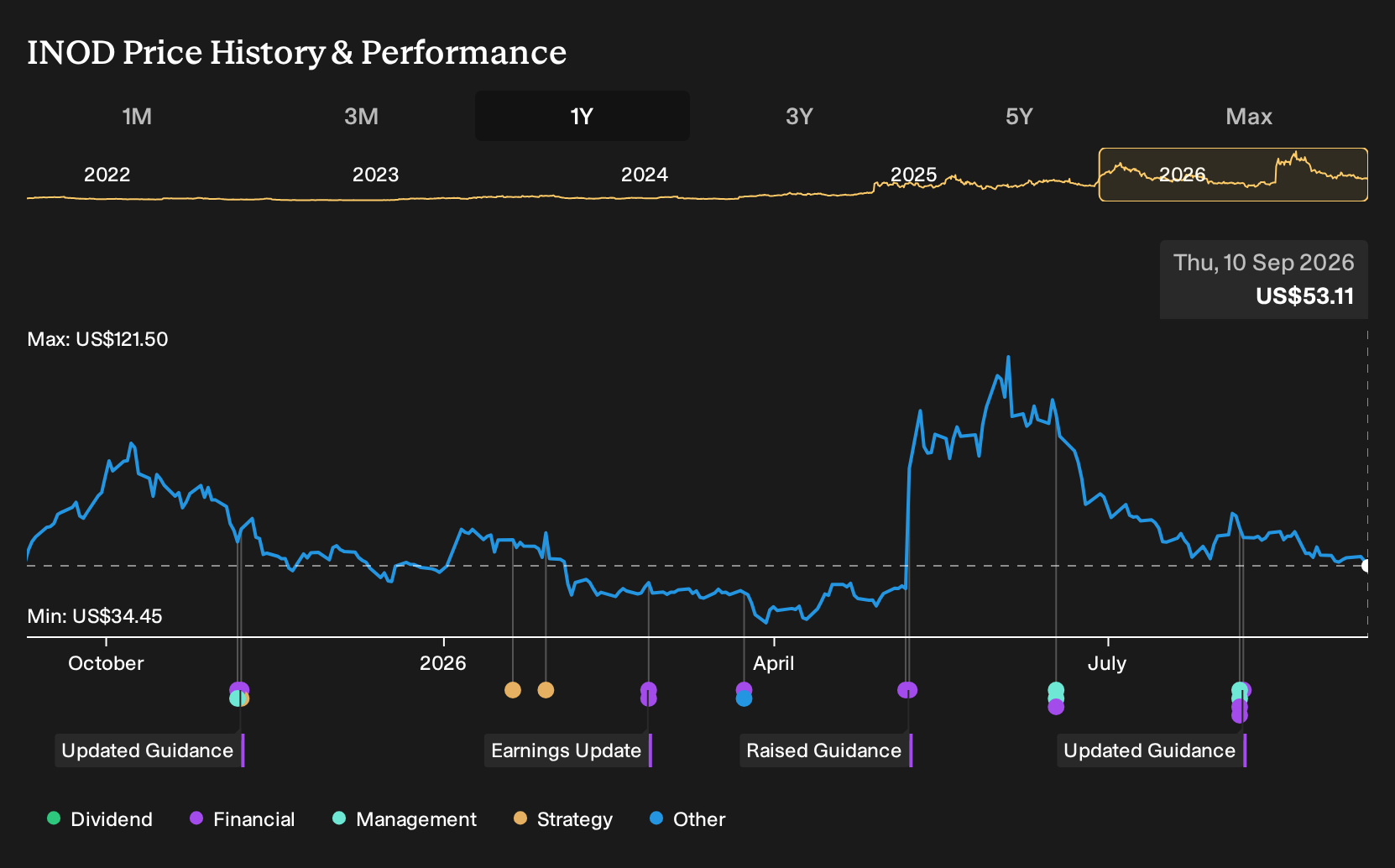
Valuation anchors those operational guesses to a specific price target. The analyst group is using that 2029 outlook for roughly US$618.6 million of sales and US$71.7 million of net income, along with a projected P/E of 74.5x, to arrive at a consensus target of US$122.75 per share. That multiple is higher than the cited 18.5x for the broader US Professional Services peer set, so you would be paying a premium if you lean on these assumptions.
For you as an investor, the important step is not to accept that P/E premium at face value. Instead, treat it as a checklist. You would need to think Innodata can deliver on three things to close the gap to that target. First, compound revenue at close to 30% a year without losing key contracts. Second, hold profit margins near the low teens despite wage inflation, tooling costs, and pricing pressure from automation. Third, justify a high earnings multiple while customer concentration and regulation remain front and center.
Those are the pressure points to stress test. If you believe concentration risk is likely to ease and that Innodata's tools and workflows can offset margin headwinds, the consensus path may look reasonable. If you think automation will compress pricing or that big tech clients could scale back quickly, then the forecast curve on both revenue and net income may look too generous relative to the current share price.
Uncover why Innodata's fair value indicates a 131% potential upside to its current price, which could narrow quickly.
Exploring Other Perspectives
One alternate narrative leans hard into Innodata’s potential pricing power. The most optimistic analysts were penciling in about US$703.3 million of revenue and US$119.0 million of earnings by 2029, well above consensus. With record growth now on the table, those bullish views might gain traction while more cautious investors reassess the whole range of outcomes.
Explore 7 other Innodata fair value estimates, including one that suggests as much as 164% potential upside from the current price.
The Verdict Is Yours
Don't just follow the ticker. Dig into the data and build a conviction that's truly your own.
- A great starting point for your Innodata research is our analysis highlighting 3 key rewards that could impact your investment decision.
- See our latest analysis for Innodata. The report includes a comprehensive fundamental analysis summarized in a single visual, the Snowflake, making it easy to evaluate Innodata's overall financial health at a glance.
Looking For More Innodata Investment Ideas?
If Innodata has sharpened your appetite for AI and data focused opportunities, it can help to widen your watchlist with other stocks that fit clear financial filters. The Simply Wall St Screener lets you scan the market using focused criteria so you can compare different types of opportunities side by side.
- If capital preservation is a priority, start with a 11 resilient stocks with low risk scores that have historically carried lower risk scores and may suit a steadier approach.
- For investors hunting for quality at a fair price, review a 33 high quality undervalued stocks that combine stronger balance sheets with healthier cash flows.
- Income focused readers can scan a 6 dividend fortresses that aim to pair higher yields with more resilient payout profiles.
This article by Simply Wall St is general in nature. We provide commentary based on historical data and analyst forecasts only using an unbiased methodology and our articles are not intended to be financial advice. It does not constitute a recommendation to buy or sell any stock, and does not take account of your objectives, or your financial situation. We aim to bring you long-term focused analysis driven by fundamental data. Note that our analysis may not factor in the latest price-sensitive company announcements or qualitative material. Simply Wall St has no position in any stocks mentioned.
Have feedback on this article? Concerned about the content? Get in touch with us directly. Alternatively, email editorial-team@simplywallst.com