
Learn Why The Bull Case For Kyocera Stock Could Change Following Optical Isolator Breakthrough
- Kyocera and Tohoku University reported a laser annealing method that integrates optical isolators directly onto silicon photonics chips, cutting back‑reflected light by about 95% and aiming to support faster, lower power optical links for AI data centers.
- The work uses high temperature crystallization of magneto optical garnet in a tightly targeted chip region, which points to potential manufacturing advantages for future co packaged optics where thermal budgets and chip reliability are major constraints.
- The next area of interest is how Kyocera's investment narrative might evolve as this laser annealing technology for silicon photonics matures.
Scan how Kyocera's silicon photonics work lines up with other potential AI infrastructure beneficiaries by reviewing a curated set of 89 AI infrastructure stocks.
What Is Kyocera's Investment Narrative?
To own Kyocera, you need to believe this is a diversified industrial and electronics group that can keep turning ceramic know how and component design into steady demand from semiconductors, autos and office equipment, while gradually plugging into higher value digital infrastructure. Earnings have swung sharply in the past five years, yet the most recent year delivered very strong profit growth and higher net margins at 7.8%. Forecasts point to mid single digit earnings and low single digit revenue growth, which keeps the story grounded in execution rather than breakneck expansion.
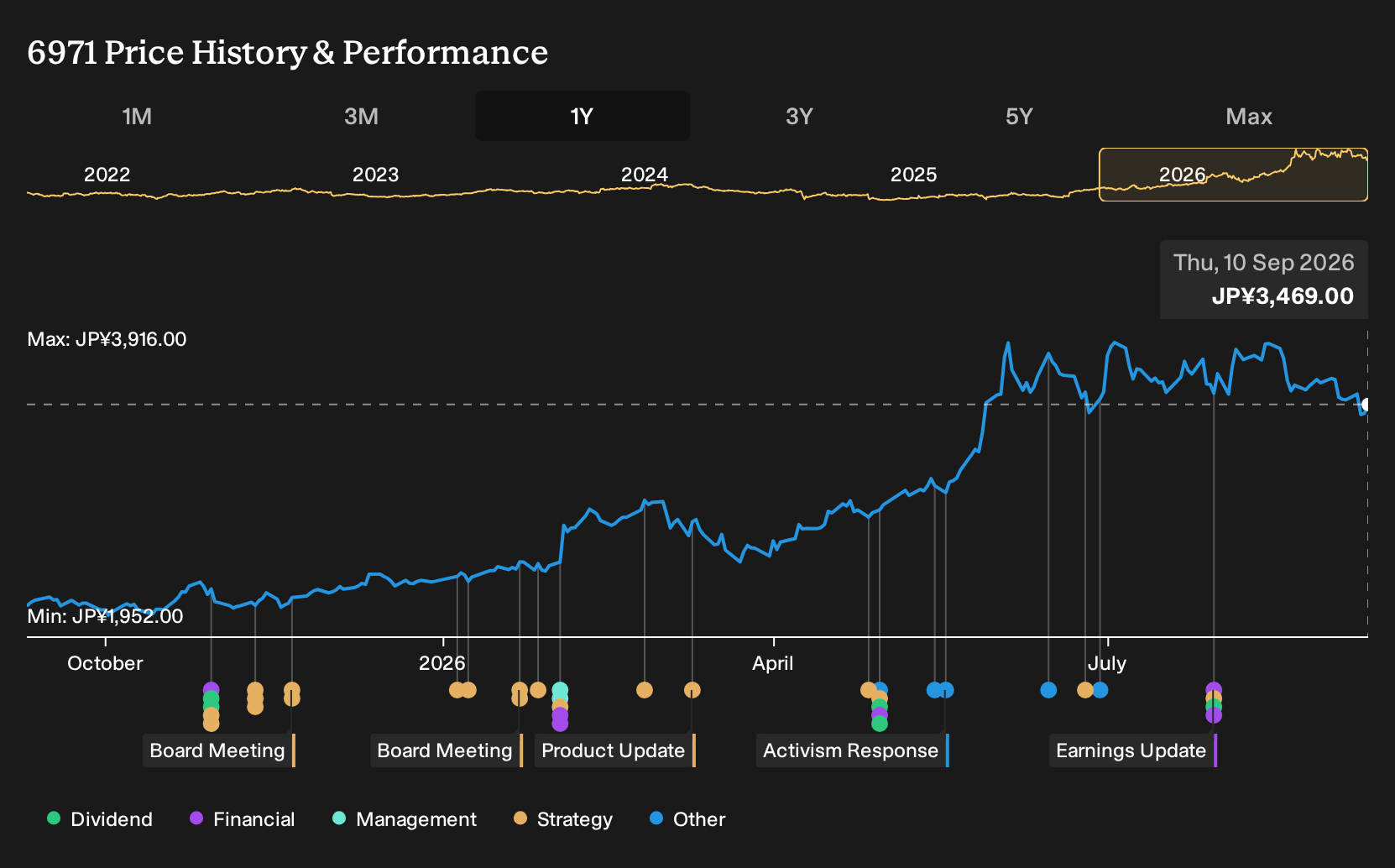
The laser annealing work with Tohoku University fits that pattern. It is early stage, so the direct impact on near term results or orders for AI data center optics is unlikely to be large yet. The near term focus still sits on pricing power in core components, capital needs across factories and tools, and whether management can justify a 27.4x P/E when revenue growth is slower than the broader JP market. Recent share gains, including a 1 year total return above 70%, suggest expectations are already demanding.
Even so, there is a structural weak spot in the Kyocera story that often gets glossed over when talking about AI upside...
There's only one way to know the right time to buy, sell or hold Kyocera. Head to Simply Wall St's company report for the latest analysis of Kyocera's Fair Value.
Exploring Other Perspectives
Two fair value estimates from the Simply Wall St Community span roughly ¥2,743 to ¥3,500 per share, which already shows how far opinions on Kyocera can spread. With the laser annealing silicon photonics work now published but not yet in these numbers, you should test your own view against several contrasting community perspectives.
Explore another Kyocera fair value estimate, including one that suggests it could be worth as much as ¥3500.
Reach Your Own Conclusion
Disagree with this assessment? Extraordinary investment returns rarely come from following the herd, so go with your instincts.
- A great starting point for your Kyocera research is our analysis highlighting 2 key rewards that could impact your investment decision.
- See our latest analysis for Kyocera. The report includes a comprehensive fundamental analysis summarized in a single visual, the Snowflake, making it easy to evaluate Kyocera's overall financial health at a glance.
Looking For More Ideas Beyond Kyocera?
If Kyocera's silicon photonics work has you thinking about where else AI infrastructure demand or balance sheet resilience could matter, it can help to widen the lens and compare it with other listed businesses using the Simply Wall St Screener.
- For investors who want to balance quality with valuation discipline, scan a curated set of 17 high quality undervalued stocks that pair stronger fundamentals with more modest pricing.
- If steady income matters to your plan, review a group of 18 dividend fortresses that combine higher yields with a focus on sustainability.
- For those who care most about capital strength and financial resilience, start with a list of solid balance sheet and fundamentals (19 results) to see which companies match your risk tolerance.
This article by Simply Wall St is general in nature. We provide commentary based on historical data and analyst forecasts only using an unbiased methodology and our articles are not intended to be financial advice. It does not constitute a recommendation to buy or sell any stock, and does not take account of your objectives, or your financial situation. We aim to bring you long-term focused analysis driven by fundamental data. Note that our analysis may not factor in the latest price-sensitive company announcements or qualitative material. Simply Wall St has no position in any stocks mentioned.
Have feedback on this article? Concerned about the content? Get in touch with us directly. Alternatively, email editorial-team@simplywallst.com