
Does Virtual Crash Testing Change The Bull Case For Autoliv (ALV)?
- Autoliv reported that it advanced its Human Body Model Safety Suite for virtual crash testing, with Toyota becoming the first customer to evaluate the integrated platform across simulation, analysis, and decision support.
- The move into virtual human body modelling points to Autoliv’s push to embed itself earlier in vehicle development cycles. In these stages, digital tools that shorten lead times and support evolving safety requirements can influence long-term program wins and content per vehicle.
- We will now look at how Autoliv's virtual Human Body Model Safety Suite could reshape the company’s broader investment narrative.
Scan how Autoliv's push into virtual crash testing compares with other safety and automation plays by running the curated 38 robotics and automation stocks alongside this news.
Autoliv Investment Narrative Recap
To own Autoliv, you need to believe that tighter safety rules and higher safety content per vehicle continue to matter more than swings in light vehicle production. The HBM Safety Suite fits that belief because it pushes Autoliv deeper into OEM development workflows. The near term story still hinges on execution in China, cost control, and maintaining content per car despite pricing pressure.
The biggest immediate risk remains softer build rates and contract pricing pressure that could weigh on margins, especially with Autoliv already carrying a high debt load and facing tariff uncertainty. This HBM news is directionally positive for positioning, but not a near term catalyst on the same scale as auto production trends or cost recovery from customers.
Among recent developments, the most relevant here is Autoliv’s broader push into efficiency and digitalization. Management has been working on automation and data driven tools to lower the cost base and tighten operating discipline. The HBM Safety Suite lines up with that effort because virtual testing can reduce reliance on slower, more expensive physical programs.
For you as a shareholder, the link is practical. If Autoliv can turn tools like HBM into sticky software and service relationships, that supports higher safety content per vehicle and potentially steadier program wins when light vehicle production wobbles. Execution risk is real, since OEMs hold bargaining power and margins are sensitive to cost inflation and mix shifts toward lower value segments.
Autoliv's current analyst scenario points to revenues of $12.0b and earnings of $923.2m by 2029, based on an assumed 2.9% yearly revenue growth rate and an earnings increase of about $214.2m from current earnings of $709.0m.
Uncover how Autoliv's fair value indicates a 9% potential upside to its current price before that discount starts to close.
Exploring Other Perspectives
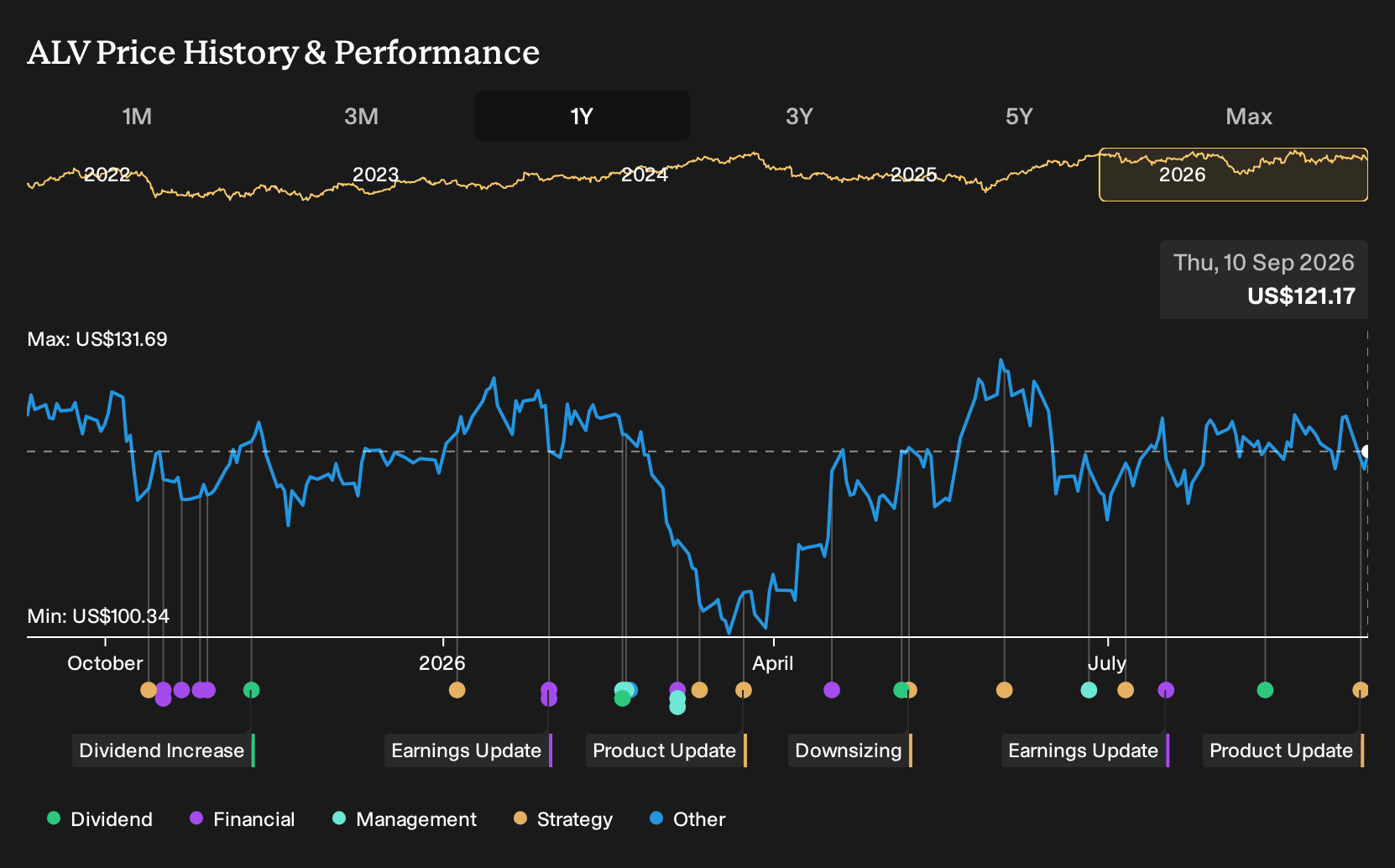
Four fair value estimates from the Simply Wall St Community span roughly US$103 to about US$195, so retail opinions on Autoliv’s worth are far from aligned. When you set that wide spread against tariff risk, softer vehicle build forecasts, and rising virtual testing adoption, you get a mix that really rewards comparing multiple views.
Explore 3 other Autoliv fair value estimates, including one that suggests potential upside of up to 61% from the current price.
Form Your Own Verdict
Don't just follow the ticker. Dig into the data and build a conviction that's truly your own.
- A great starting point for your Autoliv research is our analysis highlighting 3 key rewards and 3 important warning signs that could impact your investment decision.
- See our latest analysis for Autoliv. The report includes a comprehensive fundamental analysis summarized in a single visual, the Snowflake, making it easy to evaluate Autoliv's overall financial health at a glance.
Looking for more Autoliv style investment ideas?
If Autoliv's mix of real world hardware and digital tools appeals to you, it can help to cast the net wider and compare it with other businesses that share similar financial strengths or income profiles.
- For investors who care most about resilient balance sheets and steady fundamentals, start with a list of solid balance sheet and fundamentals (23 results) that filters for companies with stronger financial footing.
- If dependable income streams matter more to you than headlines, scan a 6 dividend fortresses that focuses on higher yielding payouts with an emphasis on stability.
- When you want to find overlooked ideas before the crowd catches on, use a 18 high quality undiscovered gems that homes in on quality businesses that are still off most radars.
This article by Simply Wall St is general in nature. We provide commentary based on historical data and analyst forecasts only using an unbiased methodology and our articles are not intended to be financial advice. It does not constitute a recommendation to buy or sell any stock, and does not take account of your objectives, or your financial situation. We aim to bring you long-term focused analysis driven by fundamental data. Note that our analysis may not factor in the latest price-sensitive company announcements or qualitative material. Simply Wall St has no position in any stocks mentioned.
Have feedback on this article? Concerned about the content? Get in touch with us directly. Alternatively, email editorial-team@simplywallst.com