
Jabil (JBL) Stock Looks Like A Bargain Despite A Huge Five Year Run
Jabil stock has turned a very strong five year run into a fresh valuation puzzle for investors, with an intrinsic value estimate pointing to meaningful upside while market multiples look roughly in line and the recent pullback raises questions about how much is already priced in.
- The share price has delivered about 388.3% over five years, which puts pressure on any valuation case to be backed by durable cash generation rather than just sentiment.
- Future cash flow can be supported if Jabil continues to convert revenue into free cash at a steady clip. However, any hit to margins or contract volumes could quickly challenge the current price tag.
- The stock screens as a mixed picture rather than a clear bargain or clear overvaluation on broader checks, with 4.0 of 6 valuation tests pointing to value.
The issue now is whether Jabil's recent share price, after a sharp multi year climb and a short term pullback, still offers a margin of safety relative to its intrinsic value estimate.
Scan how Jabil's run compares with other potential mispriced opportunities by checking 33 high quality undervalued stocks that are throwing off strong cash and carrying solid balance sheets.
Is Jabil a Bargain on Cash Flow?
The Discounted Cash Flow (DCF) model here is built around Jabil’s ability to keep turning its contracts into steady free cash. Over the last twelve months, the business generated about $1.20b in free cash flow, and the projections assume that this cash pool grows over time rather than shrinking. That pattern supports a 2 Stage Free Cash Flow to Equity framework, where the analysis focuses on Jabil’s capacity to sustain meaningful cash generation in both the near and longer term.
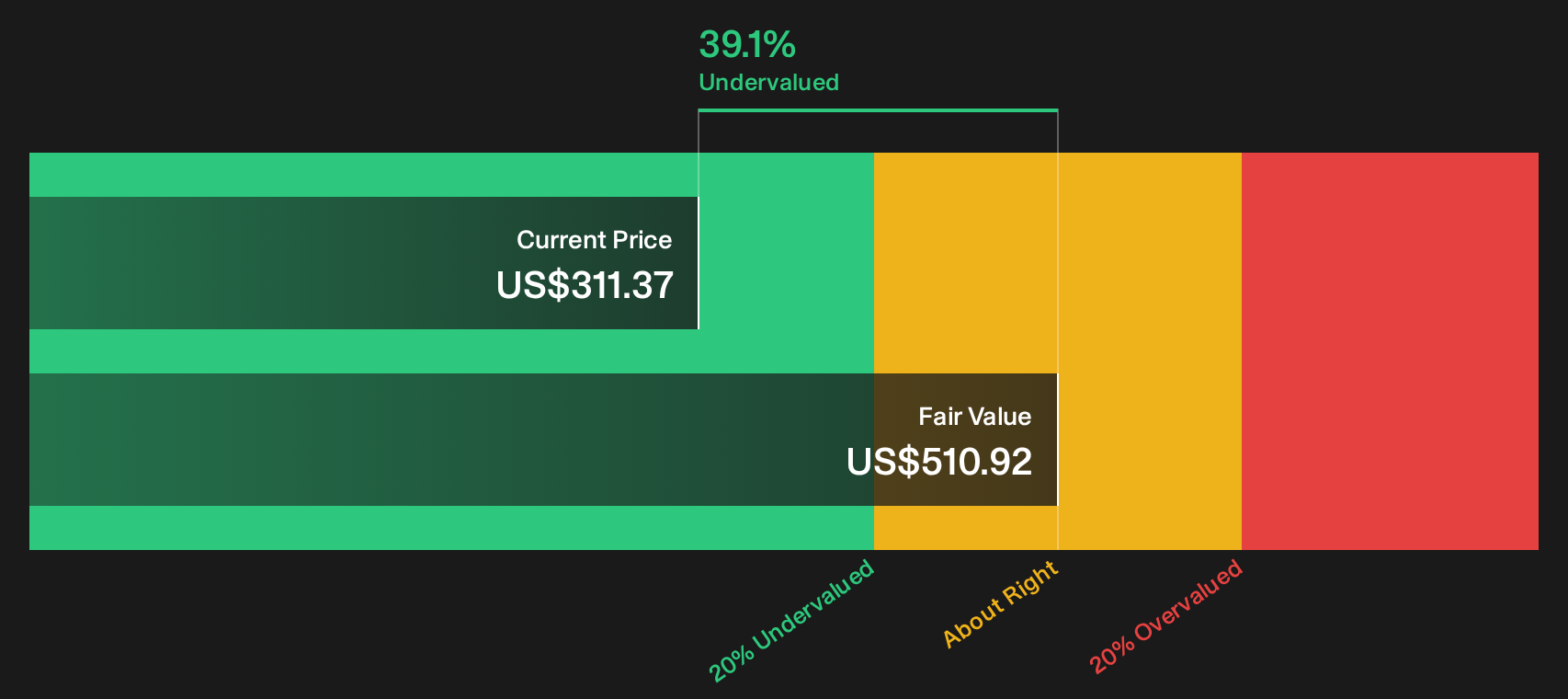
On those assumptions, the DCF points to an estimated intrinsic value of about $511 per share. That compares to a current market price that implies roughly a 40.8% discount to the cash flow based estimate. The result is a gap that depends less on valuation multiple changes and more on how confident investors are that Jabil can protect its margins and contract pipeline.
On this cash flow model, the stock currently screens as undervalued relative to its estimated intrinsic worth.
Our Discounted Cash Flow (DCF) analysis suggests Jabil is undervalued by 40.8%. Track this in your watchlist or portfolio, or discover 33 more high quality undervalued stocks.
Is Jabil Fairly Priced on Earnings?
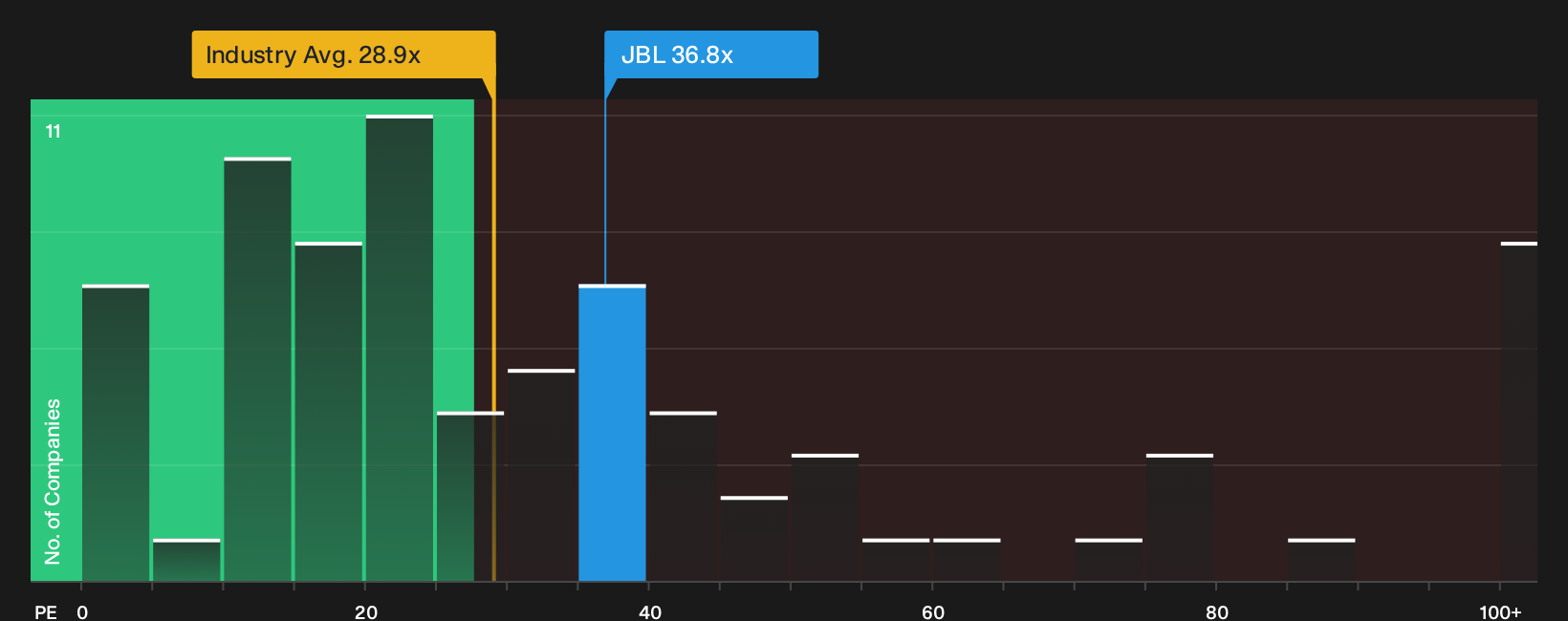
P/E works well for Jabil because earnings are a core driver for how investors tend to price established manufacturers and service providers. On this yardstick, the stock trades on about 36.8x earnings. That is slightly above the wider Electronic industry average of roughly 28.9x, and close to the peer group average of about 36.4x.
The Fair Ratio model, which tries to account for Jabil’s specific mix of growth prospects, profitability profile, size and risk, points to a P/E of about 40.1x. The current multiple sits a little below that, and the gap is not big enough to imply a clear discount or a clear premium.
On the P/E measure, Jabil shares look priced roughly in line with what the Fair Ratio model suggests is reasonable.
See what the numbers say about this price — find out in our valuation breakdown.
The Jabil Narrative: What Would Justify Today's Price?
Jabil’s valuation story only really comes into focus once you spell out what future cash generation and profitability would need to look like for today’s price to be too low or too rich. Simply Wall St Narratives on the Community page take that idea further by setting out different paths for Jabil’s growth, margins and earnings, and each one lays out the assumptions behind its fair value so you can later compare those expectations with the actual results Jabil delivers.
One of the top community narratives on Jabil: 30% undervalued
"Strong demand in AI-related markets, with expected revenue growth of 40% year-on-year, indicates significant potential to drive future revenue and improve operating margins through an expanded share of high-growth technology sectors..."
Read one of the top narratives on Jabil
Do you think there's more to the story for Jabil? Head over to our Community to see what others are saying!
The Bottom Line
Jabil screens as undervalued on a Discounted Cash Flow (DCF) view, with the intrinsic value estimate sitting well above the current share price, while the P/E work suggests the market is already pricing the stock at about the right level relative to peers. That split is shaped by different lenses, since the intrinsic model leans heavily on the timing and durability of free cash generation, while the multiple view reflects how investors currently rate growth potential and risk versus comparable companies. After a sharp move in the share price, the key question from here is whether Jabil can keep margins and contract volumes resilient enough to turn that DCF discount into realised value rather than a value trap.
This article by Simply Wall St is general in nature. We provide commentary based on historical data and analyst forecasts only using an unbiased methodology and our articles are not intended to be financial advice. It does not constitute a recommendation to buy or sell any stock, and does not take account of your objectives, or your financial situation. We aim to bring you long-term focused analysis driven by fundamental data. Note that our analysis may not factor in the latest price-sensitive company announcements or qualitative material. Simply Wall St has no position in any stocks mentioned.
Have feedback on this article? Concerned about the content? Get in touch with us directly. Alternatively, email editorial-team@simplywallst.com