
Oracle (ORCL.US) AI Gambling Reward! Q1 performance exceeded expectations, cloud infrastructure business revenue soared 121%, and RPO surged to US$664 billion
The Zhitong Finance App learned that cloud computing giant Oracle (ORCL.US) announced better-than-expected results for the first quarter of fiscal year 2027. The much-publicized growth rate of the cloud business exceeded analysts' expectations, and raised some performance guidelines, indicating that the company's bets on large-scale artificial intelligence (AI) data center projects are paying off. As of press release, Oracle's US stocks rose nearly 4% after the market on Thursday.
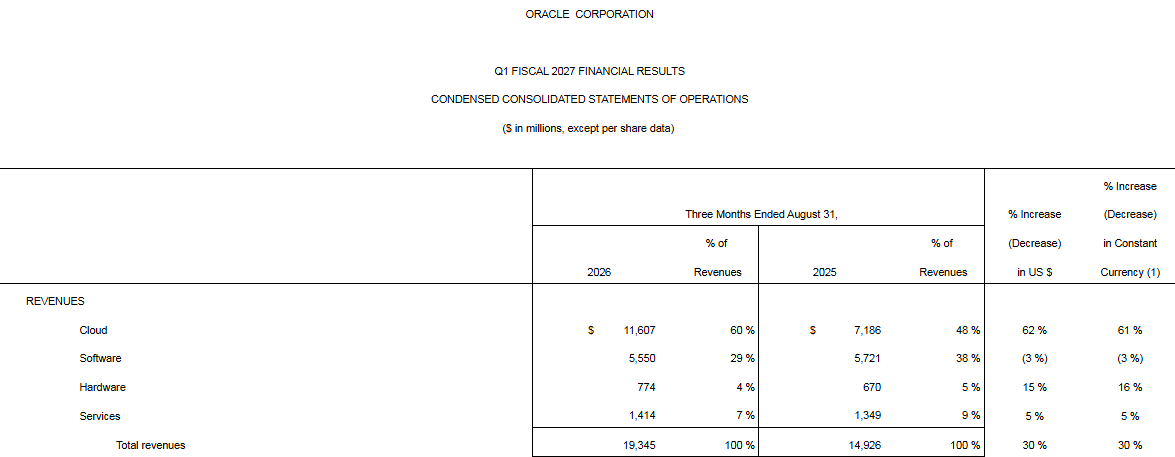
According to financial reports, Oracle's revenue for the first quarter increased 30% year over year to US$19.35 billion, better than analysts' average expectations of US$19.13 billion. The company attributed revenue growth to trends such as strong cloud infrastructure business performance and increased data center capacity. Operating profit was $6.73 billion, up 57% year over year; net profit attributable to common shareholders was $4.68 billion, up 60% year over year; adjusted earnings per share was $1.92, better than analysts' average forecast of $1.75.
By business segment, cloud business revenue increased 62% year over year to US$11.61 billion, a record high, better than analysts' average forecast of US$11.52 billion. Among them, cloud infrastructure business revenue increased 121% year over year to 7.4 billion US dollars, better than analysts' average forecast of 7.19 billion US dollars; cloud application revenue increased 10% year over year to 4.2 billion US dollars. Some analysts previously predicted that as the market demand for AI computing power continues to rise, the increasingly competitive pricing environment will benefit the Oracle Cloud business.
At the same time, software business revenue fell 3% year over year to US$5.55 billion, falling short of analysts' average expectations of US$5.67 billion; hardware business revenue increased 15% year over year to US$770 million, better than analysts' average expectations of US$670 million; service business revenue increased 5% year over year to US$1.41 billion, better than analysts' average expectations of US$1.38 billion. Regarding the decline in software business revenue, Oracle said that this reflects the continuous migration of customers from locally deployed products to cloud products.
Oracle has long been famous for database software, and now it has repositioned itself as a computing power provider for AI computing services, and is building large-scale data centers for OpenAI and other customers. Wall Street is watching the scale of capital expenditure for these ambitious projects and how quickly Oracle can complete them. The company said it added 850 megawatts of data center capacity this quarter.
Customer demand for AI cloud training and inference services continues to grow, outpacing supply. Oracle added more than $30 billion in AI cloud contracts in the first quarter, increasing its remaining performance obligations (RPO) by 4% month-on-month to $664 billion, higher than analysts' average expectations of $618 billion. Based on the structure of these new contracts, the company confirmed that there would be no additional impact on its financing plans. Since the end of the fourth quarter of fiscal year 2026, the company has also delivered more than 300,000 GPUs to its AI cloud customers, almost three times the delivery capacity of the fourth quarter of fiscal year 2026.
“We are delivering data center and GPU capacity at a speed that seemed impossible just a year ago,” said Clay Magouyrk, co-CEO of Oracle during a conference call with analysts after the announcement of the earnings report.
Another co-CEO, Mike Sicilia, spoke highly of the company's AI progress. He said, “By combining applied AI with complex business rules, regulatory compliance systems, security models, data models, and customer configurations accumulated over decades, we can enable our customers to continuously realize the value of AI.”
Operating cash flow for the first quarter reached US$23.1 billion, up 184% year over year; free cash flow for the first quarter was negative US$5.4 billion. The company has yet to give a specific timeline for restoring positive free cash flow. However, Oracle Chief Financial Officer Hilary Maxson said, “What I want to say is that every project we are advancing is, by its very nature, a project that can generate strong free cash flow.” Following this logic, Hilary Maxson anticipates that Oracle's current ongoing projects will generate positive free cash flow “soon” after it starts scaling up.
Oracle said that capital expenditure for the three months ending August 31 was US$28.5 billion, most of which was for data center equipment. This figure is far higher than analysts' estimate of $19.23 billion. Hilary Maxson confirmed that the company expects capital expenditure for the fiscal year ending May 2027 to reach $70 billion. Additionally, since some parts require advance payments, an additional $20 billion to $25 billion will also be spent.
As Oracle leverages debt to help finance the expansion of the AI business, capital expenditure has always been one of the top concerns of Oracle investors. Clay Magouyrk said during the company's earnings call that in addition to using its own capital, the company is constantly looking for “interesting ways to fund the business.”
He said, “We have established numerous partnerships with different suppliers and vendors, and created new business models including 'bring-your-own-hardware' (bring-your-own-hardware), all of which can share this capital expenditure in different ways.” He was referring to a model where Oracle allows customers to place their own hardware devices within an Oracle data center. He added that not all of the capital needs to be provided by Oracle, and this is not “a factor limiting our business growth.”
Barclays analyst Raimo Lenschow wrote in a report that although capital expenditure was higher than expected, the company's control of other expenses was good, and the negative level of free cash flow was not as serious as the market feared.
Looking ahead, for the second quarter, Oracle expects revenue to increase 30% to 34% year over year, slightly better than analysts' average forecast of 31.9%; the company also expects adjusted earnings per share of $1.85 to $1.93, which is in line with analysts' average forecast of $1.89. For fiscal year 2027, Oracle expects revenue to “reach at least $90 billion,” up from $90 billion; the company raised its adjusted earnings per share forecast to $8.10 billion from $8.05 previously.