
St. Joe (JOE) Stock May Be Overvalued On Its 54% Five Year Run
St. Joe has delivered a solid 54.5% return over the past five years, yet the broader valuation checks currently lean toward the stock being on the expensive side rather than an obvious bargain.
- A 54.5% gain over five years points to meaningful long term value creation for shareholders, even if shorter term moves have been choppy.
- Future cash generation from St. Joe's real estate projects can support the current share price. However, any slowdown in property demand or weaker pricing may weigh on how much investors are willing to pay for that pipeline.
- The broader indicators give St. Joe a low value score, which signals the stock leans expensive and is not a clear discount to its peers on key valuation checks.
The issue now is whether that track record of returns still justifies paying up for St. Joe at today's valuation.
Scan beyond St. Joe and compare its rich-looking valuation with other real estate and quality-focused businesses using the hand-picked 32 high quality undervalued stocks.
Does St. Joe Look Pricey on Earnings?
The P/E ratio is often a useful way to judge what you are paying for each dollar of St. Joe earnings, especially for a real estate group that is already generating profits.
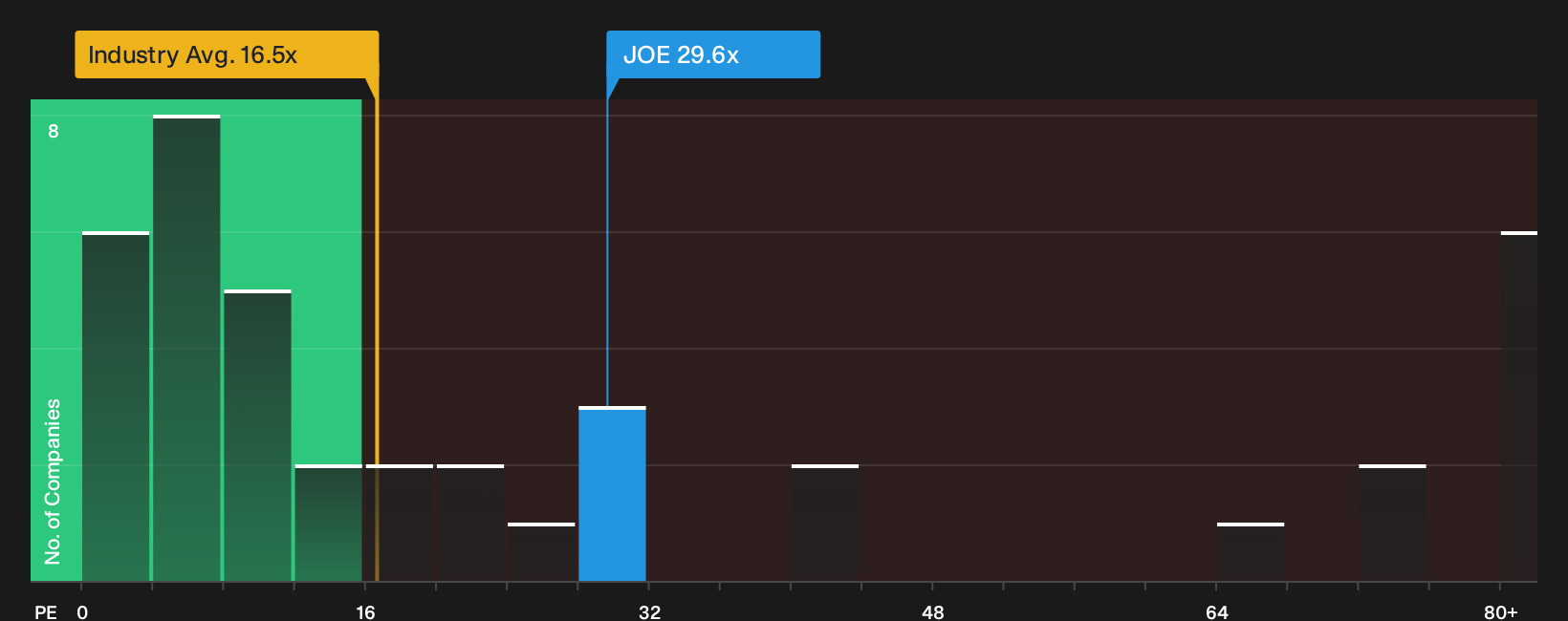
St. Joe trades on a P/E of about 29.6x, which is higher than the wider Real Estate sector average of roughly 16.5x. That gap means you are paying a much richer price for each unit of earnings than the typical listed property company. Against a peer set that averages about 26.1x, the stock still comes out at a premium, so this is not just an industry mix effect.
Such a mark up can reflect confidence in St. Joe and its project pipeline. However, on this simple earnings yardstick, the market is already attaching a full price to that story.
On the P/E multiple alone, St. Joe stock appears expensive compared with both sector and peer benchmarks.
See what the numbers say about this price — find out in our valuation breakdown.
The St. Joe Narrative: What Would Justify Today's Price?
Simply Wall St Narratives pick up where the P/E puzzle leaves off for St. Joe by detailing which paths for future growth, profitability and earnings would need to occur for the shares to be worth materially more or less than they trade for today on the market. Each narrative links a fair value estimate to a clear storyline about St. Joe's potential catalysts and key risks, so you can track over time which version of events appears to be unfolding in practice on the Community page.
Share a narrative on St. Joe and lay out a data-driven case on where its growth, margins and execution go from here.
By spelling out your thesis now, you can be one of the early voices in the Simply Wall St community, tracking how that view holds up as new data lands.
Do you think there's more to the story for St. Joe? Head over to our Community to see what others are saying!
The Bottom Line
St. Joe now looks overvalued on simple earnings multiples, which means investors are paying a premium valuation for its current profit profile. That kind of pricing only makes sense if the property pipeline continues to translate into resilient demand and solid project economics. The real fork in the road is whether that rich P/E holds up or slips back toward sector norms. Your own view on future real estate appetite and pricing power is what ultimately determines whether this premium feels justified or stretched.
This article by Simply Wall St is general in nature. We provide commentary based on historical data and analyst forecasts only using an unbiased methodology and our articles are not intended to be financial advice. It does not constitute a recommendation to buy or sell any stock, and does not take account of your objectives, or your financial situation. We aim to bring you long-term focused analysis driven by fundamental data. Note that our analysis may not factor in the latest price-sensitive company announcements or qualitative material. Simply Wall St has no position in any stocks mentioned.
Have feedback on this article? Concerned about the content? Get in touch with us directly. Alternatively, email editorial-team@simplywallst.com