
Enphase Energy (ENPH) Stock Looks Fairly Valued Despite New Product Hopes
Enphase Energy stock has had a rough five year stretch, yet the current valuation picture is more nuanced. A Discounted Cash Flow (DCF) estimate suggests the shares are roughly in line with intrinsic value, while market multiples flag the stock as expensive.
- The share price has fallen 76.4% over the past five years, which leaves long term holders facing heavy losses and raises the question of what the current price really reflects.
- New products such as IQ Solid-State Transformer modules for AI data centers and the IQ EV Charger 2 in Europe can support expectations for future cash flows, while execution risk on these rollouts and adoption timing may weigh on how much investors are willing to pay today.
- The broader checks give a mixed read on Enphase Energy, with a value score of 3 that points to neither a clear bargain nor an obviously stretched valuation overall.
The issue now is whether Enphase Energy's current share price already reflects the intrinsic value suggested by the DCF estimate or still embeds a premium implied by the market multiples.
Scan beyond Enphase Energy and size up other potential AI power and grid infrastructure beneficiaries with the hand picked 39 power grid technology and infrastructure stocks in one quick pass.
Does Enphase Energy Look Fairly Valued on Cash Flow?
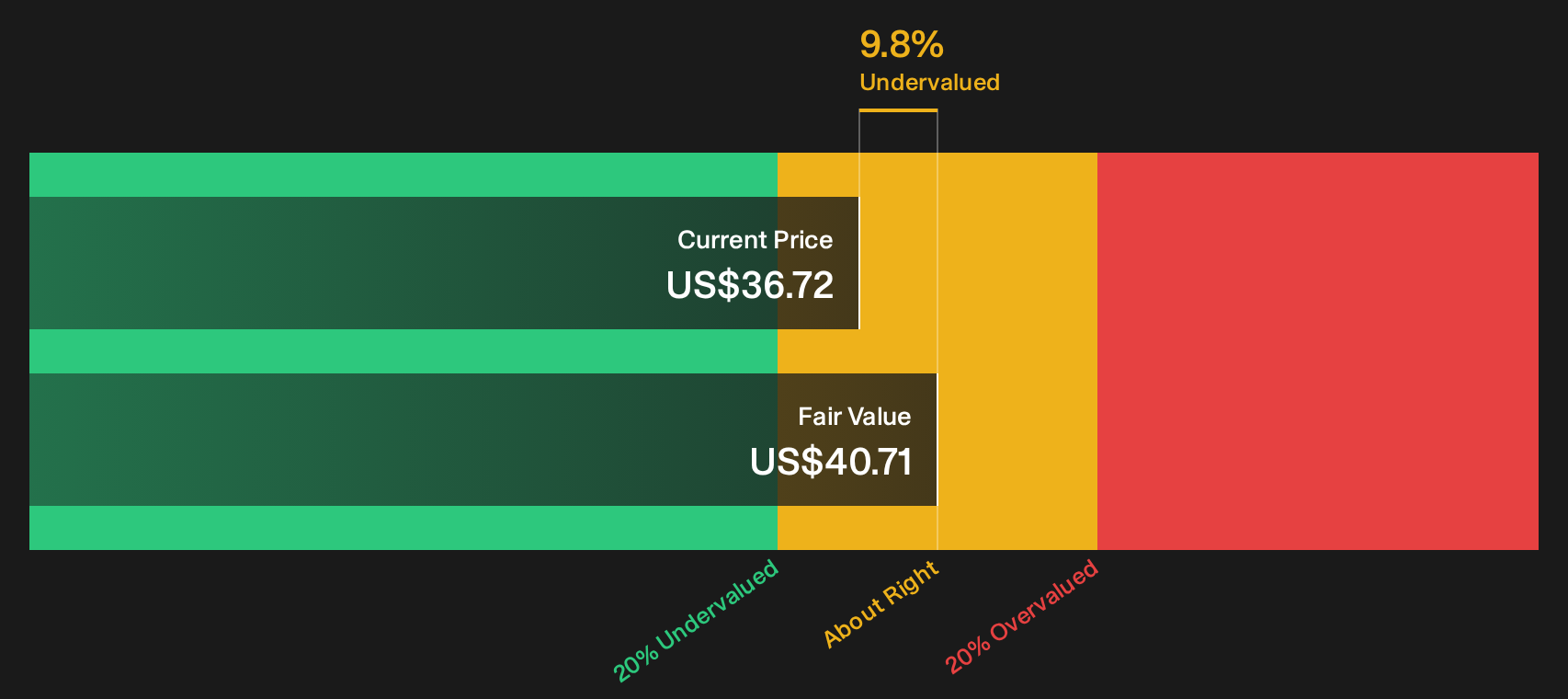
The Discounted Cash Flow (DCF) model used here projects what Enphase Energy might generate in future free cash and then works back to a value per share today. On the latest twelve month numbers, the business produced free cash flow of about $156.8 million, with the model assuming that cash generation grows over time rather than shrinking. Those projections translate into an estimated intrinsic value of about $40.71 per share.
Set against the current share price, that DCF outcome points to the stock trading roughly 9.8% below the modelled value, so Enphase Energy screens as slightly undervalued on this method. The recent push into IQ Solid-State Transformer modules for AI data centers helps explain why analysts are comfortable using a growing cash flow path, even though the commercial roll out extends into 2026 and 2027.
On this cash flow view, Enphase Energy appears to be around fairly valued with only a modest tilt toward undervalued territory.
Enphase Energy is fairly valued according to our Discounted Cash Flow (DCF), but this can change at a moment's notice. Track the value in your watchlist or portfolio and be alerted on when to act.
Is Enphase Energy Getting Expensive on Earnings?
P/E fits Enphase Energy well because earnings are already positive and provide a clean anchor for what investors are paying for each dollar of profit.
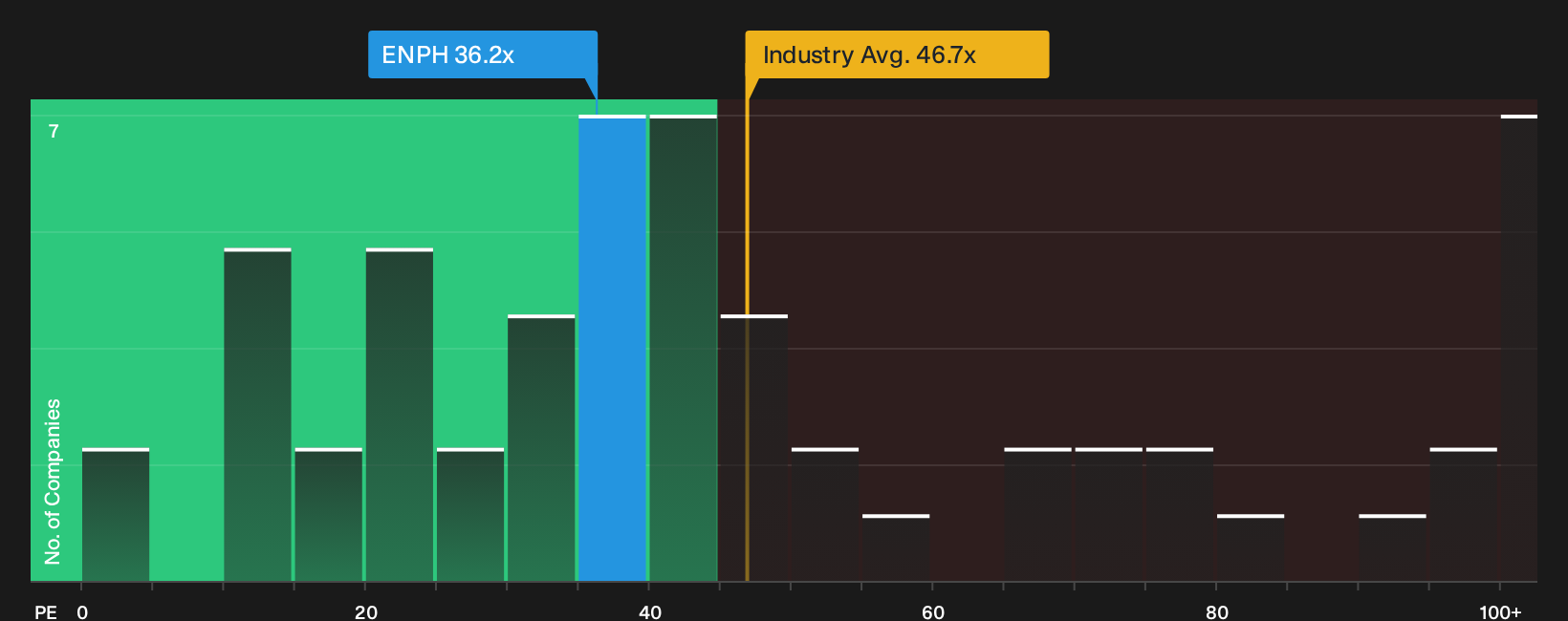
The stock trades on about 36.2x earnings, which is below the semiconductor industry average of roughly 46.7x and also under the peer group at about 57.1x. On raw comparison, that might look like a discount. The fair P/E that factors in Enphase Energy's profile comes in lower though, at about 31.9x. This means the current valuation still sits meaningfully above what this framework suggests as a balanced level.
This gap implies investors are paying a premium multiple for Enphase Energy despite the more measured fair ratio signal and the mixed read from other checks.
On the P/E yardstick, Enphase Energy appears overvalued relative to what its fair multiple implies.
See what the numbers say about this price — find out in our valuation breakdown.
The Enphase Energy Narrative: What Would Justify Today's Price?
Simply Wall St Narratives pick up where the Enphase Energy valuation puzzle leaves off and spell out which paths for growth, margins and earnings would need to play out for the stock to be worth meaningfully more or meaningfully less than today’s price on the Community page. Rather than relying on a single multiple or model, each narrative lays out the assumptions behind its view of fair value so you can compare those expectations with actual results as they are reported.
Community views on Enphase Energy sit far apart, with one camp focused on upside from new energy infrastructure and another fixated on residential solar strain.
Bull case: 22% undervalued
"Upcoming launches of next-generation products including the IQ9 microinverter with gallium nitride technology, the fifth-generation high-density battery, and bidirectional EV chargers position Enphase to capture new commercial, multi-phase, and EV oriented market segments…"
Read the full Bull Case to see why Enphase Energy could be undervalued
Bear case: 36% overvalued
"The expected expiration of the 25D homeowner tax credit and an ensuing 20% reduction in the U.S. total addressable market for residential solar in 2026 signal declining installation volumes, disproportionately hurting Enphase's core revenue base…"
Read the full Bear Case to see why Enphase Energy could be overvalued
Do you think there's more to the story for Enphase Energy? Head over to our Community to see what others are saying!
The Bottom Line
Enphase Energy appears roughly fairly valued on a Discounted Cash Flow (DCF) basis, with only a modest discount to the intrinsic value estimate, while the earnings multiple still looks elevated relative to its own fair P/E. That split comes down to timing and confidence. Cash flow modelling relies on long term projects and capital expenditure, whereas the market multiple is tied to how much growth and margin expansion investors are willing to pay for today. The key question from here is whether Enphase Energy can translate its product pipeline into more dependable earnings without the market having to assign an even higher P/E to maintain its current stance.
This article by Simply Wall St is general in nature. We provide commentary based on historical data and analyst forecasts only using an unbiased methodology and our articles are not intended to be financial advice. It does not constitute a recommendation to buy or sell any stock, and does not take account of your objectives, or your financial situation. We aim to bring you long-term focused analysis driven by fundamental data. Note that our analysis may not factor in the latest price-sensitive company announcements or qualitative material. Simply Wall St has no position in any stocks mentioned.
Have feedback on this article? Concerned about the content? Get in touch with us directly. Alternatively, email editorial-team@simplywallst.com