
3 Gulf Stocks Tied To Rising Strait Of Hormuz Shipping Costs
Shipping routes through the Strait of Hormuz now carry far higher war‑risk insurance, and that extra cost ripples into food, medicine and construction prices across the Gulf. That kind of squeeze can pressure some stocks while opening room for others tied to food security and supply chains. This article walks through three stocks exposed to these disruptions, explaining how the same shock could either support or strain each investment case.
The stocks covered below are only a starting sample. The full screen surfaced 14 more Gulf food, port and logistics companies with equally compelling resilience stories that are not included in this article. If you want to identify and analyze those extra candidates in detail, head straight into the Gulf Food & Supply Chain Resilience Plays screener.
Saudi Basic Industries (SASE:2010)
Overview: Saudi Basic Industries is a Riyadh based chemicals giant that also supplies fertilizers, making it central to Gulf food security.
Operations: The business generates about SAR 96.2b from petrochemicals and SAR 11.5b from agri-nutrients, selling across KSA, wider Asia, China, Europe, the Americas, Africa and other markets.
Market Cap: SAR 149.2b
Saudi Basic Industries sits at the intersection of Gulf food security and trade disruption, because its fertilizers are produced inside the region rather than imported through riskier shipping lanes.
"Intensifying global efforts to impose strict environmental regulations and accelerate decarbonization policies are expected to raise compliance costs and restrict market access for traditional petrochemical products, which may erode revenue and compress net margins over the long term."
What matters for Saudi Basic Industries now is how one quiet shift in its fertilizer and chemicals mix ultimately affects margins.
That quiet shift starts with understanding how Saudi Basic Industries balances petrochemicals against agri nutrients. Read the full narrative for Saudi Basic Industries to see how regulators and supply chains could reshape the story.

Sustained Infrastructure Holding (SASE:2190)
Overview: Sustained Infrastructure Holding is a Jeddah based investment group that owns and operates port terminals, logistics parks, warehouses and water solutions assets across Saudi Arabia and overseas.
Operations: The group generates about SAR 1.86b from port development and operations, SAR 161.9m from logistic parks and support services, and SAR 101.4m from water desalination and distribution, with revenue primarily from Saudi Arabia and Bangladesh.
Market Cap: SAR 3.1b
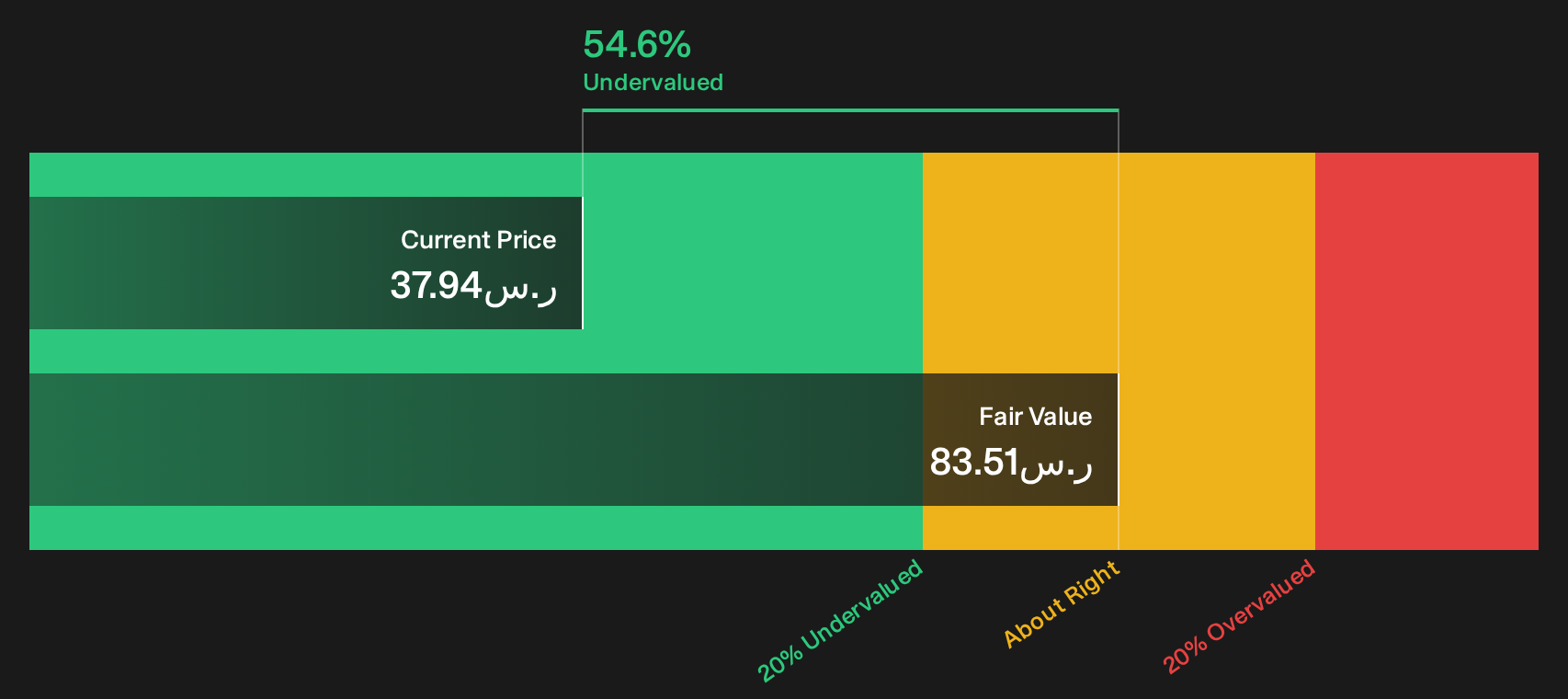
Sustained Infrastructure Holding ties neatly into the Gulf Food & Supply Chain Resilience theme because its ports, logistics parks and warehouses sit directly on the trade routes that bring food and essential goods into the region. Recent earnings strength and a valuation gap give investors a way to back that import infrastructure, depending on how one unseen pressure plays out.
That valuation gap is the real hinge, so check the DCF valuation analysis for Sustained Infrastructure Holding to see whether current pricing underrates Sustained Infrastructure Holding’s import backbone story.
APM Terminals Bahrain B.S.C (BAX:APMTB)
Overview: APM Terminals Bahrain B.S.C operates Khalifa Bin Salman Port, handling container, general cargo, RoRo and marine services for Bahrain’s trade.
Operations: The business generates about BHD 35 million from port services, with all reported revenue sourced from Bahrain based activity.
Market Cap: BHD 76.5 million
APM Terminals Bahrain B.S.C runs Bahrain’s main container gateway. It plugs directly into Gulf efforts to keep food and essential imports flowing even as shipping through the Strait of Hormuz becomes more expensive and uncertain. Investors get exposure to a key logistics hub and the real swing factor is what happens if a single key assumption about future throughput and pricing shifts.
If that throughput assumption is the real swing factor, start with the analysis report for APM Terminals Bahrain B.S.C to see how APM Terminals Bahrain B.S.C could respond if volumes decouple from pricing.

Seeking Alternatives Beyond Gulf Supply Chains
Fresh ideas move first. By the time momentum headlines hit, early entries are already flying. Scan under the radar for now, before the crowd catches up, and consider acting before conditions change.
- Look for potential turnaround stories with strong cash buffers by scanning the list of solid balance sheet and fundamentals (194 results), which focuses on resilience while many investors may still overlook it.
- Explore structural shifts toward automation by reviewing the curated 37 robotics and automation stocks, which includes companies building the hardware and software used across factory and warehouse floors.
- Monitor capital flowing into metals used in electrification by checking the hand picked 29 top copper producer stocks, which highlights producers with meaningful exposure to this key resource.
This article by Simply Wall St is general in nature. We provide commentary based on historical data and analyst forecasts only using an unbiased methodology and our articles are not intended to be financial advice. It does not constitute a recommendation to buy or sell any stock, and does not take account of your objectives, or your financial situation. We aim to bring you long-term focused analysis driven by fundamental data. Note that our analysis may not factor in the latest price-sensitive company announcements or qualitative material. Simply Wall St has no position in any stocks mentioned.
Have feedback on this article? Concerned about the content? Get in touch with us directly. Alternatively, email editorial-team@simplywallst.com