
Tapestry (TPR) Stock Stays Cheap After Its 297% Three Year Run
Tapestry stock has delivered a very strong 3 year share price gain, yet current valuation checks still suggest the market price may sit well below an intrinsic value estimate built from future cash flows. With both a Discounted Cash Flow (DCF) view and earnings multiples pointing to an undervalued profile, the key issue is how much of that gap truly reflects business risk rather than opportunity.
- Over the past 3 years, Tapestry has returned about 297.5%, which puts recent share weakness in the context of a very strong longer term run.
- The investment case can benefit if the group continues to turn brand strength into consistent cash generation, while any hit to discretionary luxury spending or brand relevance remains a clear drag on what investors are willing to pay.
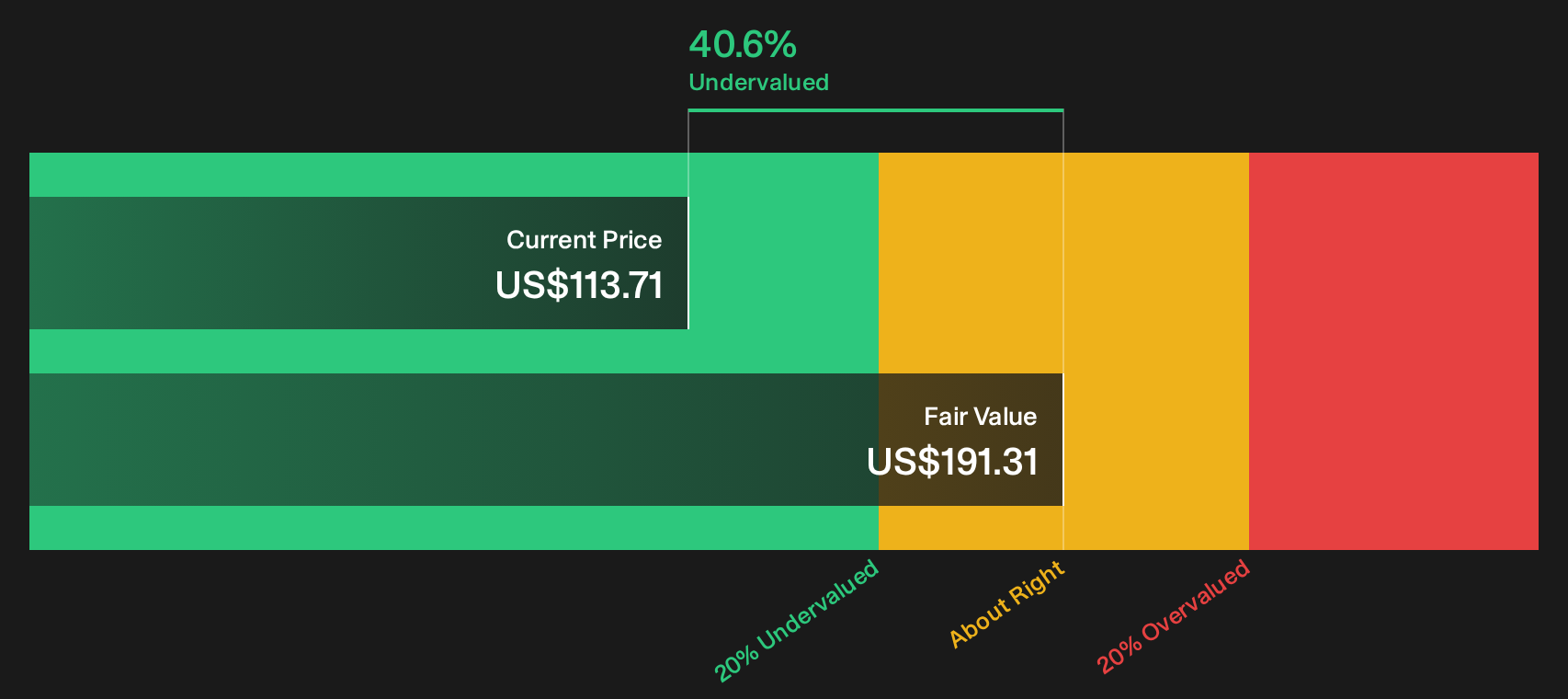
- The broader checks lean cheap, with a high value score of 5 out of 6 and a Discounted Cash Flow (DCF) intrinsic value estimate that sits about 40.6% above the recent share price.
The issue now is whether Tapestry's current share price already reflects the main business risks or if the discount to intrinsic value will appeal to patient investors over the next few years.
Scan beyond Tapestry to see how other potentially underpriced companies compare with its valuation gap by reviewing 31 high quality undervalued stocks in one place.
Does Tapestry Look Undervalued on Cash Flow?
The Discounted Cash Flow (DCF) approach values Tapestry by projecting the cash it can return to shareholders and then discounting that stream back to today. In this model, the group is treated as a business with positive, growing free cash flow rather than a turnaround story built on heavy future improvement.
Tapestry generated about $1.83b of free cash flow over the last twelve months, and the DCF model assumes that this pool of cash continues to grow from here rather than contract. On those inputs, the 2 Stage Free Cash Flow to Equity framework points to an estimated intrinsic value of about $191 per share. Compared with the current share price used in the model, that implies the stock screens around 40.6% undervalued on a pure cash flow basis.
On this DCF view, Tapestry stock appears undervalued relative to the cash the business is projected to produce.
Our Discounted Cash Flow (DCF) analysis suggests Tapestry is undervalued by 40.6%. Track this in your watchlist or portfolio, or discover 31 more high quality undervalued stocks.
Is Tapestry a Bargain on Earnings?
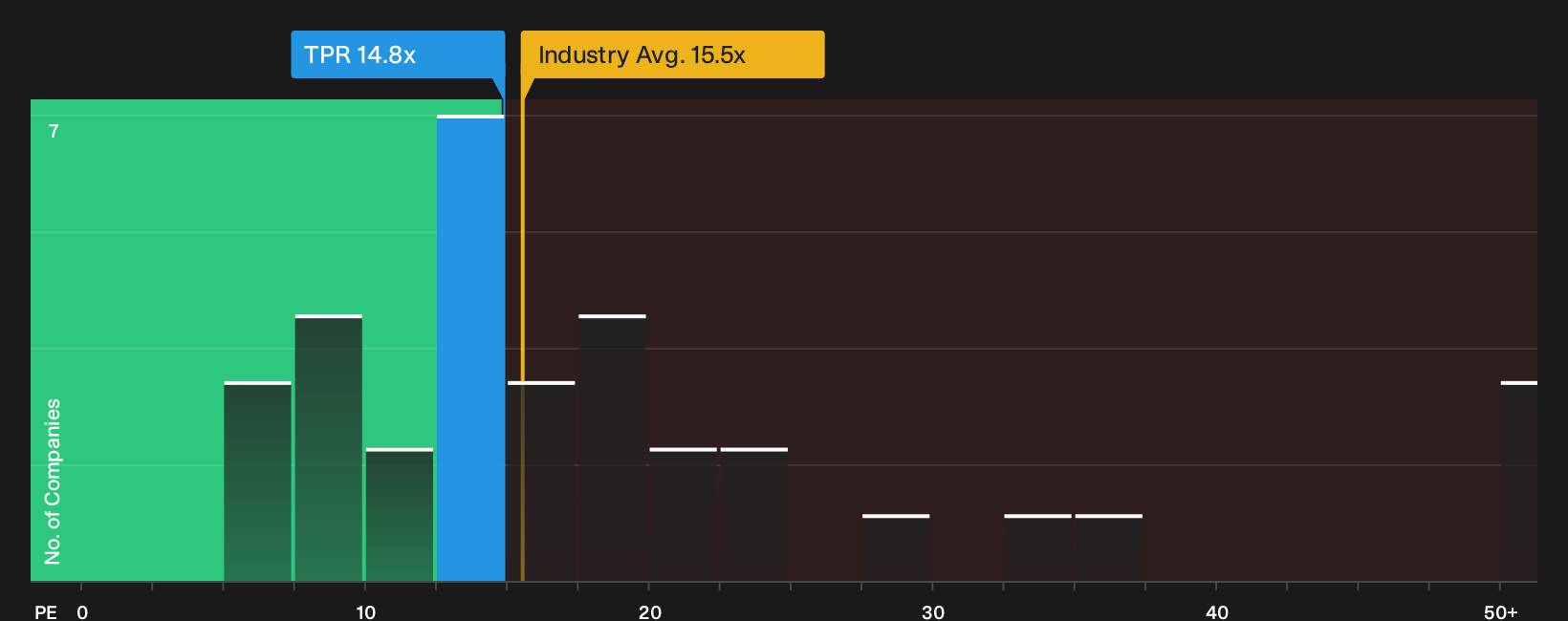
The P/E ratio suits Tapestry because earnings are a central focus for investors in a mature branded consumer business. On this measure, Tapestry trades on about 14.8x earnings, which is slightly below the wider luxury sector at roughly 15.5x. Compared with a peer group that clusters closer to 18.0x, the stock changes hands at a clear discount.
A more tailored lens is the implied fair P/E of around 19.0x, which reflects what investors might typically pay for a company with Tapestry's mix of margins, scale and risk. Against that benchmark, the current multiple suggests a sizeable valuation gap that indicates the market is pricing the shares cautiously compared with both industry norms and those modelled fundamentals.
On the P/E yardstick, Tapestry shares appear undervalued relative to both peers and the fair multiple implied by the business profile.
See what the numbers say about this price — find out in our valuation breakdown.
The Tapestry Narrative: What Would Justify Today's Price?
Narratives on Tapestry pick up where the valuation gap leaves off by spelling out which paths for growth, profitability and earnings would need to unfold for the shares to be worth materially more or less than today’s price, all housed on Simply Wall St’s Community page. Each scenario links a fair value estimate to a specific mix of potential catalysts and threats so you can track over time which version of Tapestry's story appears to be taking shape.
Community views on Tapestry could hardly be further apart, with one camp leaning into the growth story and the other fixated on execution risk.
Bull case: 32% undervalued
"Ongoing investments in digital infrastructure, omnichannel capabilities, and data-driven customer engagement are expected to enable margin expansion and direct-to-consumer growth..."
Read the full Bull Case to see why Tapestry could be undervalued
Bear case: roughly fairly valued
"Digital disruption is intensifying, with agile direct-to-consumer and social media-native competitors rapidly gaining market share, which could increasingly marginalize established brands like Coach and Kate Spade..."
Read the full Bear Case to see why Tapestry could be overvalued
Do you think there's more to the story for Tapestry? Head over to our Community to see what others are saying!
The Bottom Line
Tapestry looks undervalued on both the Discounted Cash Flow (DCF) intrinsic value estimate and its P/E comparison, which is a rare alignment for any stock. The gap only closes if the business keeps turning its brands into steady free cash flow and the market grows more comfortable paying closer to the implied fair multiple. Everything hinges on that question: Is the current discount compensation for real execution and demand risk, or is it an opening for investors who believe Tapestry can sustain its cash generation story?
This article by Simply Wall St is general in nature. We provide commentary based on historical data and analyst forecasts only using an unbiased methodology and our articles are not intended to be financial advice. It does not constitute a recommendation to buy or sell any stock, and does not take account of your objectives, or your financial situation. We aim to bring you long-term focused analysis driven by fundamental data. Note that our analysis may not factor in the latest price-sensitive company announcements or qualitative material. Simply Wall St has no position in any stocks mentioned.
Have feedback on this article? Concerned about the content? Get in touch with us directly. Alternatively, email editorial-team@simplywallst.com