
Will AI Customer Tools Change Twilio (TWLO) Narrative
- Twilio recently announced new AI-powered customer engagement tools, including Conversation Memory, Conversation Orchestrator and Conversation Intelligence, designed to coordinate AI agents, human agents and multichannel interactions.
- The decision to keep Twilio's platform model neutral, allowing businesses to plug in multiple AI and speech providers, directly targets adoption barriers in voice AI such as latency, accuracy and regulatory complexity.
- Next, the focus shifts to how Twilio's model neutral Conversation Orchestrator approach might influence its broader investment narrative and risk profile.
Scan beyond Twilio and see how other AI builders are wiring customer engagement by comparing it to a curated group of 89 AI infrastructure stocks.
Twilio Investment Narrative Recap
To own Twilio, you need to be comfortable with a communications platform that is still reshaping its mix between usage based connectivity and higher value software. The near term story revolves around whether tools like Conversation Orchestrator can deepen customer engagement enough to support revenue that recently sat at US$5.6b and net income of US$1.1b, while protecting margins from carrier fees and regulatory costs. The biggest swing factor remains execution on richer products versus low margin messaging, and the news on AI orchestration is directionally aligned but not yet a clear catalyst breaker.
Conversation Orchestrator is the announcement that matters most here. It ties directly into Twilio's attempt to keep enterprises on its platform as AI heavy customer contact models mature. By staying model neutral and letting clients plug in different AI and speech providers, the company leans into flexibility rather than locking users into a single stack. That could support monetisation of omnichannel usage, but it does not remove the risk that some large customers still choose tightly integrated cloud suites or in house builds if Twilio cannot keep software adoption moving.
Even so, there is a specific pressure point in Twilio's story that deserves a closer look before getting too comfortable with the AI pitch...
Read the full Twilio narrative to see the case behind these numbers.
Twilio AI Orchestration Meets Analyst Expectations
Twilio's AI orchestration pitch sits on top of a consensus forecast that already bakes in a meaningful reset in how the business earns money, not just how it routes calls and messages. Analysts are underwriting a shift from low margin traffic handling toward richer software style economics, and the numbers they publish give a sense of how much improvement is already assumed before any potential contribution from tools like Conversation Orchestrator is reflected.
Twilio's narrative cites analyst projections of US$7.2b revenue and US$686.9m earnings by 2029. These figures are based on assumptions of 10.8% yearly revenue growth and an earnings increase of about US$582.9m from US$104.0m today.
Twilio's forecasts mark fair value at $200.92 against the $227.19 share price, a 12% downside to its current price that leaves little room for error.
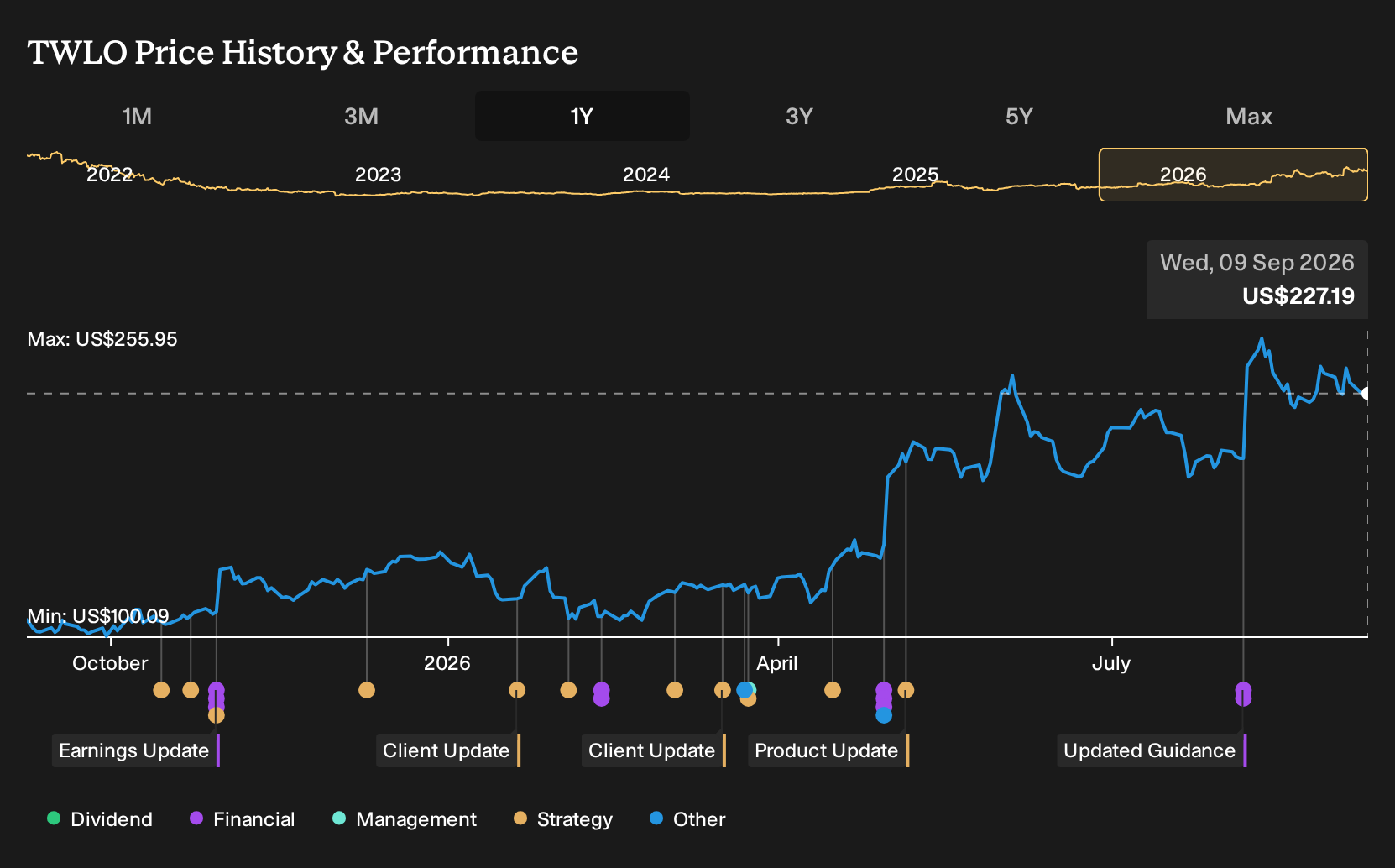
Exploring Other Perspectives
One bullish twist on Twilio focuses on AI orchestration as a potential revenue accelerator. The most optimistic analysts were already pencilling in US$8.3b revenue and US$900.8m earnings by 2029 before this news, far above consensus. That gap shows how widely views can differ, so consider multiple scenarios before evaluating what this announcement might change.
If you want a quick way to cross-check where Twilio might be mispriced, compare today's market tag with 3 other fair value estimates for Twilio.
The Verdict Is Yours
Don't just follow the ticker. Dig into the data and build a conviction that's truly your own.
- A great starting point for your Twilio research is our analysis highlighting 1 key reward and 3 important warning signs that could impact your investment decision.
- See our latest analysis for Twilio. The report includes a comprehensive fundamental analysis summarized in a single visual, the Snowflake, making it easy to evaluate Twilio's overall financial health at a glance.
Looking For More Ideas Beyond Twilio?
If Twilio has sharpened your interest in where customer engagement and AI might head next, it can help to line it up against a broader watchlist. A targeted screener lets you quickly spot other stocks that match the kind of balance sheet strength, value profile, or income focus you want to pair with a higher risk communications platform.
- For investors who care most about financial resilience, start by scanning a list of solid balance sheet and fundamentals (24 results) that can complement exposure to a communications and software story like Twilio.
- If you want potential value opportunities to compare against Twilio's current pricing, check a curated 31 high quality undervalued stocks that already meet quality and fundamentals criteria.
- For readers building a more income focused portfolio alongside growth names such as Twilio, filter for a 6 dividend fortresses that concentrate higher yields into a single shortlist.
This article by Simply Wall St is general in nature. We provide commentary based on historical data and analyst forecasts only using an unbiased methodology and our articles are not intended to be financial advice. It does not constitute a recommendation to buy or sell any stock, and does not take account of your objectives, or your financial situation. We aim to bring you long-term focused analysis driven by fundamental data. Note that our analysis may not factor in the latest price-sensitive company announcements or qualitative material. Simply Wall St has no position in any stocks mentioned.
Have feedback on this article? Concerned about the content? Get in touch with us directly. Alternatively, email editorial-team@simplywallst.com