
Is Fidelity National Information Stock Underperforming the S&P 500?
Fidelity National Information Services, Inc. (FIS) is a global financial technology company that helps financial institutions and businesses manage the complex world of money, from payments and banking to investing. Its technology supports the financial infrastructure that underpins the global economy, helping clients run, grow and protect their businesses. Headquartered in Jacksonville, Florida, FIS is a Fortune 500 company.
With its broad reach across the financial ecosystem, the company sits behind many of the everyday transactions and financial services that keep money moving around the world. With a market capitalization of roughly $19.63 billion, Fidelity National Information Services comfortably falls into the large-cap category. Companies valued at $10 billion or more are generally considered large-cap stocks, putting FIS well above that benchmark.
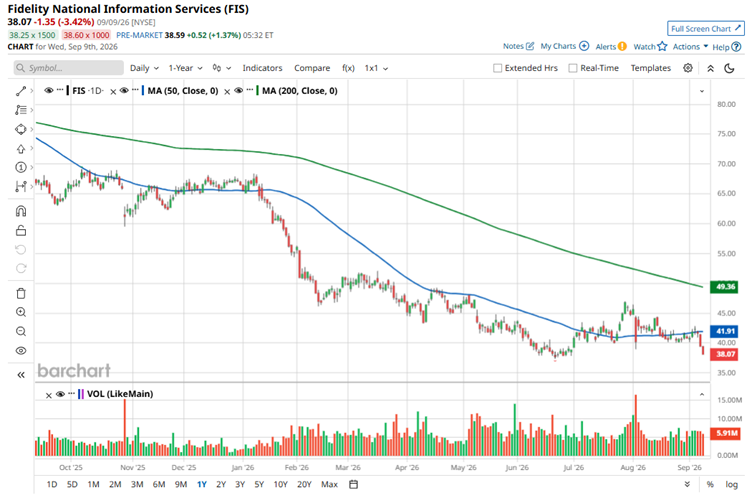
But FIS investors haven’t had much to celebrate lately. The stock has tumbled about 45% from its 52-week high of $69.14, reached in October last year, and its recent performance has remained underwhelming. Shares have slipped 4.8% over the past three months, while the broader S&P 500 Index ($SPX) has gained 3.4% over the same period.
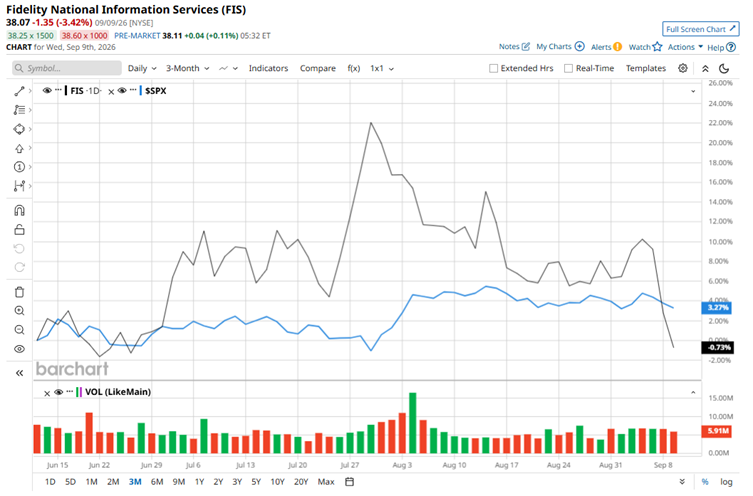
Zooming out, the picture looks even tougher. FIS has fallen 44.5% over the past year and is down 42.7% so far in 2026. The broader market, meanwhile, has moved in the opposite direction, gaining 17.3% over the past year and 11.6% in 2026. In other words, FIS hasn’t just struggled. It has significantly lagged the broader market across every period.
The bearish trend becomes even clearer on the technical front. FIS has been trading below its 200-day moving average since last year and has also remained below its 50-day moving average, despite some fluctuations along the way, underscoring that the stock has struggled to regain sustained upward momentum.
Fidelity National Information Services has been under pressure, with a mix of lowered full-year financial guidance, cautious technology spending among banks and analyst downgrades weighing on investor sentiment. The pressure intensified after the company unveiled its fiscal 2026 second-quarter results on Aug. 4, disappointing investors who had been hoping for a more reassuring update. Shares fell roughly 1.2% on the same day. The quarter itself was a mixed bag. Revenue came in at $3.4 billion, up 29% year over year, but narrowly missed consensus estimates.
Strong growth in FIS’ Banking Solutions segment and steady performance in Capital Market Solutions, supported by recurring revenue growth, margin expansion and acquisition benefits, drove the results. However, those gains were partly offset by higher cost of revenue and increased selling, general and administrative expenses. On the bottom line, FIS delivered a brighter result. Adjusted EPS climbed 8.8% year over year to $1.48, edging past Wall Street’s estimate of $1.47.
FIS isn’t the only fintech name under pressure. Peer Broadridge Financial Solutions, Inc. (BR) has also taken a hit, although its decline has been relatively less severe. BR is down roughly 33.4% over the past year and 24.7% year to date.
Wall Street analysts are moderately bullish on FIS' stock. The stock has a consensus rating of “Moderate Buy” from the 29 analysts covering it. The mean price target of $50.12 implies a 37% upside from current price levels.
On the date of publication, Anushka Mukherjee did not have (either directly or indirectly) positions in any of the securities mentioned in this article. All information and data in this article is solely for informational purposes. For more information please view the Barchart Disclosure Policy here.