
Philip Morris International (PM) Stock Could Be Cheap On Cash Flow Yet Pricey On Earnings
Philip Morris International has delivered strong shareholder gains over the past few years, yet its current share price still sits below an intrinsic value estimate from a Discounted Cash Flow (DCF) framework, while broader valuation checks lean on the expensive side rather than flagging a clear bargain.
- Over 5 years, Philip Morris International has returned 125.6%, which puts recent short term share price softness into the context of a much stronger longer run move.
- Expansion of the ZYN smoke free nicotine pouch portfolio in the U.S. can support expectations for future cash generation, but regulatory and product risk around nicotine remains a key overhang for any long term valuation.
- The broader scorecard rates Philip Morris International as undervalued in only 2 of 6 checks, which leans more toward a fully priced stock than a clear value opportunity.
The issue now is whether Philip Morris International's current price already reflects the bulk of that cash flow potential, or if the DCF style intrinsic value still points to meaningful upside from here.
Scan how Philip Morris International compares with other hand picked cash generative opportunities by reviewing 31 high quality undervalued stocks in one place.
Does Philip Morris International Look Undervalued on Cash Flow?
The Discounted Cash Flow (DCF) approach estimates what Philip Morris International might be worth based on the cash it is expected to generate for shareholders. On this model, the group is treated as a mature, cash rich business, with last twelve month free cash flow of about $12.7b and a forecast profile that assumes ongoing cash generation rather than sharp swings.
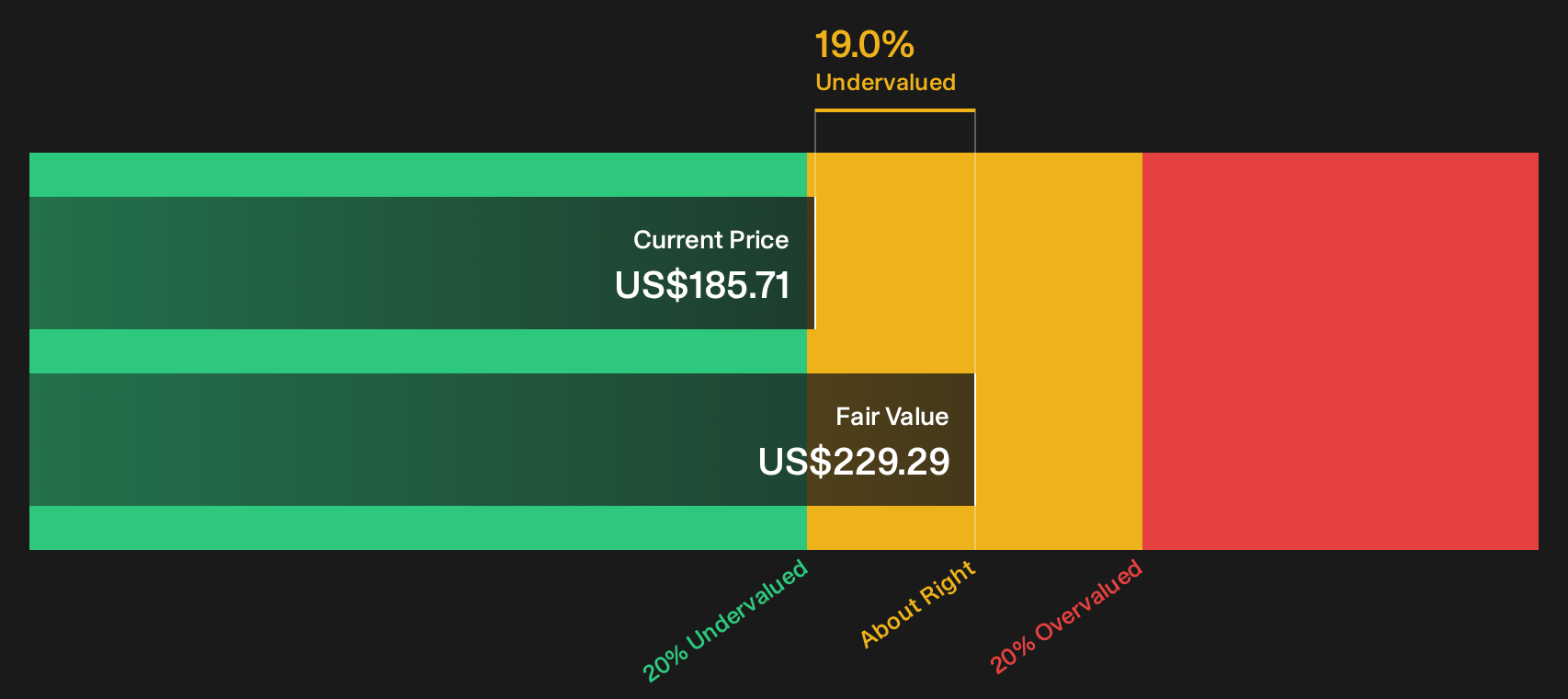
Feeding those cash flows into a 2 Stage Free Cash Flow to Equity model produces an estimated intrinsic value of about $229 per share. Compared with the current market price, that implies the stock screens roughly 19.0% undervalued on this DCF view. The recent expansion of the ZYN smoke free pouch range in the U.S. is one factor that helps explain why the market is willing to ascribe a relatively full earnings multiple, yet the cash flow model still suggests more value than the price implies.
On this DCF framework, Philip Morris International appears undervalued relative to the cash flows currently built into the model.
Our Discounted Cash Flow (DCF) analysis suggests Philip Morris International is undervalued by 19.0%. Track this in your watchlist or portfolio, or discover 31 more high quality undervalued stocks.
Where Does Philip Morris International Sit on Earnings?
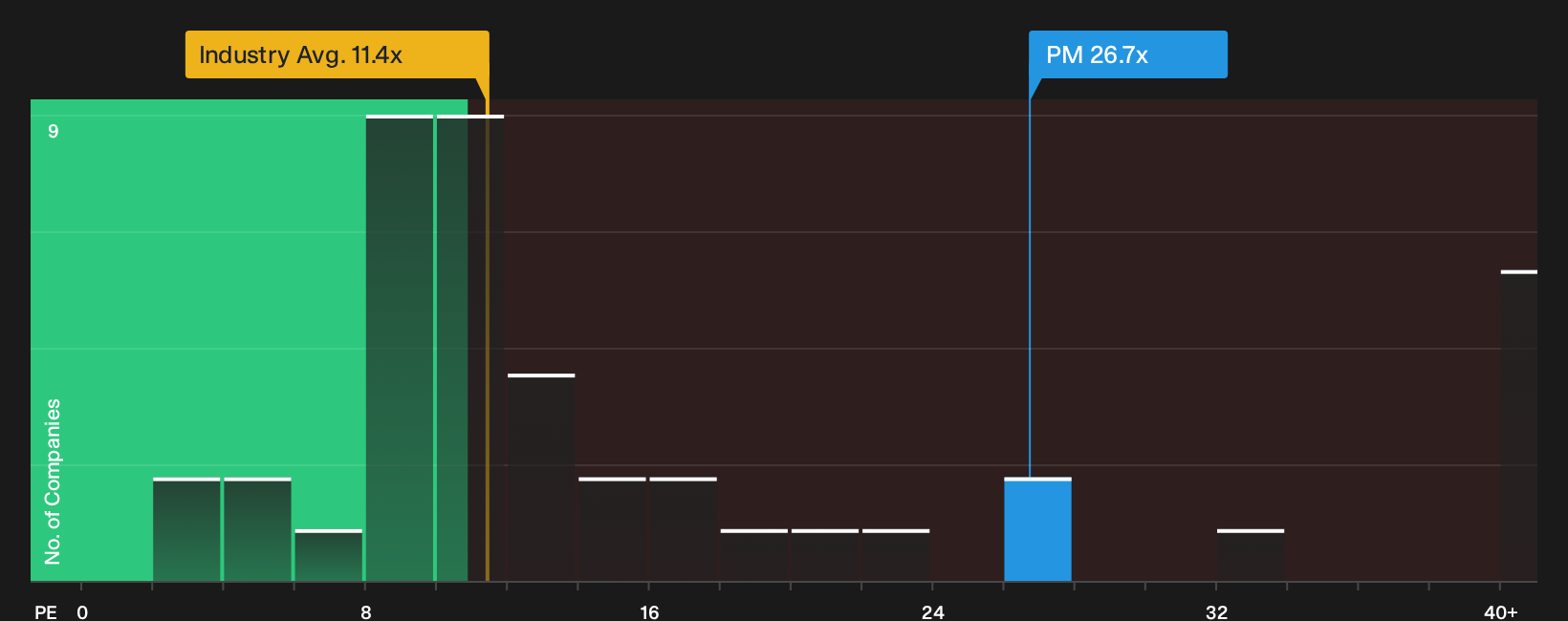
The P/E ratio suits Philip Morris International because earnings remain a core anchor for how investors are weighing the business. The stock trades on about 26.7x trailing earnings, which is higher than the Tobacco industry average near 11.4x and also above a peer group around 22.8x. That points to investors assigning a premium to Philip Morris International compared with many tobacco peers.
A fair P/E multiple derived from the broader fundamentals sits at roughly 27.2x. The current 26.7x level is close to that mark, so the valuation premium versus the sector and peers does not look extreme on this framework. The market seems to be pricing the earnings stream in a way that is broadly consistent with that fair ratio estimate.
On the P/E lens, Philip Morris International looks roughly fairly valued compared with what the tailored fair multiple suggests.
See what the numbers say about this price — find out in our valuation breakdown.
The Philip Morris International Narrative: What Would Justify Today's Price?
Narratives on Simply Wall St help connect Philip Morris International's valuation puzzle to concrete assumptions about future growth, profitability and earnings. They spell out what would need to happen for the shares to be worth meaningfully more or less than today, and they sit on the stock's Community page. Each scenario ties a potential fair value to a clear set of catalysts and risks, so you can monitor over time which version of Philip Morris International's story is actually unfolding.
Community views on Philip Morris International stretch from a smoke free pivot story to worries that regulation and capital intensity keep the odds finely balanced.
Bull case: 9% undervalued
"The accelerating global adoption of smoke-free alternatives, driven by increasing health awareness and regulatory moves away from combustibles, is fueling strong double-digit volume and margin growth in PMI's IQOS, ZYN, and VEEV platforms…"
Read the full Bull Case to see why Philip Morris International could be undervalued
Bear case: 6% overvalued
"The regulatory environment is growing increasingly complex and adverse, with new or heightened restrictions and taxation frameworks on both combustible and smoke-free products, such as evolving EU excise directives and the lack of effective countermeasures against the illicit trade, posing material risks to compliance costs and future operating margins…"
Read the full Bear Case to see why Philip Morris International could be overvalued
Do you think there's more to the story for Philip Morris International? Head over to our Community to see what others are saying!
The Bottom Line
Philip Morris International screens as undervalued on the Discounted Cash Flow (DCF) view, yet the P/E work suggests the market already prices the earnings stream at roughly a full level. That disconnect reflects a cash flow model that leans on the durability of Philip Morris International's free cash generation, while the multiple view is more anchored to current sentiment toward tobacco and where peers trade. Broader checks remain weak. The key question is whether regulatory and product risks around smoke free nicotine justify the discount or whether the intrinsic value estimate better captures the long term cash story.
This article by Simply Wall St is general in nature. We provide commentary based on historical data and analyst forecasts only using an unbiased methodology and our articles are not intended to be financial advice. It does not constitute a recommendation to buy or sell any stock, and does not take account of your objectives, or your financial situation. We aim to bring you long-term focused analysis driven by fundamental data. Note that our analysis may not factor in the latest price-sensitive company announcements or qualitative material. Simply Wall St has no position in any stocks mentioned.
Have feedback on this article? Concerned about the content? Get in touch with us directly. Alternatively, email editorial-team@simplywallst.com