
Is Taiwan Semiconductor Manufacturing (NYSE:TSM) Reasonable When Cash Flow And Earnings Disagree?
Taiwan Semiconductor Manufacturing has delivered an extremely strong 3 year run, yet the valuation checks do not point in a single direction, with the Discounted Cash Flow (DCF) estimate indicating a premium to intrinsic value while earnings based multiples screen more forgiving. That split leaves the stock looking neither clearly cheap nor obviously stretched at first glance.
- The share price return over the past 3 years is about 390.0%, which puts recent gains front and center in any valuation conversation.
- New chip production for Xiaomi and other AI focused processors can support high expectations baked into Taiwan Semiconductor Manufacturing's price. At the same time, any shift in demand for advanced nodes or large capital spending needs may pressure what investors are willing to pay.
- The broader checks, including a value score of 3, point to a mixed picture rather than a clear bargain or clear overvaluation.
The issue now is whether Taiwan Semiconductor Manufacturing's current market value leaves enough room between price and intrinsic value to justify that recent performance.
Spot opportunities beyond Taiwan Semiconductor Manufacturing by scanning 55 AI infrastructure stocks that could also be positioned for the next leg of AI hardware demand.Does Taiwan Semiconductor Manufacturing Look Pricey on Cash Flow?
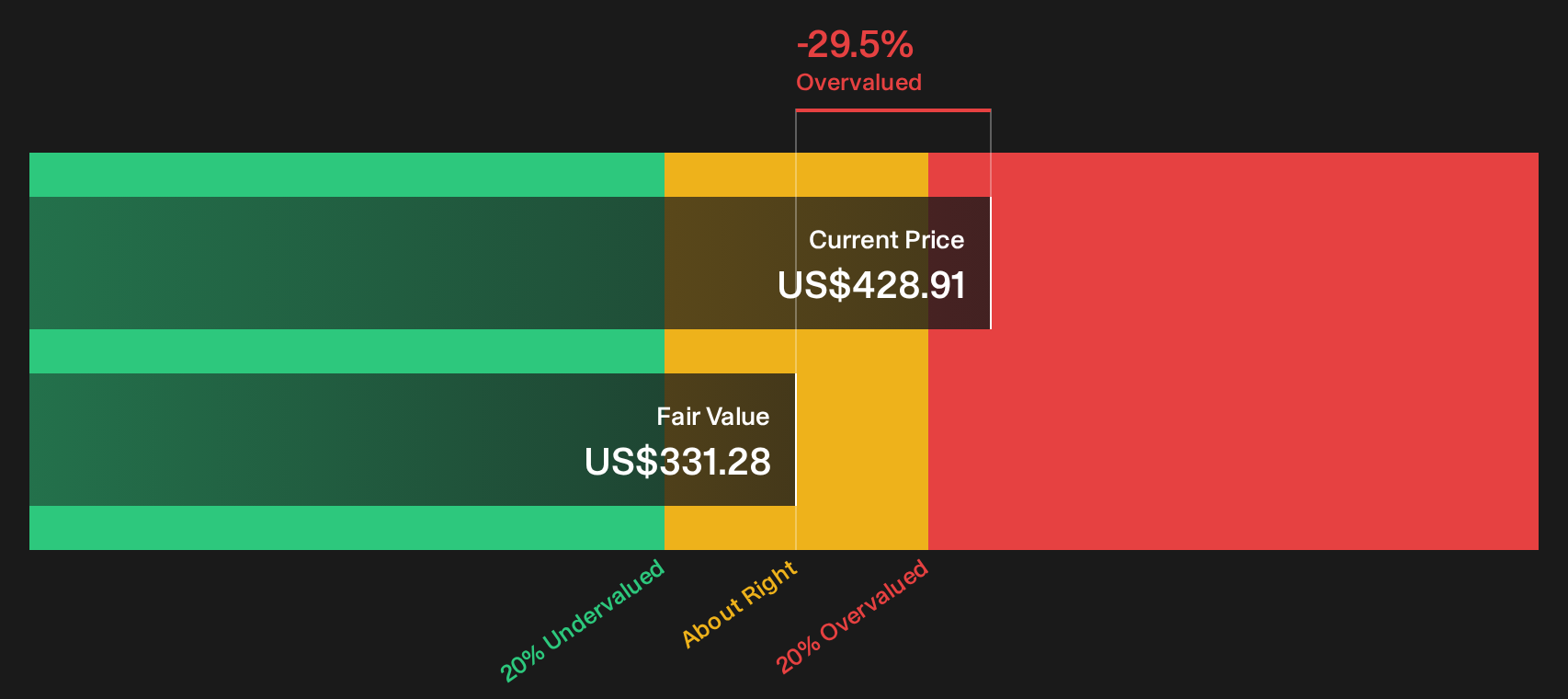
The Discounted Cash Flow (DCF) model here values Taiwan Semiconductor Manufacturing by projecting what its future cash generation could be worth today. On this math, the latest twelve month free cash flow is about NT$1.1b, with the model assuming growing cash flows over time rather than a shrinking business. That stream of projected cash is then discounted back, producing an estimated intrinsic value of about $331 per share.
Compared with the current share price, that DCF outcome points to the stock trading roughly 29.5% above the model’s intrinsic value, so the shares screen as overvalued on this cash flow lens. News that Taiwan Semiconductor Manufacturing is producing three new chips for Xiaomi on its advanced process nodes helps explain some of the enthusiasm that pushes the market price beyond what the current cash flow model supports.
On this DCF framework, Taiwan Semiconductor Manufacturing stock currently screens as overvalued relative to its estimated intrinsic value.
Our Discounted Cash Flow (DCF) analysis suggests Taiwan Semiconductor Manufacturing may be overvalued by 29.5%. Discover 49 high quality undervalued stocks or create your own screener to find better value opportunities.
Does Taiwan Semiconductor Manufacturing Look Undervalued on Earnings?
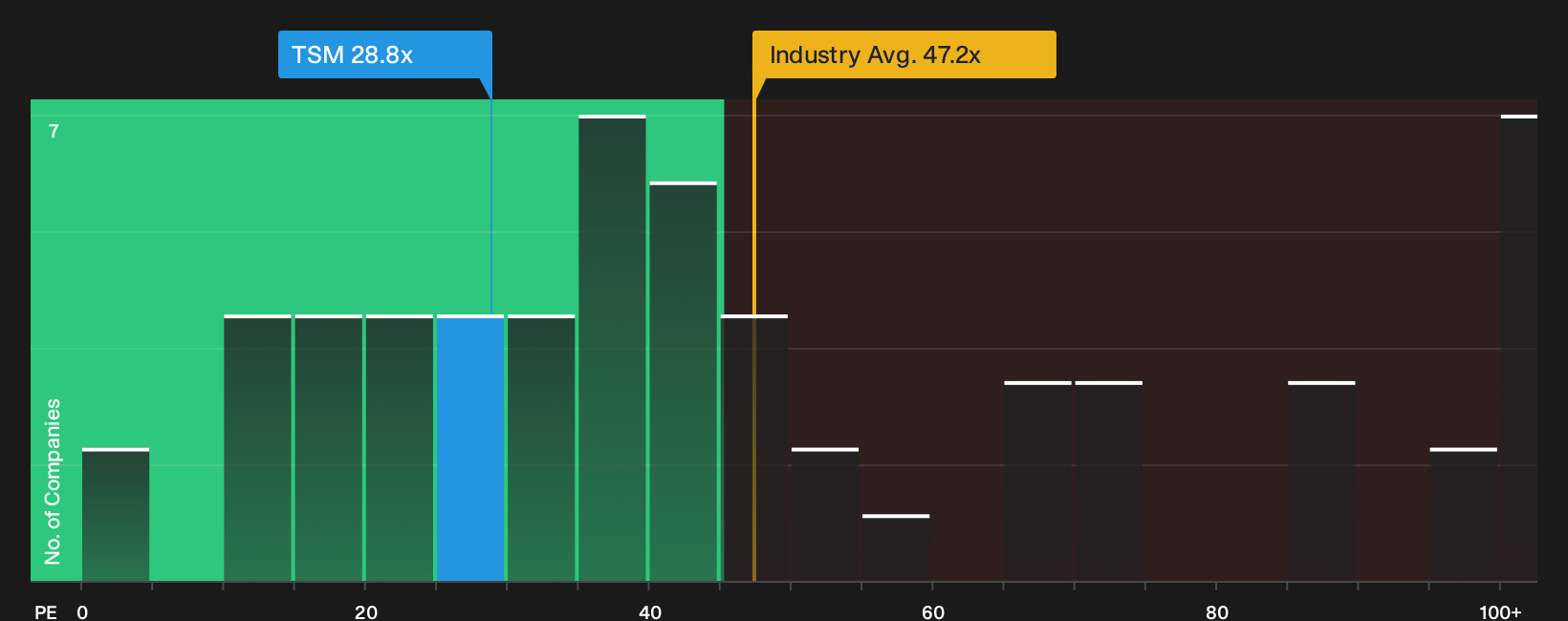
P/E is a straightforward way to think about Taiwan Semiconductor Manufacturing because earnings remain the central yardstick most investors watch in the chip sector. On this basis, the stock trades at about 28.8x earnings, which is well below the broader semiconductor industry average of roughly 47.2x and also under the peer group at around 54.2x.
The fair P/E for Taiwan Semiconductor Manufacturing, given its profile within the sector, is estimated at about 43.2x. This is materially higher than the current multiple, which indicates the market is assigning a discount even though the firm is central to advanced chip production and AI hardware supply chains. The gap between the existing P/E and this fair ratio points to a valuation that is not aligned with how similar semiconductor businesses are currently priced.
On the P/E yardstick, Taiwan Semiconductor Manufacturing stock appears undervalued relative to what the fair multiple implies.
See what the numbers say about this price — find out in our valuation breakdown.
The Taiwan Semiconductor Manufacturing Narrative: What Would Justify Today's Price?
Narratives on Taiwan Semiconductor Manufacturing pick up where this valuation split leaves off by spelling out which paths for growth, margins and earnings would need to play out for the shares to be worth materially more or materially less than they are today on Simply Wall St's Community page. Each market view links its number to a specific stance on how the business might expand, how profitability could shift and how risks might evolve, so you can test those assumptions as fresh information comes through.
Community views on Taiwan Semiconductor Manufacturing stretch from aggressive upside to a much tougher stance on risk and required valuation cushion.
Bull case: roughly fairly valued
"The meat moving the needle right now is CoWoS packaging."
Read the full Bull Case to see why Taiwan Semiconductor Manufacturing could be undervalued
Bear case: 13% overvalued
"That tension, between the most magnificent business economics I have ever studied and the most sobering geopolitical risk I have ever priced, is the entire intellectual challenge of owning TSMC..."
Read the full Bear Case to see why Taiwan Semiconductor Manufacturing could be overvalued
Do you think there's more to the story for Taiwan Semiconductor Manufacturing? Head over to our Community to see what others are saying!
The Bottom Line
Taiwan Semiconductor Manufacturing presents a clear valuation divide. The Discounted Cash Flow (DCF) view suggests the share price sits materially above the intrinsic value estimate, which reflects heavy investment needs and the timing of future cash generation. The earnings multiple perspective points the other way, with a P/E that implies the stock trades at a discount to sector peers despite its position in advanced AI hardware. The key issue for investors is whether future profitability and demand for leading edge capacity eventually align with the more optimistic cash flow assumptions, or whether the current P/E gap reflects the market’s assessment of execution and geopolitical risk.
This article by Simply Wall St is general in nature. We provide commentary based on historical data and analyst forecasts only using an unbiased methodology and our articles are not intended to be financial advice. It does not constitute a recommendation to buy or sell any stock, and does not take account of your objectives, or your financial situation. We aim to bring you long-term focused analysis driven by fundamental data. Note that our analysis may not factor in the latest price-sensitive company announcements or qualitative material. Simply Wall St has no position in any stocks mentioned.
Have feedback on this article? Concerned about the content? Get in touch with us directly. Alternatively, email editorial-team@simplywallst.com