
3 Auto Parts Stocks With Tariff Exposure Retail Investors Should Watch
Trade tariffs between the U.S. and Canada are no longer just political theatre. They now feed directly into the cost of steel, autos, and cross border supply chains that touch everything from basic repair jobs to higher priced performance parts. That creates pricing friction, profit risk, and also openings for investors watching auto aftermarket and parts retailers. This article walks through three stocks exposed to this news and explains why each one matters now.
The stocks covered below are a sample of U.S.-listed auto aftermarket and parts retailers. The full screen surfaced 12 more companies with equally compelling narratives that sit outside this article. If you want to move quickly from idea to potential watchlist, head straight into the U.S.-listed Auto Aftermarket and Parts Retailers screener.
Advance Auto Parts (AAP)
Advance Auto Parts plugs directly into the vehicle maintenance theme of this screener, supplying everyday repair parts and services to both home mechanics and professional garages that keep cars on the road when new auto sales or cross border trade slow down.
Advance Auto Parts generates about US$8.6b in revenue from its Advance Auto Parts/Carquest segment, selling aftermarket parts, fluids, and related services, and the stock is valued at roughly US$2.7b in market cap.
Advance Auto Parts is leaning into that role by refreshing what sits on its shelves and how reliably it is available for the repair market.
"The company is rolling out a new assortment framework across the top 50 designated market areas (DMAs) over the next 12 to 18 months, improving store in-stock depth."
What really matters for investors is how one less visible pressure on profitability and pricing power ultimately resolves.
That pressure point is exactly where the story starts to get interesting for long term holders of Advance Auto Parts. Read the full narrative for Advance Auto Parts to see how assortment changes, trade risks, and execution could be quietly reshaping the risk reward profile.

Dana (DAN)
Dana gives you exposure to the auto parts theme from a different angle by supplying axles, driveshafts and energy-management hardware to vehicle makers that ultimately feed long term maintenance and replacement demand across fleets.
Dana generates about US$5.4b in Light Vehicle revenue and roughly US$2.4b from Commercial Vehicle customers, with a market value near US$3.4b.
For investors watching how cross border tariffs might reshape where components are built and sourced, Dana sits close to the action through its role as a Tier 1 supplier to global automakers and truck builders.
"Dana is investing around US$325 million of 2026 capital spending to support higher margin backlog and Applied Technologies such as defense and powersports."
The real swing factor is how one less visible shift in where future vehicle programs land ultimately filters through to margins and cash generation.
That shifting production map is where things start to get interesting, and the full narrative for Dana shows how tariff risk, backlog and capital spending could be quietly decoupling Dana's future earnings power.

CarMax (KMX)
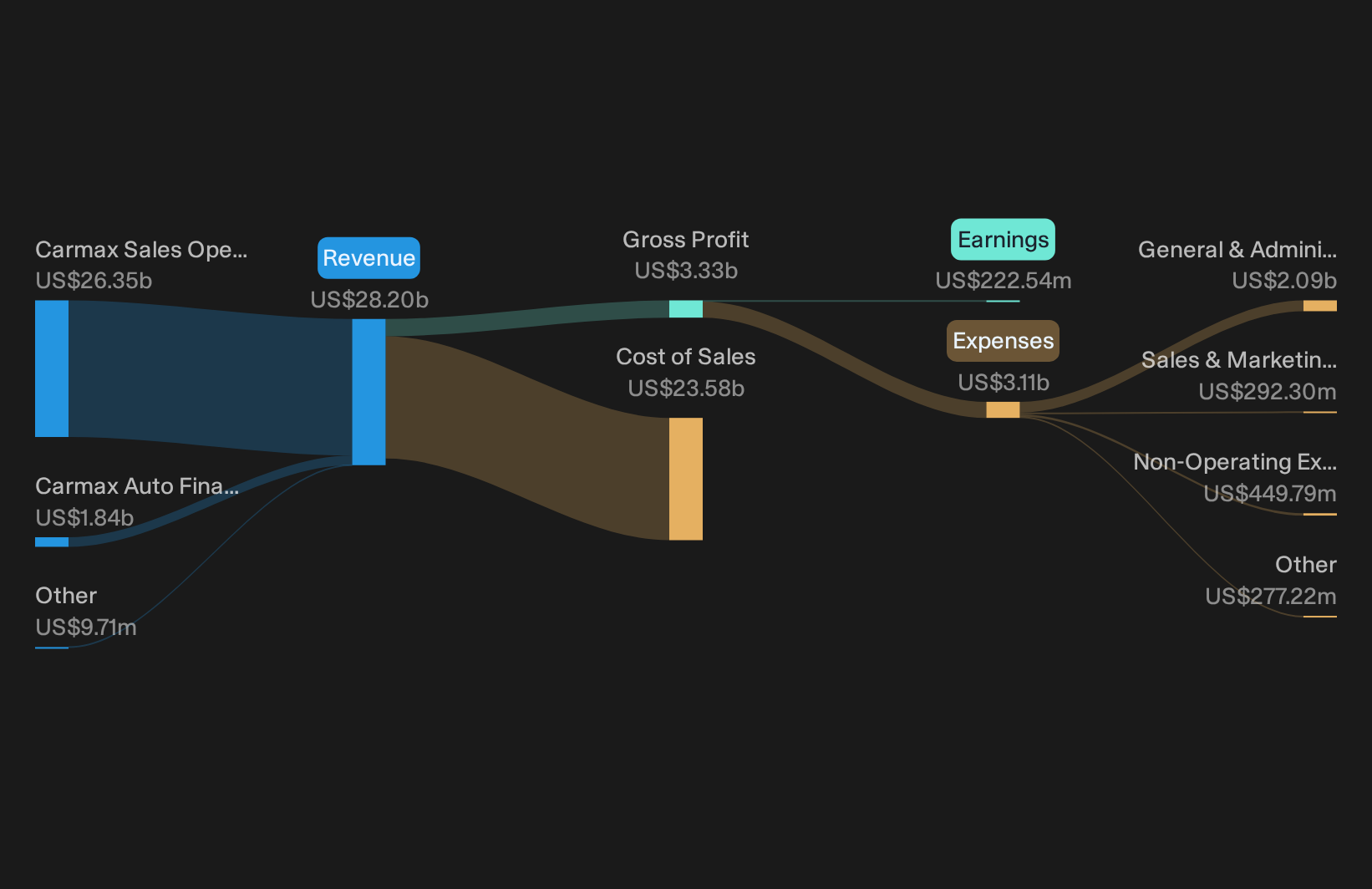
CarMax sits in this auto aftermarket screen as a used vehicle retailer whose sales and in house reconditioning keep customers tied into repair and service cycles rather than new car showrooms. The company reports US$26.3b from Sales Operations and US$1.8b from Auto Finance, all in the U.S., and a market value near US$9.0b.
CarMax matters here because tariffs that push new car prices higher can funnel shoppers toward late model used vehicles and the repair ecosystem around them. This is the segment where this retailer already operates at scale.
"CarMax's growth in digital sales channels, including an increase in omnichannel sales, positions the company to expand its market share and boost revenue in the future."
What investors will really watch is how one less visible pressure on used vehicle margins and reconditioning costs shapes that growth story from here.
If that margin pressure is what you care about, read the full narrative for CarMax to see whether CarMax's omnichannel engine is masking risks or accelerating upside.
Seeking Fresh Alternatives Before They Fly
Fresh ideas tend to move first. By the time momentum reaches the headlines, early entries may already be moving. Review these under the radar lists before the window closes and consider your options.
- Identify stronger balance sheets before the broader market by using the list of solid balance sheet and fundamentals (24 results) to filter for sturdier cash profiles and cleaner fundamentals.
- Explore early AI momentum across established businesses using the 73 profitable AI stocks that aren't just burning cash to find companies already converting that spending into earnings and cash flow.
- Evaluate opportunities ahead of potential power buildout activity by scanning the 39 power grid technology and infrastructure stocks to focus on infrastructure companies connected to grid upgrades and electrification themes.
This article by Simply Wall St is general in nature. We provide commentary based on historical data and analyst forecasts only using an unbiased methodology and our articles are not intended to be financial advice. It does not constitute a recommendation to buy or sell any stock, and does not take account of your objectives, or your financial situation. We aim to bring you long-term focused analysis driven by fundamental data. Note that our analysis may not factor in the latest price-sensitive company announcements or qualitative material. Simply Wall St has no position in any stocks mentioned.
Have feedback on this article? Concerned about the content? Get in touch with us directly. Alternatively, email editorial-team@simplywallst.com