
Valvoline (VVV) Stock Looks Fairly Valued But Its Earnings Still Look Rich
Valvoline has given investors a rough ride over the past year, with the share price falling 19.4%, and the valuation checks at first glance do not flag the stock as a clear bargain even after that pullback.
- The 1 year return is down 19.4%, which signals that expectations around the business have cooled compared with where the stock traded a year ago.
- Future cash generation from the service-focused model can support the current share price, while any pressure on margins or capital spending needs could weigh on what investors are willing to pay.
- The broader valuation score is low, with the stock screening as attractive on only 1 of 6 checks. As a result, Valvoline does not screen as an obvious value opportunity on the cross checks.
The issue now is whether Valvoline’s current price around US$32 still builds in too much optimism after a year of weak share performance, or whether it is close to fair value for what the business delivers.
Compare Valvoline’s recent 1 year slide with a curated set of companies that also screen as beaten up but potentially better priced through the 49 high quality undervalued stocks.
Does Valvoline Look Fairly Valued on Earnings?
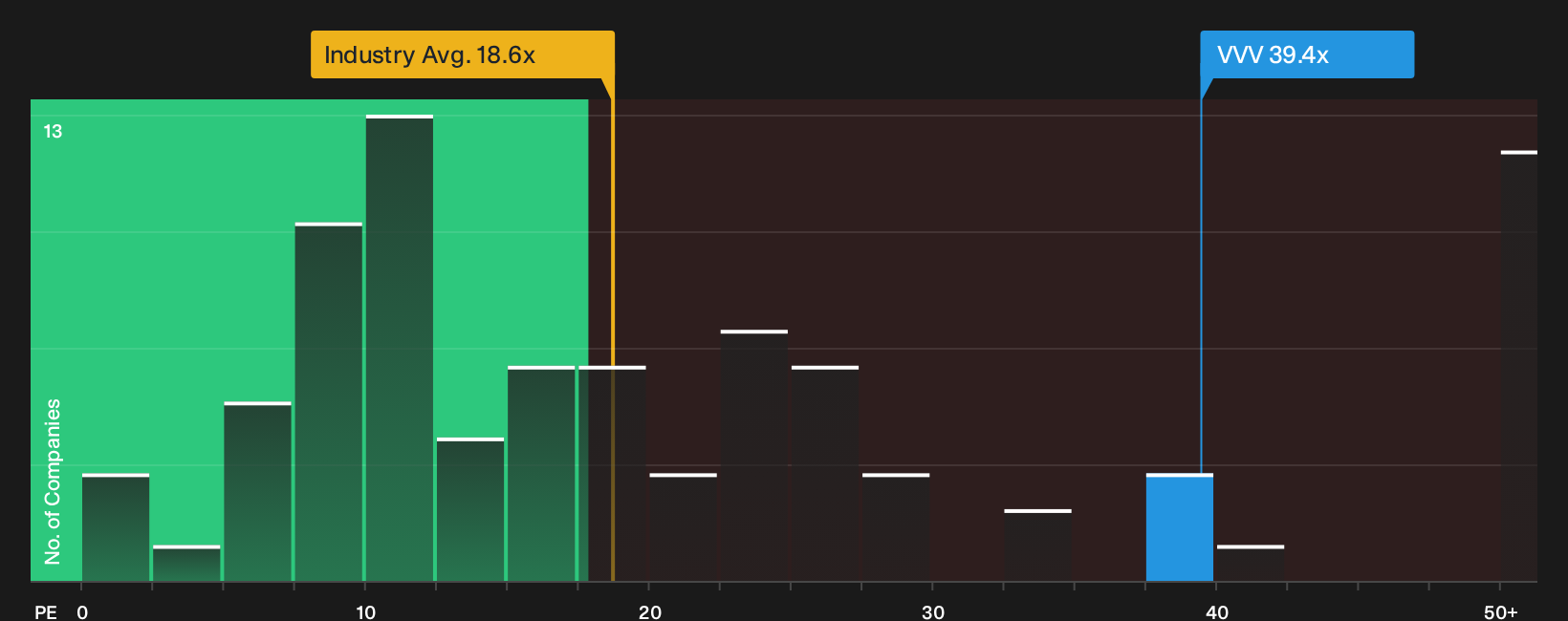
The P/E ratio fits Valvoline because earnings are the key way investors tend to value a service-heavy auto care business. On that measure, the stock trades on about 39.4x earnings, which is more than double the Specialty Retail industry average of roughly 18.6x and well above the peer group near 10.3x. That is a rich headline number for a company already well established in its niche.
The Fair Ratio estimate for Valvoline sits at about 37.8x P/E. This figure reflects what investors might typically pay for the stock once factors such as profitability profile, sector, size and risk are blended together. The current 39.4x is only slightly higher than that benchmark, so the premium to the sector and peers looks less extreme when viewed through this more tailored lens.
On the P/E multiple, Valvoline looks priced roughly in line with what the customised Fair Ratio suggests is reasonable.
See what the numbers say about this price — find out in our valuation breakdown.
The Valvoline Narrative: What Would Justify Today's Price?
Simply Wall St Narratives pick up where the P/E puzzle for Valvoline leaves off and spell out which future paths for growth, margins and earnings would need to play out for the stock to be worth materially more or less than today’s price on the Community page. Instead of giving a single valuation figure, they describe the specific future that figure relies on so you can later check whether the real business is moving in that direction.
Add your own narrative on Valvoline to present a clear, number-driven view of its growth, margins and execution, and let the data over time show how that thesis holds up.
By contributing, you can be one of the first voices in the Simply Wall St community to frame the risk and reward trade-off on Valvoline in a way that other investors can track and challenge.
Do you think there's more to the story for Valvoline? Head over to our Community to see what others are saying!
The Bottom Line
Valvoline now trades on a P/E that looks close to what the tailored Fair Ratio suggests is reasonable, so the market is no longer pricing it as an obvious bargain or clear excess. The broader valuation checks remain weak though, which hints that any case for upside rests on more than just headline multiples. The crux is whether the business can defend margins and turn its service model into dependable cash generation without demanding heavy extra investment. If that holds, the current valuation could look sensible, but if profitability or capital needs disappoint, the multiple may prove demanding.
This article by Simply Wall St is general in nature. We provide commentary based on historical data and analyst forecasts only using an unbiased methodology and our articles are not intended to be financial advice. It does not constitute a recommendation to buy or sell any stock, and does not take account of your objectives, or your financial situation. We aim to bring you long-term focused analysis driven by fundamental data. Note that our analysis may not factor in the latest price-sensitive company announcements or qualitative material. Simply Wall St has no position in any stocks mentioned.
Have feedback on this article? Concerned about the content? Get in touch with us directly. Alternatively, email editorial-team@simplywallst.com