
Why Southwest Airlines (LUV) Stock’s Implosion Could Offer a Contrarian Ticket Higher
On paper, the air travel sector is a mixed bag, which theoretically should have Southwest Airlines (LUV) cruising in a consolidation pattern. However, a pivotal financial decision appears to have spooked investors due to negative forward-looking implications. Subsequently, LUV stock has fallen off roughly 16% in the trailing month, leading to a 40% Sell rating from the Barchart Technical Opinion indicator.
What adds to the misfortune is that Southwest offered solid results for its second-quarter earnings, with the airliner robustly exceeding profitability targets but coming slightly short on revenue. Another positive is the overall industry. While it’s obvious that the broader economy is struggling, Google Finance’s summary sheet notes that Americans are flying in unprecedented numbers.
That’s also evidenced by Southwest’s seating and premium pivot. Rather than sticking with its traditional open-seating model, the company has introduced assigned seating and extra-legroom configurations. Analysts believe that this move could significantly exceed revenue expectations by unlocking high-margin premium traveler spending. Subsequently, there’s a rational basis for optimism toward Southwest stock.
So, why the recent downturn? Primarily, Google Finance identified fuel hedging vulnerability as a key culprit. It made a strategic decision to discontinue its fuel hedging program right before crude oil and jet fuel prices surged. Naturally, this misfortune fully exposed the airline to soaring energy costs. As well, analysts then had to adjust their expectations for LUV stock.
Granted, this bit of tough luck has also expanded the competitive gap between Southwest and its rivals. But it’s also fair to suggest that the bad news in Southwest Airlines stock may be priced in. With the airline industry remaining robust despite wider headwinds, speculative traders — especially options traders — may have a contrarian opportunity here.
Order Flow Imbalance Sets Up Contrarianism for LUV Stock
As a basic hypothesis, my bullish argument for Southwest stock centers on the concept of mean reversion. Right now, LUV is down more than 4% on a year-to-date basis, which without context seems rather poor. However, the extended pessimism since late June has done a number on the discount airliner. Without this unfortunate event, LUV would have been a strong performer.
Now, I don’t want to argue the “woulda, shoulda, coulda” narrative; the point is that LUV stock is technically wounded. Nevertheless, because of the underlying positives in air travel, it’s possible that Southwest could march its way back to prior trading ranges. If so, speculators entering a position prior to the wave may enjoy sizable profits — especially if they use the leverage of options.
Of course, advanced traders are reluctant to expose themselves to highly risky transactions on vibes and opinions. That’s where the order flow imbalance argument becomes compelling. I don’t believe that LUV stock will simply rise higher just because it suffered a bearish cycle. Instead, I’m making my assessment on an inference based on past analogs.
Specifically, we know that Southwest stock has inked only three positive weekly candlesticks over the past 10 weekly sessions, leading to an overall downward slope. This 3-7-D quantitative sequence doesn’t offer anything inherently special other than being a static snapshot in time. But it’s what happens after this signal materializes in the charts that’s most intriguing.
Using historical data going back to January 2009, we know that when the aforementioned sequence flashes, the median performance is a rise of about 8.5% at the end of the sixth week (roughly coinciding with the Oct. 16 expiration date). If this is true, LUV stock could potentially reach around $43. As such, a rational options strategy may be to consider the 40/42.50 bull call spread expiring Oct. 16.
It’s a tempting proposition because, for a net debit (cash outlay) of $101, the speculator will receive a profit of $149 should Southwest Airlines stock rise through the $42.50 second-leg strike at expiration. That would be a payout of 147.53% — but there’s a catch.
Wall Street doesn’t believe this trade is probabilistically viable.
An Alternative Proposition Weighs on Southwest Stock
Right now, the Street’s options pricing protocol suggests that the implied probability of LUV stock hitting the call spread’s 41.01 breakeven price at expiration is only 38.9%. What’s worse, if you reverse engineer Barchart’s Expected Move calculator, the chance that LUV will trigger the second-leg strike is only 27.9%.
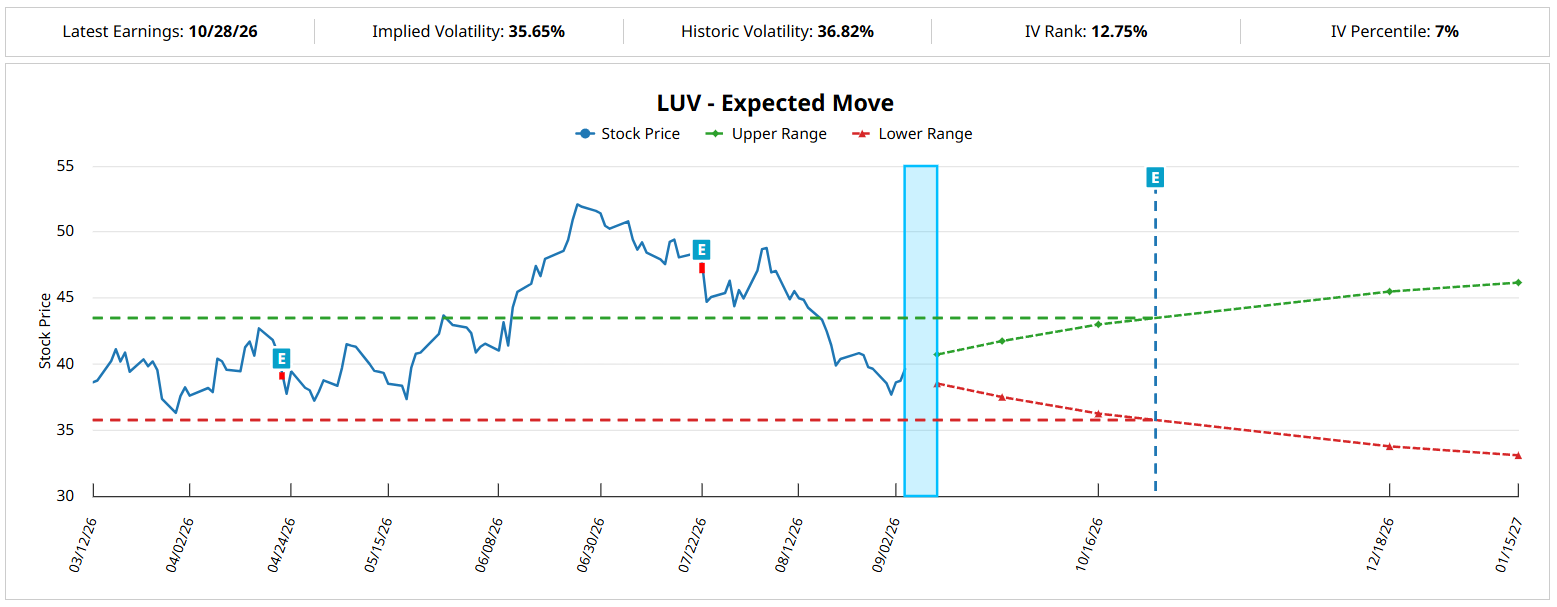
You can easily see the problem here without formerly running an expected value (EV) calculation. Since you’re only fully winning less than a third of the time — and only breaking even less than 40% of the time — you would be projected to lose money if you run this identical trade across multiple parallel universes.
Sure, parallel universes represent fantasy talk and it’s possible to win big on any given moment. However, because the odds are stacked against you, that moment doesn’t seem very likely. Naturally, then, most financial experts would likely steer you away from the 40/42.50 bull spread.
Granted, that’s a reasonable take given the information at hand. Still, before you make the final decision, you should realize how the above probabilities are calculated.
Essentially, the core assumption is that Southwest stock will undergo a random walk between now and the expiration date, with the current implied volatility (IV) serving as a constant “fuel” throughout the journey. That means the options pricing is assuming randomness and risk-neutrality, which may or may not be the dominant force.
Personally, I believe that LUV stock will undergo a nonrandom walk between now and expiration, for the reason I mentioned earlier — bearish order flow imbalance. With only three positive candlesticks out of the last 10, I suspect that institutional investors may view Southwest as a discount.
If we were to take this presupposition, we would infer that, because the 3-7-D signal flashed 34 times on a rolling basis, and that LUV stock exceeded the $42.50 strike on week 6 a total of 18 times, the conditioned probability may be 52.9%.
That’s not an earthshattering success ratio but it’s far superior to 27.9%.
Which Model is Right?
Options traders may wonder, which model is right? To that, I must say, “I don’t know.” When you’re dealing with the unknown future — especially about the future of a reflexive environment such as the equities market — any forecast is bound to be presuppositional.
In my opinion, the only way I can shed some light on the matter is something similar to inference to the best explanation. I can’t guarantee what happens next just because LUV stock flashed the 3-7-D signal. I just know that in the past roughly two decades, whenever this signal has materialized, LUV usually witnesses an above-average performance.
That’s why I believe the forward journey from this particular juncture will be nonrandom. The data simply suggests that this would likely be the case. Unfortunately, we can’t guarantee the outcome. We can only say that there’s a real possibility that Wall Street is mispricing this risk.
If you find this approach convincing, Southwest Airlines stock may be worth a closer look.
On the date of publication, Josh Enomoto did not have (either directly or indirectly) positions in any of the securities mentioned in this article. All information and data in this article is solely for informational purposes. For more information please view the Barchart Disclosure Policy here.