
How Is Aflac’s Stock Performance Compared to Other Insurance Stocks
Valued at a market cap of $61.7 billion, Aflac Incorporated (AFL) is a global insurance company headquartered in Columbus, Georgia. It provides financial protection to millions of policyholders in the United States and Japan through policies that pay cash benefits for expenses related to accidents, cancer treatments, critical illnesses, hospital stays, and other health-related events that may not be fully covered by primary insurance plans.
Companies worth $10 billion or more are generally described as "large-cap stocks," and Aflac fits right into that category, with its market cap exceeding this threshold, reflecting its substantial size and influence in the life insurance industry. Aflac’s competitive edge lies in its specialized supplemental insurance model, strong brand recognition, and established distribution network. Its focus on products that help customers manage out-of-pocket medical expenses differentiates it from traditional health insurers, while its leadership in cancer and medical insurance in Japan provides a strong market position.
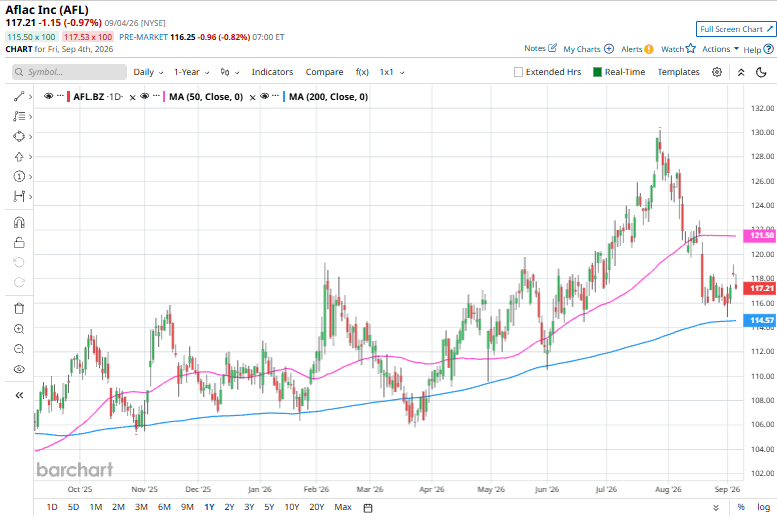
However, shares of Aflac are 10% down from its 52-week high of $130.22, hit on July 29. They have gained 1.7% over the past three months, compared to the iShares U.S. Insurance ETF (IAK), which has advanced 12.4%
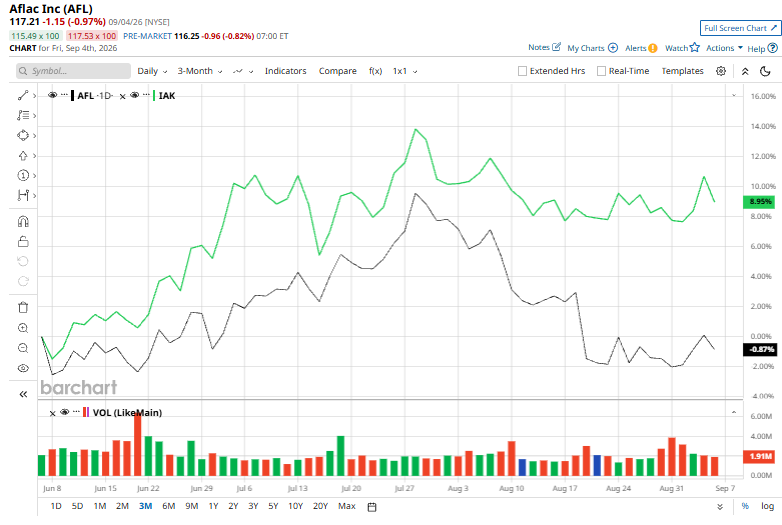
The longer-term picture is steadier, with AFL up 6.3% year to date and 8% over the past year, slightly behind IAK’s 6.9% and 8.3% gains.
Technically, the stock has mostly held above its 200-day moving average over the past year, but its dip below the 50-day average in mid-August suggests that near-term momentum has weakened.
Aflac’s underperformance over the past year reflects a more cautious earnings outlook, with investors questioning whether its core businesses can deliver enough growth to justify a stronger valuation. The main pressure points are slowing Japan operations, softer premium growth, and concerns that share buybacks are doing too much of the work in supporting EPS growth.
The company’s recent Q2 results reinforced those concerns, with adjusted earnings of $1.75 missing expectations and revenue of $4.1 billion falling 1% year over year. Higher benefits and claims also pressured Aflac U.S.’s profitability, while analysts have become more cautious about the sustainability of earnings growth.
The market’s reaction was particularly clear on Aug. 19, when AFL shares dipped 4.3% after Wolfe Research initiated coverage with an “Underperform” rating and a $103 price target.
When we compare Aflac with its industry rival, MetLife, Inc. (MET), the difference is clear. MetLife stock has gained 23.7% year to date and 19.4% over the past 52 weeks, delivering a stronger run than AFL over both periods.
As a result, analysts remain cautious and have adopted a neutral stance on AFL's outlook. It has a consensus rating of “Hold” from the 17 analysts covering it, and the mean price target of $118.94 represents a 1.5% upside to the current market price.
On the date of publication, Kritika Sarmah did not have (either directly or indirectly) positions in any of the securities mentioned in this article. All information and data in this article is solely for informational purposes. For more information please view the Barchart Disclosure Policy here.