
SAP (XTRA:SAP) Stock Still Looks Discounted After Its 62% Five Year Gain
SAP stock has delivered a solid 61.8% gain over the past 5 years, yet current valuation checks send a more cautious message, with the intrinsic value estimate pointing to meaningful upside while the share price has recently come under pressure. Recent drawdowns and a mixed overall value score leave SAP looking potentially cheap on some measures, but not an obvious across the board bargain.
- The 61.8% return over 5 years suggests SAP has rewarded patient holders, which makes any current valuation gap more important to scrutinize.
- Management focus on AI infused cloud software and sustainability data offerings can support long term cash flows, while concerns around the pace of AI monetization and cloud growth may restrain how quickly that value shows up in the share price.
- A value score of 3 out of 6 gives SAP a mixed profile, with both the Discounted Cash Flow (DCF) estimate and market multiples pointing to undervaluation relative to the current market price.
The issue now is whether SAP's recent pullback and the apparent discount to intrinsic value offer a reasonable entry point or simply reflect the risks that investors are already pricing in.
Spot 55 AI infrastructure stocks that, like SAP, are leaning into AI and cloud workloads while the market reassesses what it is willing to pay for that story.Is SAP a Bargain on Cash Flow?
The Discounted Cash Flow (DCF) model here values SAP by projecting future free cash generation and discounting it back to today. SAP produced about €8.7b of free cash flow over the last twelve months, and the model assumes that this cash pot continues growing rather than shrinking, consistent with a mature but still expanding software group.
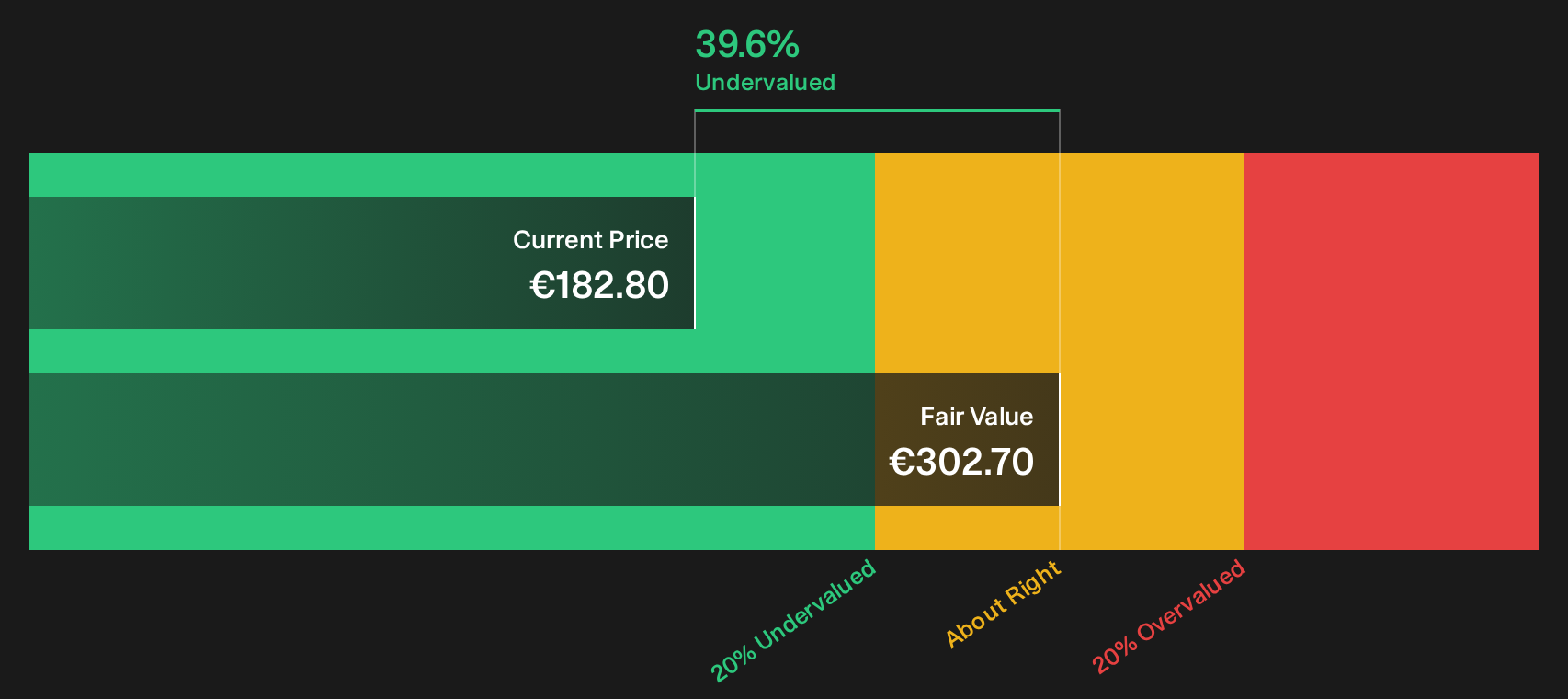
On those inputs, the 2 Stage Free Cash Flow to Equity model lands on an estimated intrinsic value of about €302.70 per share. That implies a 39.6% discount relative to the current market price, which presents SAP as undervalued on this cash flow view. UBS’s recent downgrade on concerns around AI monetization and cloud momentum helps explain why the share price sits well below the DCF estimate despite the underlying cash generation profile.
On balance, the DCF work suggests SAP stock appears undervalued compared with what its projected cash flows would justify.
Our Discounted Cash Flow (DCF) analysis suggests SAP is undervalued by 39.6%. Track this in your watchlist or portfolio, or discover 253 more high quality undervalued stocks.
Does SAP Look Undervalued on Earnings?
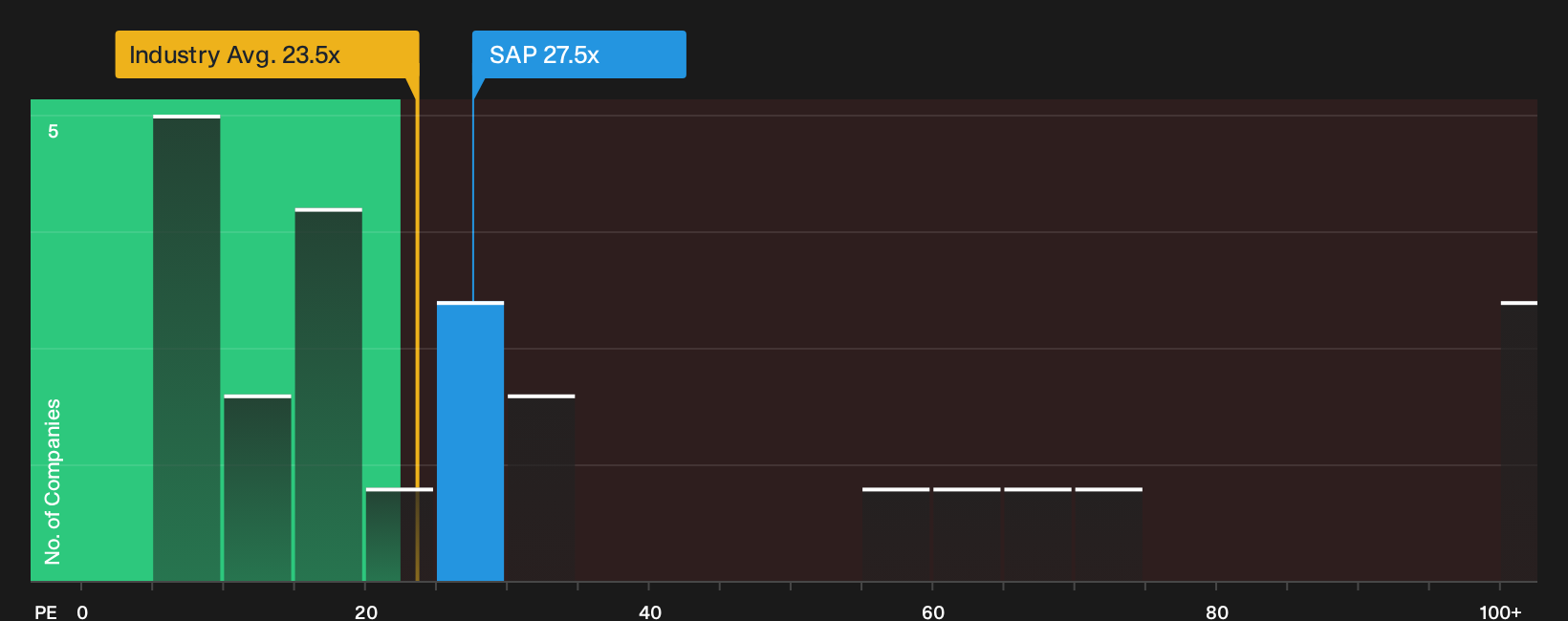
P/E fits SAP reasonably well because earnings remain a key anchor for how investors view large software platforms with recurring revenue streams. SAP currently trades on about 27.1x earnings, compared with an average P/E of roughly 22.5x for the broader software industry and 21.0x for its peer group. On raw comparison, the stock changes hands at a premium to many sector rivals.
The tailored fair P/E for SAP is estimated at 35.8x. That figure reflects what investors might typically pay given its size, profit profile and risk mix. Set against the current 27.1x, the market is applying a discount of several turns to that fair multiple even though the shares already look more expensive than the sector average.
Taken together, SAP stock appears undervalued on an earnings basis because its current P/E sits below this more customized fair multiple, despite trading above typical software peers.
See what the numbers say about this price — find out in our valuation breakdown.
The SAP Narrative: What Would Justify Today's Price?
SAP's valuation gap raises a simple question for investors: which future path would justify today’s price? Simply Wall St Narratives on SAP spell out those paths in plain terms, linking different assumptions for growth, margins and earnings to concrete scenarios in which the stock could be worth materially more or less than it trades for today. Each one anchors a fair value to a specific mix of potential catalysts and risks so you can track over time which version of events is actually unfolding.
Community views on SAP could hardly be further apart, with one camp seeing a transformation story on sale and the other warning on execution risk and competition.
Bull case: 26% undervalued
"Beneath the noise, the fundamentals are robust, cloud revenue up 23%, Cloud ERP Suite up 28%, non-IFRS operating profit up 28%, and free cash flow nearly doubled to €8.2 billion..."
Read the full Bull Case to see why SAP could be undervalued
Bear case: 18% overvalued
"Industry-wide acceleration in cloud-native and low/no-code software is increasing competition, reducing technological barriers and threatening the differentiated value that SAP's legacy platform provides..."
Read the full Bear Case to see why SAP could be overvalued
Do you think there's more to the story for SAP? Head over to our Community to see what others are saying!
The Bottom Line
SAP currently screens as undervalued on both the Discounted Cash Flow (DCF) view and the earnings multiple work, which gives the valuation case some consistency even if the overall scorecard is only mixed. The key uncertainty is whether AI linked cloud offerings and related monetization progress fast enough to close that intrinsic value gap, rather than leaving the stock stuck on a discounted P/E. For anyone weighing SAP, the real hinge is execution on cloud and AI, since that is what ultimately decides whether today’s apparent discount is a genuine opportunity or compensation for the risks already flagged by more cautious holders.
This article by Simply Wall St is general in nature. We provide commentary based on historical data and analyst forecasts only using an unbiased methodology and our articles are not intended to be financial advice. It does not constitute a recommendation to buy or sell any stock, and does not take account of your objectives, or your financial situation. We aim to bring you long-term focused analysis driven by fundamental data. Note that our analysis may not factor in the latest price-sensitive company announcements or qualitative material. Simply Wall St has no position in any stocks mentioned.
Have feedback on this article? Concerned about the content? Get in touch with us directly. Alternatively, email editorial-team@simplywallst.com