
The “Go to Hormuz” wave spawned a revival in Suez! The orbiting dividend boosted canal revenue by 42%
The Zhitong Finance App learned that the Suez Canal is speeding up to meet the demand for shipping diversion brought about by the “going to Hormuz effect” in Middle Eastern countries, but this round of recovery is occurring at the same time as rising energy transportation costs in the Middle East and the world. Not long ago, US Treasury Secretary Bessent said that with the development of alternative channels such as onshore oil pipelines, the Strait of Hormuz will be bypassed within two years, stressing that the construction of oil and gas pipelines and other important transportation ports in the Middle East will bypass the Strait of Hormuz “within two years,” and even called it “worthless waters” at that time.
In reality, energy shipping adjustments to Middle Eastern countries have already begun: Saudi Arabia transports crude oil to Red Sea ports through land pipelines, and the threat of the Houthis near the Strait of Mande in the Red Sea region has also forced some oil tankers in the direction of Asia to go north to Suez and then go eastward around Africa. This “alternative route re-routing” helps explain the strong recovery performance of the Suez Canal in July, where revenue increased by 42% year-on-year and navigable vessels increased by 27%.
Furthermore, the UAE's expansion of ports, pipelines, and railways on the east coast, and Saudi Arabia's increased layout of the Yanbu port's energy transportation infrastructure and oil and gas production capacity are in line with this idea of weakening strait restrictions through alternative infrastructure.
Ship diversion brings revenue recovery, and SUEZ returns to major energy transportation routes
The core reason behind the 42% year-on-year increase in revenue from the Suez Canal in July is that due to the US-Israel-Iran war, the Strait of Hormuz is actually in an extremely dangerous state where merchant ships face military attacks at any time. Coupled with military armed threats from Iran-backed Houthis forces in the southern Red Sea, prompted more ships to use this waterway located in Egypt.
According to data from the Central Office of Public Mobilization and Statistics, Egypt's national statistics agency, a total of 1,340 ships passed through the canal during the month. This is a 27% increase from July 2025, and up from 1,208 ships in June this year, continuing part of the recovery trend that began earlier this year.
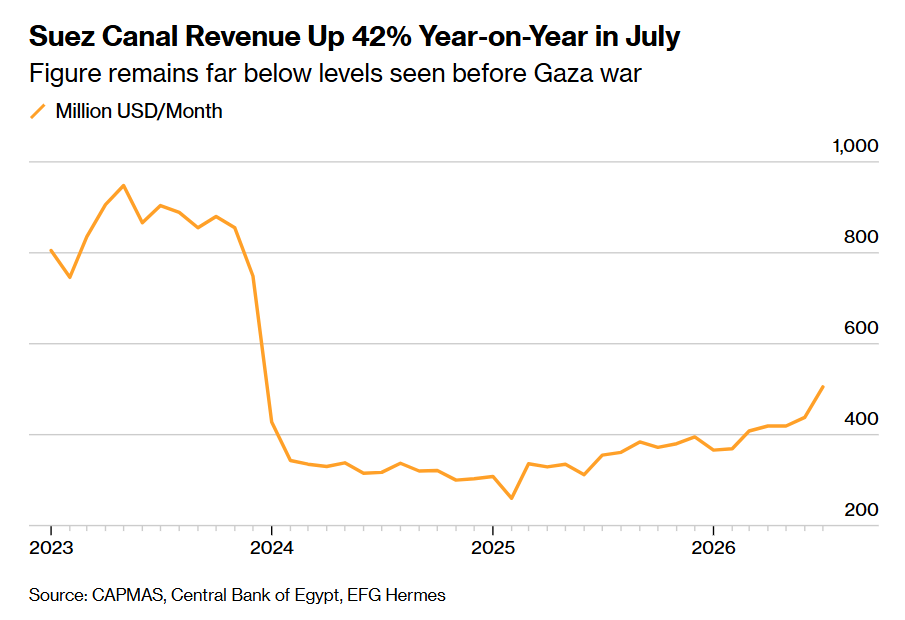
As shown in the chart above, revenue from the Suez Canal increased by 42% year on year in July, but this figure is still far below the level before the outbreak of the war in Gaza. Source: Egyptian Central Office of Public Mobilization and Statistics, Central Bank of Egypt, EFG Hermes.
Of the ships that passed through the canal in July, oil tankers accounted for 526, compared to 485 last month. This increase is likely to reflect, at least in part, the shift in Saudi crude oil exports to the Red Sea after the closure of the Strait of Hormuz. Subsequently, threats from the Houthis in Yemen prompted many ships to sail north instead of crossing the Mander Strait, another key global energy transit port.
According to data from Egypt's Central Bureau of Public Mobilization and Statistics, canal revenue rose to 505 million US dollars in July, the highest monthly level since December 2023. At the beginning of 2024, the Houthis began attacking international shipping in the southern Red Sea to put pressure on Israel during the war between Israel and Hamas in Gaza. As a result, the canal traffic volume plummeted.
This shortest sea route connecting Europe and Asia has always been an important source of foreign exchange for Egypt, along with tourism and overseas remittances. Chairman of the Suez Canal Authority Osama Rabier said in a local TV interview last week that the agency expects annual revenue to increase from US$4.1 billion in 2025 to US$5.8 billion to US$6 billion.
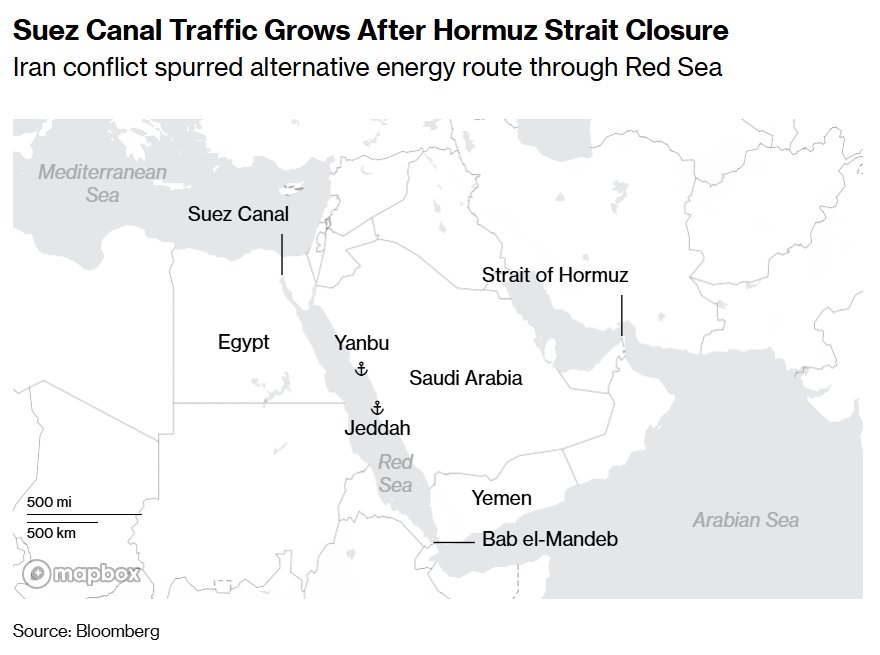
As shown in the chart above, traffic on the Suez Canal increased after the closure of the Strait of Hormuz — the Iranian conflict prompted alternative energy transportation routes to the Red Sea.
Despite a recent recovery, traffic and revenue are still far below pre-war levels in Gaza. According to data from Egypt's Central Bureau of Public Mobilization and Statistics, the canal's revenue reached a record $10.2 billion in 2023, and about 2,300 ships passed through in April of that year.
Mohammed Abu Basha, head of macroeconomic analysis at investment bank EFG Hermes, said that this recovery is expected to continue in the next few months as crude oil exports to Asia are re-rerouted and several European shipping companies announce the resumption of services on some Red Sea routes.
“Closed at sea” is compounded by land-based attacks, and the safety costs of alternative routes and comprehensive energy costs continue to rise
Iran proposed the establishment of a new maritime “prohibited zone” and threatened ships entering the relevant waters with a sanctions list, reflecting that it is trying to turn navigation control into a continuous means of economic pressure. Rezai, secretary of Iran's Supreme National Security Council, claimed that he would sign a transit arrangement with Oman, while Islamic Parliament Speaker Kalibaf said future responses would be stronger; these statements mean that shipowners not only need to determine whether the waterway is physically passable, but also assess the risk of differentiation caused by the flag, supply, destination, and escort relationships. As a result, the Suez Canal received alternative transportation needs, but the energy transportation system is still paying extra costs due to uncertainty.
The Houthis launched a land-based attack on Saudi Arabia's deep-seated energy facilities, further weakening the security assumption that “transporting oil to the Red Sea can guarantee exports.” Maritime attacks extend voyages, and damage to land-based facilities may also reduce crude oil or refined oil products that can be transported. Both impacts will simultaneously raise delivery costs.
This also determines the differentiation of investment returns: canals, some replacement ports, and tankers that can operate safely may handle diversion needs, while energy importers and transport-intensive companies face cost pressure. SUEZ's annual revenue target of 5.8 billion to 6 billion US dollars is equivalent to an increase of about 41.5% to 46.3% over 2025, but it is still significantly lower than the 10.2 billion US dollars in 2023. There is room for recovery and security constraints. Based on the Brent crude oil futures price of $60.85 and WTI of $57.42 at the end of 2025, the two have risen by about 61.5% and 63.2%, respectively, since this year. For Egypt, diversion increases canal charges and foreign exchange revenue; for energy importers, higher comprehensive energy costs and transportation costs jointly drive up onshore costs, reduce corporate profits, and increase inflationary pressure.
The military conflict has substantially reduced the traffic volume of key straits. In the 10 days up to September 6, only 10 commodity carriers passed through the Strait of Hormuz every day, the lowest since May; amid the impact of the Houthis attack on Saudi energy facilities in July, only 11 commodity carriers passed through the Strait of Mande on July 26, falling to a low level of several months. On September 8, the Houthis further attacked several cities in southern Saudi Arabia. The Saudi side reported 73 injuries and the operation of some energy facilities was interrupted. The risk extends from maritime routes to onshore facilities, so that even if exporters find alternative ports, they still have to bear the safety pressure of production, handling and transportation.
Under the geopolitical situation of the US-Iran war, the continued high detour costs are expected to be a long-term positive catalyst to support the bullish market in shipping stocks. It takes about 19 days for the tanker to sail from Yanbu Port in Saudi Arabia to Taiwan, China; after switching to the Suez Canal, the Mediterranean, Gibraltar, and the Cape of Good Hope, it takes about 48 days, an increase of 29 days. The cost of fuel rose from about US$1.26 million to US$2.87 million, an increase of about 127.8%, and an additional US$1 million in Suez Canal expenses. Based on these sub-items, the additional fuel and canal costs alone are approximately $2.61 million. Longer voyages also take up more shipping schedules, reducing the transportation turnover that can be completed by the same fleet, further supporting freight rates.
Based on February 27, before the outbreak of the US-Iran war, the TD3C route freight rates for 270,000-ton oil tankers from the Middle East Gulf to China have risen sharply. According to data from the Baltic Exchange, its world freight rate index rose from WS216.89 to WS677.22 as disclosed in the September 4 weekly report, an increase of about 212.2%; the corresponding round-trip equivalent rental income (TCE, that is, daily revenue after deducting voyage expenses) rose from $209,550 per day to close to $704,000, an increase of about 236%, to about 3.36 times before the war. Compared to the level of 585,000 US dollars on August 21, daily earnings increased by about 20.3%. This reflects not only the military risk premium, but also the strain on effective capacity caused by ships being trapped, deviated, and reduced turnover.