
“Bottom cleanup+trend rebound”, when will pioneer pharmaceutical-B (09939) stand at the key point of valuation reversal?
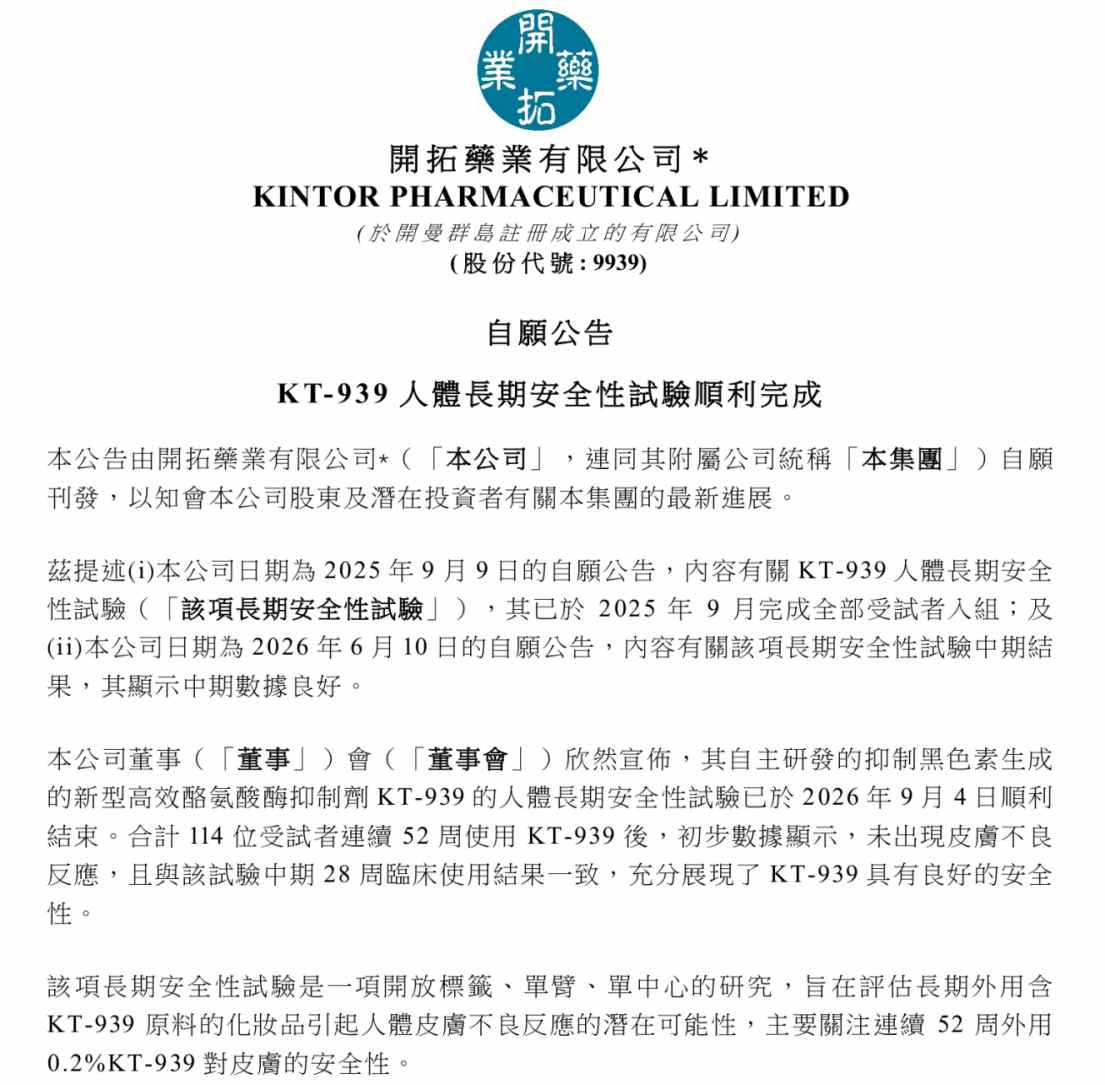
On September 7, before the market, Kaituo Pharmaceutical-B (09939) issued an announcement announcing that the long-term human safety test of KT-939, a novel high-efficiency tyrosinase inhibitor developed independently by it to inhibit melanin production, was successfully completed on September 4, 2026.
Preliminary data showed that a total of 114 subjects had no adverse skin reactions after using KT-939 for 52 consecutive weeks, and clinical use results for 28 weeks in the middle of the trial were consistent, fully demonstrating that KT-939 had good safety.
Stimulated by this favorable news, Kaituo Pharmaceutical's stock price rose rapidly after opening on the same day. The increase rose to 9.89% within half an hour, and the stock price once again reached HK$2.
The Zhitong Finance App observed that since the disclosure of the 26H1 financial report on August 19, Kaituo Pharmaceutical's stock price has experienced a period of “bottoming out first and then rebounding”, and how far the company's stock price can rebound this time has become the focus of investors' attention.
With strong consolidation at the bottom, how far can the overfall repair go?
From May to July of this year, although phase III clinical data for the company's core pipeline KX-826 was approved at an international conference and the commercial layout was ready, the overall liquidity of the Hong Kong stock market was tight at that time, investors' risk appetite declined significantly, and capital flowed out of the highly volatile growth sector.
This market-wide valuation contraction has had a significant impact on developing the pharmaceutical industry, which relies on future cash flow. As a result, the company's stock price fell by nearly 50% during the period, falling short for a while. Until early August of this year, the company's stock price was driven by a combination of three factors: the proximity of key fundamentals, favorable industry policies, and a change in market style. From August 4 to 12, it emerged from the “Six Lianyang” market, and after a technical decline to August 31, it once again rebounded.
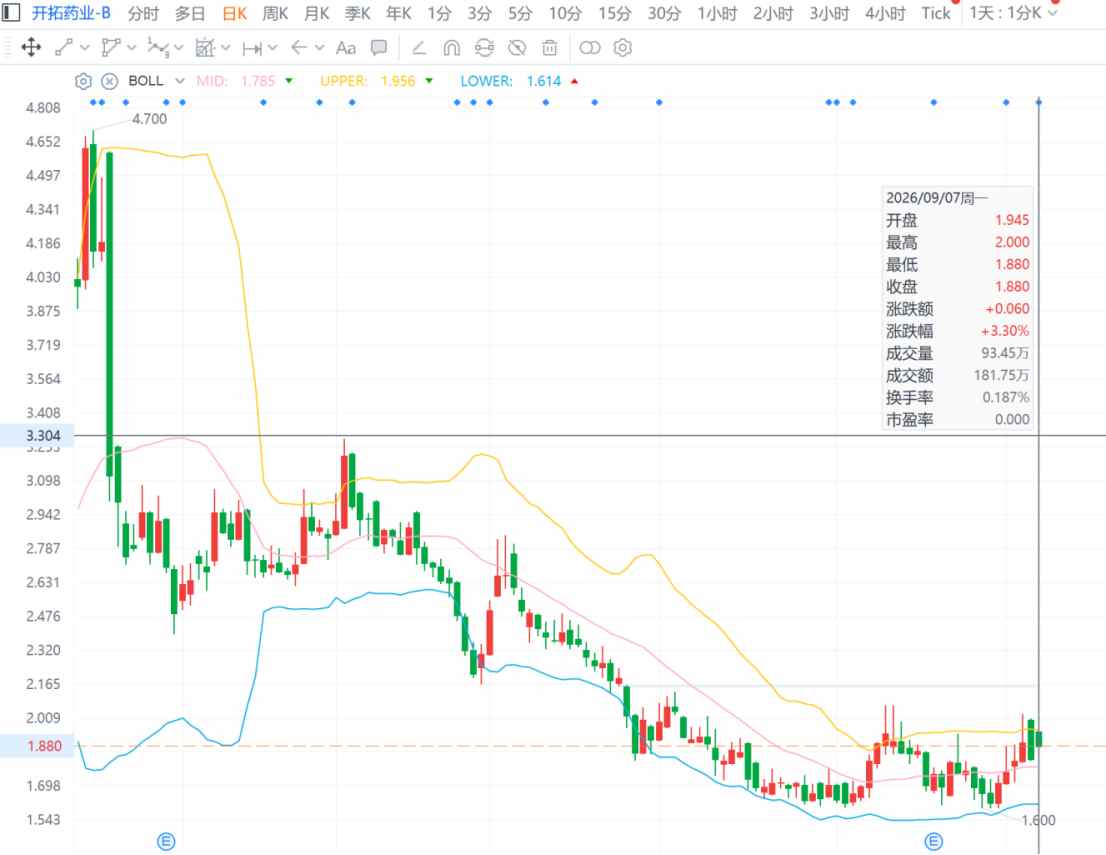
Judging from the market, from August 31 to September 4, Kaituo Pharmaceutical showed a strong consolidation structure of “starting volume, increasing volume moderately, reducing volume drastically, and then increasing volume.”
Specifically, August 31 to September 3 is a typical active attack phase. During this period, Kaituo Pharmaceutical's stock trading volume increased from 2.188 million shares to 2.651 million shares. At the same time, the company's prices rose at the same time, and the characteristics of a sharp rise in volume and price were obvious.
Since then, although the company's stock price closed down by 3.96% on September 4 and there was a certain correction, the daily trading volume was only 851,000 shares. The corresponding turnover was only 47.9% of the average daily turnover in the range, and the turnover rate was only 0.17%. Stock prices and volume can show a pattern of contraction and decline, or indicate that the market capital to develop the pharmaceutical industry on the same day was not concentrated and escaped, but more like a strong consolidation. Overall, the average daily volume of the company's stock price increase was about 2.5 times that of the day it fell, while the net value of OBV turnover rose from -4143,000 to 1.276,000. It also shows that the price rebound was accompanied by net capital inflows, and there was a marked improvement in OTC capital acceptance; it was not an insignificant air rise.
The recent sharp rise in volume and price in Kaituo Pharmaceutical shows that it can also be cross-verified on the technical side. In the range from August 31 to September 6, the stock was clearly in an accelerated phase of overfall and rebound, and showed a multi-period moving average bullish arrangement.
Looking at the EMA performance, in a short period of time, the 5-day EMA has turned upward and crossed the 20-day EMA, but the 60-day EMA still forms medium-term pressure; in terms of BOLL's performance, the company's stock price rebounded from a low of around the downtrend of HK$1.60 on August 28 to above the middle track, and fell continuously on September 3, 4, and 7. Currently, it is in a strong area between the middle and upper tracks.
However, although the company's stock price rose for a while on September 7, the daily volume ratio was only 0.57. At the same time, the price hit a phased high, there was a significant contraction or short-term kinetic energy decline; at the same time, at the close of trading on September 3, Kaituo Pharmaceutical's RSI6 index was 79.7, and the indicator further rose to 82.4 on September 7, showing a situation where the price did not reach a new high and RSI6 continued to rise. Momentum strengthened significantly, but due to the sharp contraction of the September 7 trading volume compared to September 3, there was a slight decline in price deviation from September 3. It has appeared.
When will short-term gains be followed by long-term value?
Judging from the fundamental performance, the development of pioneering the pharmaceutical industry's “beauty cross-border” strategy, which was previously questioned by the market, has matured in recent years.
The reason why the announcement issued by the company on September 7 triggered a clear reaction from the market on the same day was the KT-939, a product mentioned in the announcement, and high revenue expectations brought about by KOSHINÉ/KT-939.
According to the Zhitong Finance App, KT-939 was independently developed by Kaituo Pharmaceutical. It is a tyrosinase inhibitor that can efficiently inhibit melanin production and has both antioxidant and anti-inflammatory effects. Earlier, Pioneer Pharmaceutical clearly stated in public data that KT-939 is significantly superior to current mainstream whitening ingredients in human cell tyrosinase inhibition activity tests, cellular melanin production tests, and protein binding tests.
As early as September 2025, all subjects of KT-939 were enrolled, and the KT-939 skin safety test with external use of 0.2% for 52 weeks began. Interim results showed that a total of 119 subjects did not experience any adverse skin reactions after 28 weeks of continuous use of KT-939, including cosmetic contact dermatitis, cosmetic photosensitive dermatitis, cosmetic pigmentation disorder, cosmetic contact urticaria, and cosmetic acne.
From a market perspective, data shows that in 2025, the retail sales of effective cosmetics for whitening and freckle removal in China reached 128.93 billion yuan, an increase of 20.6% over the previous year. The battle for the Red Sea market has reached a heated stage, and brands need and must tell new stories. This is one of the reasons why major companies are scrambling to lay out new whitening ingredients.
Meanwhile, the 52-week data from the KT-939 long-term human safety test was released, further verifying the efficacy and safety performance of the product, and also gave Pioneer Pharmaceuticals a foothold in the whitening ingredients/new product market, which has now entered intense competition.
However, compared to KT-939, the NDA promotion of the core product KX-826 and its subsequent commercialization may be the key support for pioneering the pharmaceutical industry to show stock price elasticity in the medium to long term.
According to the Zhitong Finance App, on July 10, 2024, Kaituo Pharmaceutical announced the launch and sale of cosmetics with KX-826 as the main ingredient. Its first product was a topical anti-release solution for androgenic alopecia (AGA). It's easy to see that although this product is a cosmetic product, it still targets the same hair loss market as male baldness products.
According to GrandViewResearch's research report, in 2022, the global hair loss treatment market is 8.2 billion US dollars. It is expected to grow at a compound annual growth rate (CAGR) of 9.0% from 2023 to 2030, and the market size is expected to reach 16.02 billion US dollars in 2030.
According to the 26H1 financial report disclosed by Kaituo Pharmaceutical on August 19, during the reporting period, the company's revenue increased from 6 million yuan in the same period last year to 52 million yuan for the six months ending June 30, 2026, with a net loss of 757.82 million yuan, a year-on-year decrease of 8.99%. The increase in revenue was mainly due to live e-commerce sales driving global sales of the new high-end cosmetics brand KOSHINÉ (KX-826, one of the company's core products).
Judging from the company's product operation strategy, KX-826 is undoubtedly the core asset that determines its upper valuation limit. This drug is not just a cosmetic ingredient, but a potential first-in-class topical AR antagonist. After KX-826 is successfully approved for release, it is also expected to push the market to switch the company's valuation logic from “small market value loss Biotech+ beauty sales” to a “commercialization platform for innovative drugs for hair loss.”
According to Kaituo Pharmaceutical's previous plan, KX-826 is expected to submit an NDA in the second half of this year and is expected to be approved in the second half of 2027, while the company's goal is “release volume after approval” and “sales target exceeding 100 million yuan.” However, for investors who are optimistic in the market, now is probably an important point in the smooth progress of the game's medium- to long-term plans.