
Is Valero Energy Stock Outperforming the Dow?
San Antonio-based Valero Energy Corporation (VLO), founded in 1980, has grown into one of the biggest names in the refining business. At its core, Valero takes crude oil and turns it into the fuels people and businesses rely on every day, from gasoline and diesel to jet fuel and asphalt. But there’s more to the company than traditional refining. Valero also has a growing presence in lower-carbon fuels, including renewable diesel and ethanol.
The company operates 14 refineries across the U.S., Canada, and Peru, with combined throughput capacity of roughly 3 million barrels per day. Its high Nelson Complexity Index of 11.5 also highlights its ability to process different types of crude and produce higher-value fuels.
With a market capitalization of about $106.7 billion, Valero Energy comfortably sits in the “large-cap” category, which generally starts at $10 billion. Its massive refining footprint, strong fuel demand, diversified operations, and renewable-energy exposure explain why investors view Valero as a heavyweight in the energy sector.
VLO stock reached its 52-week high of $375.11 on Sept. 3, which is also its all-time high. Although down just 1.2% from that peak, the stock is up 43.2% over the past three months, outperforming the Dow Jones Industrial Average’s ($DOWI) 3.6% modest gain.
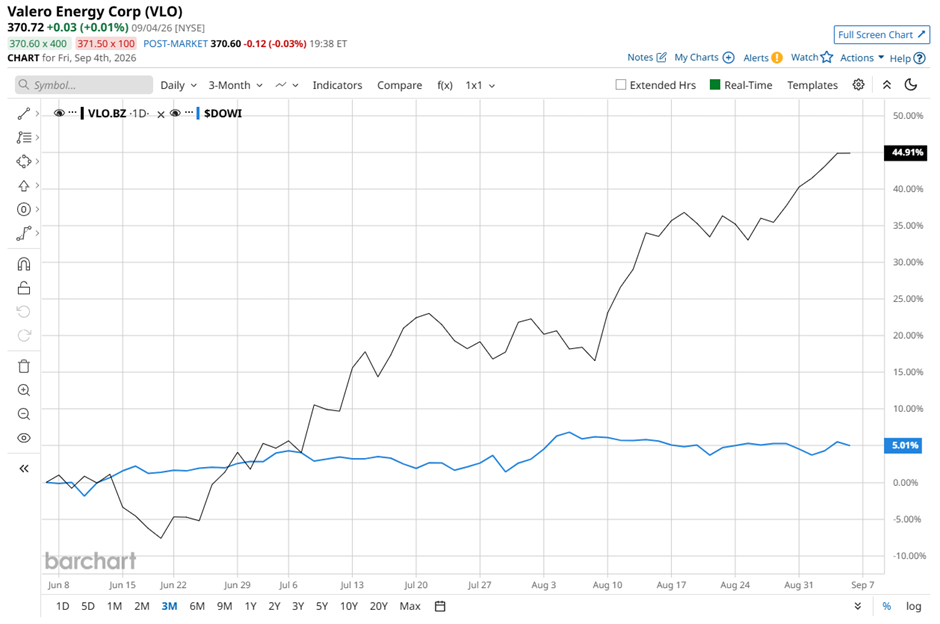
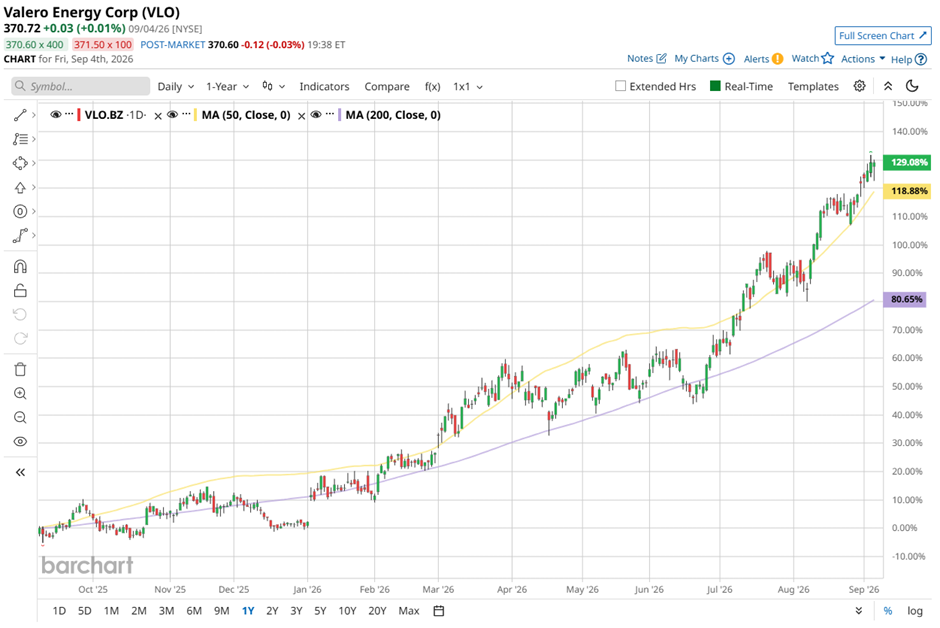
In the longer term, VLO stock has rallied 127.7% on a year-to-date (YTD) basis and gained 138.6% over the past 52 weeks, outpacing DOWI’s 11.1% returns in 2026 and 17.1% gains over the past year.
To confirm this bullish trend, VLO has been trading above the 200-day moving average since June, and above the 50-day moving average since August.
Valero Energy’s shares have been on quite a run, recently climbing to fresh all-time highs as investors pile into the refining giant. And there’s more behind the rally than just market enthusiasm. Valero has had a pretty powerful combination working in its favor – record diesel prices, a stellar second-quarter earnings report, upward earnings revisions, hefty share buybacks, and a global fuel market that has become exceptionally tight.
Q2 numbers certainly gave investors something to cheer about. On July 30, VLO shares jumped 3.5% after the company reported adjusted EPS of $12.54, comfortably ahead of Wall Street’s estimate. Revenue rose to $44.5 billion, beating expectations. The renewable diesel business bounced back strongly, while ethanol also gained ground. Looking ahead, management expects Q3 margins to improve, supported by better feedstock costs and product pricing, alongside disciplined spending and continued cash returns to shareholders.
But the bigger picture is even more interesting. Expanding refining crack spreads, supply disruptions, and strong gasoline and diesel demand have lifted refining margins. Valero has also benefited from relatively low-cost domestic crude, high refinery utilization, and limited unplanned outages.
Then there’s Valero’s Gulf Coast footprint, which puts it in a sweet spot to serve global fuel demand. With supply disruptions linked to Strait of Hormuz tensions and export restrictions from Russia and China, the global fuel market has had little room for error.
For now, that backdrop is translating into strong cash flow and a very happy stock chart. Still, investors may want to keep their feet on the ground – refining is cyclical, and after such a strong run, VLO’s valuation leaves less room for error.
Nevertheless, Valero Energy’s competitor, PBF Energy, Inc. (PBF), outperforms VLO. Shares of PBF Energy have surged 174.1% on a YTD basis and are up 163.2% over the past 52 weeks.
Wall Street remains cautiously bullish on VLO's prospects. The company has a consensus rating of “Moderate Buy” from the 21 analysts covering the stock. The stock is currently trading well above the mean target of $331.25, but the Street-high target price of $435 suggests 17.3% upside potential from current price levels.
On the date of publication, Sristi Jayaswal did not have (either directly or indirectly) positions in any of the securities mentioned in this article. All information and data in this article is solely for informational purposes. For more information please view the Barchart Disclosure Policy here.