
The wage increase in July was the highest since 1997+the GDP growth rate increased in the second quarter! The reasons for the Bank of Japan's interest rate hike this month have been strengthened
The Zhitong Finance App learned that Japan's wage increase was the highest since 1997, and that the growth rate of the Japanese economy improved in the second quarter, further strengthening the reason for the Bank of Japan to raise interest rates next week, which is now widely anticipated by the market.
According to data released by Japan's Ministry of Health, Labor, and Welfare on Tuesday, Japan's nominal wage rose 4.7% year on year in July, continuing to accelerate from the revised 4% year on year increase in June. This increase was the biggest since 1997, far exceeding economists' forecasts of 3.8%, and surpassed 3% for the sixth month in a row, setting the longest continuous growth record in 34 years.
Real wages, adjusted for inflation and excluding the impact of rents, rose 2.4%, the biggest increase in about five years; basic wages also rose 4.1%. A more stable indicator — wages for full-time employees after excluding bonuses, overtime pay, and sampling deviations — rose 2.7%.
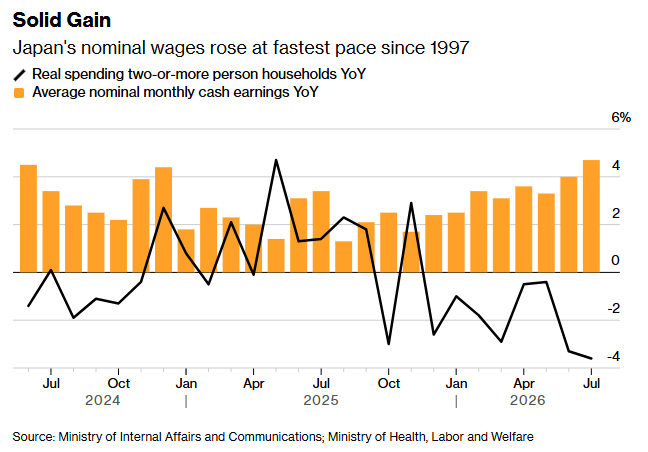
Japan's nominal wage increase is the fastest since 1997
Wage increases are partly due to another round of strong annual labor negotiations. Employees of companies affiliated with the Japan Federation of Trade Unions (Rengo) received a salary increase of more than 5% for the third year in a row. Furthermore, the national minimum wage this fiscal year was raised to an average of 1,177 yen (7.55 US dollars) per hour, the second-largest increase in history, indicating that wage growth is spreading to a wider range of workers and industries.
Continued labor shortages have further increased the pressure on companies to raise wages. According to a survey released by Imperial Data Bank last month, most companies say there is a shortage of full-time employees, with problems in the financial, construction, and logistics industries particularly prominent.
Healthy corporate profits help companies bear higher labor costs. In the three months ending June, Japanese companies' recurring profits grew for the seventh consecutive quarter, with manufacturers being the main driving force, thanks to booming demand related to artificial intelligence (AI) and data centers.
The latest data is generally consistent with the Bank of Japan's judgment on wage trends. In the latest economic outlook, the Bank of Japan expects nominal wages to continue to grow at a rate close to current levels as labor market conditions remain tense.
Meanwhile, a report released by Japan's Cabinet Office on Tuesday showed that Japan's gross domestic product (GDP) for the second quarter increased by 1.4% on an annualized basis over the previous quarter, higher than the initial value of 1.1% previously announced, but lower than the median estimate of 1.8% among economists. After incorporating new data for this period, fixed corporate investment boosted the GDP growth rate. Corporate fixed investment fell 0.9% from the previous quarter, while preliminary data showed a decrease of 1.2%.
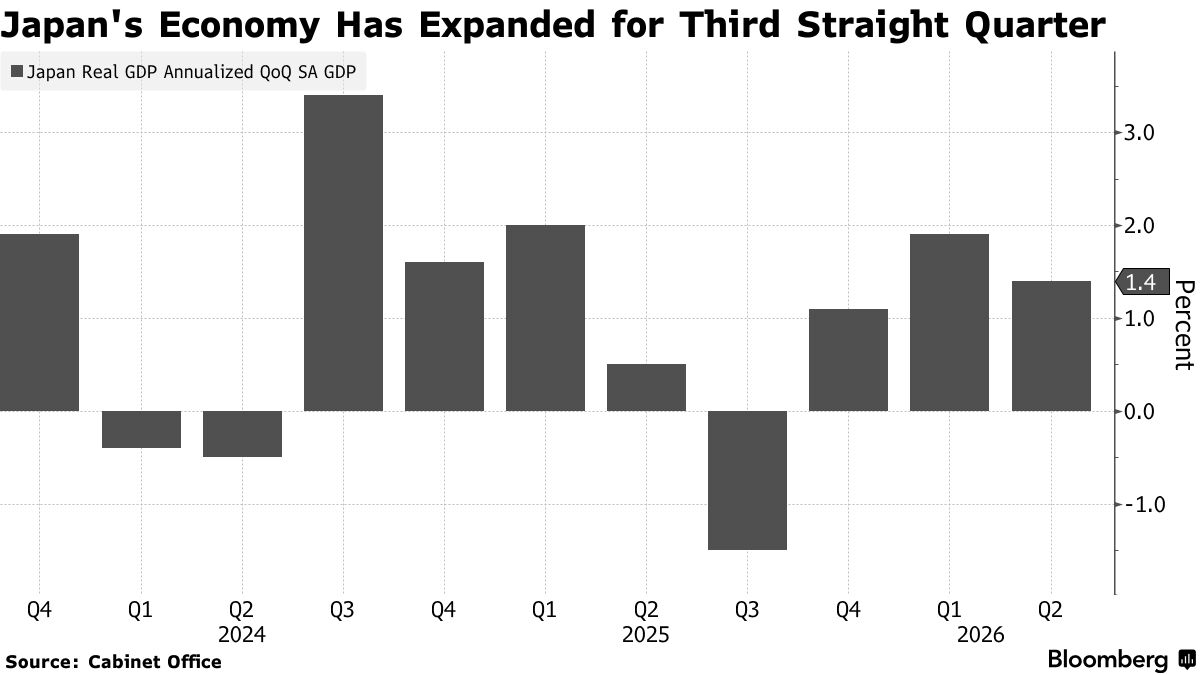
These two sets of better-than-expected data further support broad expectations that the Bank of Japan will raise interest rates next week. The market has basically absorbed the possibility that the Bank of Japan will raise interest rates at that time. Some investors expect that after this rate hike, the Bank of Japan may further tighten its policy in a relatively short interval.
Whether the Bank of Japan can maintain an austerity path depends in part on whether revenue growth translates into stronger domestic demand. However, at present, there are still doubts about this. Data released last week showed that Japanese household spending declined for the eighth consecutive month in July as consumers cut non-essential expenses. According to previously released GDP data for the second quarter, private consumption basically stagnated during the quarter.
Whether wage growth translates into more consumption depends in part on whether wage increases can outpace the rise in the cost of living. The continuing rise in the cost of living has made families cautious. Another report from Imperial Data Bank shows that prices for nearly 5,000 food and beverage products are scheduled to increase in September, three times that of a year ago. The agency said that factors driving price increases include rising crude oil and naphtha prices due to the Middle East conflict, as well as the weakening yen.
The Bank of Japan is likely to raise interest rates this month
In addition to the two latest sets of data released on Tuesday, a series of previously released data also supported the Bank of Japan's interest rate hike this month. Data released at the end of August showed that despite measures taken by the Japanese government to reduce energy costs, Tokyo's key inflation indicators accelerated for the third month in a row. Tokyo's consumer price index (CPI), which excludes fresh food, rose 1.8% year on year in August, slightly faster than the 1.7% increase in July, which is in line with the median expectations of economists in the survey. The Tokyo inflation data is generally regarded as an important leading indicator for measuring price trends across Japan. Excluding fresh food and energy, the core CPI rose 2% year over year, while the overall CPI rose 1.9% year over year. The main drivers of inflation include the cost of durable goods for education and entertainment, and medical expenses; rents have risen sharply, and restaurant costs have also risen.
Furthermore, Japan's consumer price index (CPI) excluding fresh food rose 1.8% year on year in July, up 1.8% year on year from 1.6% in January, and accelerated for the second month in a row; the core CPI excluding fresh food and energy rose 1.9% year on year, and the overall CPI also rose 1.9%; service prices, which are key indicators for measuring the sustainability of inflation, rose 1.2%, slightly accelerating compared to June.
According to people familiar with the matter, the Bank of Japan is inclined to raise the benchmark interest rate by 25 basis points this month to deal with the risk of price increases, while not ruling out the possibility of increasing the pace of interest rate increases thereafter. People familiar with the matter said they still believe that the risk of inflation is biased upward, and that rising service prices and the continued weakness of the yen reinforce the reasons for action.
People familiar with the matter revealed that at present, Bank of Japan officers' views on economic development are basically in line with expectations. One of the people familiar with the matter said that there have been no major changes in the current situation, so there is no need to take more drastic measures to raise interest rates, such as raising interest rates by 50 basis points, thus reducing the possibility of a drastic rate hike.
People familiar with the matter also revealed that the Bank of Japan is also aware that further interest rate hikes may be needed after September, and said it will adjust the pace of interest rate hikes flexibly according to economic development and the upward risk of inflation. This means that the Bank of Japan will not rule out the possibility of speeding up the pace of interest rate hikes if the situation requires it.
According to swap market data, the market has fully priced the Bank of Japan to raise interest rates by 25 basis points before September, and expectations of another rate hike before January next year are all reflected in the price. Bank of Japan Governor Kazuo Ueda has hinted that action is possible at this month's meeting; while Takada Hajime, one of the most hawkish members of the policy committee, did not rule out the possibility of a drastic or continuous rate hike.
It is worth mentioning that Nomura Securities recently pointed out that if pressure to depreciate the yen continues to increase, the Bank of Japan may raise interest rates three times in a row before December this year under extreme circumstances. Yujiro Goto, head of foreign exchange strategy at Nomura, said in an interview that this month's interest rate hike of 25 basis points “seems reasonable,” and “if the weak yen continues to spread to the 160 mark, the possibility of continuous interest rate hikes in October and December is not ruled out.”
Raising interest rates three times in a row is still an unusually aggressive pace of austerity for a central bank that has been fighting deflation and keeping borrowing costs close to zero for the past 30 years. Yujiro Goto's basic expectations are relatively mild. He believes that it is reasonable and necessary for the Bank of Japan to raise interest rates at least once every quarter in the future, and maintains the current target judgment on the USD/JPY exchange rate of 154.
Yujiro Goto also pointed out that the Japanese government's stance on monetary policy may become a key variable in whether the yen can continue to strengthen. Investors are paying close attention to Prime Minister Takaichi Sanae's remarks — she had reservations about interest rate hikes before, and the market wants to know if she supports the central bank's further policy tightening.