
How to Play Tesla Stock After Its Exclusive Cybercab Launch Event
Tesla (TSLA), the electric-vehicle (EV) and artificial-intelligence (AI) company, remains a bellwether for autonomous mobility, and its exclusive Cybercab launch in Austin marks a significant step beyond EV manufacturing toward scalable robotaxi networks.
Held Thursday, Sept. 3, at ACL Live in downtown Austin, the event was strictly invite-only and, despite weeks of teasers from Elon Musk and Tesla executives, was not livestreamed. Moreover, attendees, largely pro-Tesla influencers, were barred from posting until after the presentation began.
The two-seat Cybercab, designed without a steering wheel or pedals, was formally added to Tesla’s Robotaxi app, allowing riders in limited Austin areas to select it alongside five-seat Model Ys. Public Cybercab rides began Friday, Sept. 4, with the initial deployment limited to six cities across Texas and Florida.
The launch has also drawn regulatory scrutiny, with the National Highway Traffic Safety Administration (NHTSA) confirming that it is evaluating the deployment, as Tesla has not sought a regulatory exemption for the steering-wheel-free design.
Investors, meanwhile, responded positively to the debut. Tesla’s shares rose 5.4% on Sept. 3, as the Cybercab rollout strengthened the case for the company’s shift toward recurring, software-driven revenue.
However, the stock's gains eroded the next day. And actual financial impact from the endeavor is unlikely to manifest anytime soon. For investors comfortable with volatility, current levels could offer a reasonably staggered entry point, with modest position sizing and a willingness to ride out near-term noise.
About Tesla Stock
Tesla has evolved into far more than an electric car manufacturer. Headquartered in Austin, Texas, the company operates across several parts of the clean energy and technology landscape, spanning EVs, energy-storage systems, solar products, charging networks, and AI.
With a market value of approximately $1.4 trillion, much of Tesla’s appeal rests on its potential to expand these businesses well beyond its traditional automotive base. That potential, however, has come with considerable stock volatility.
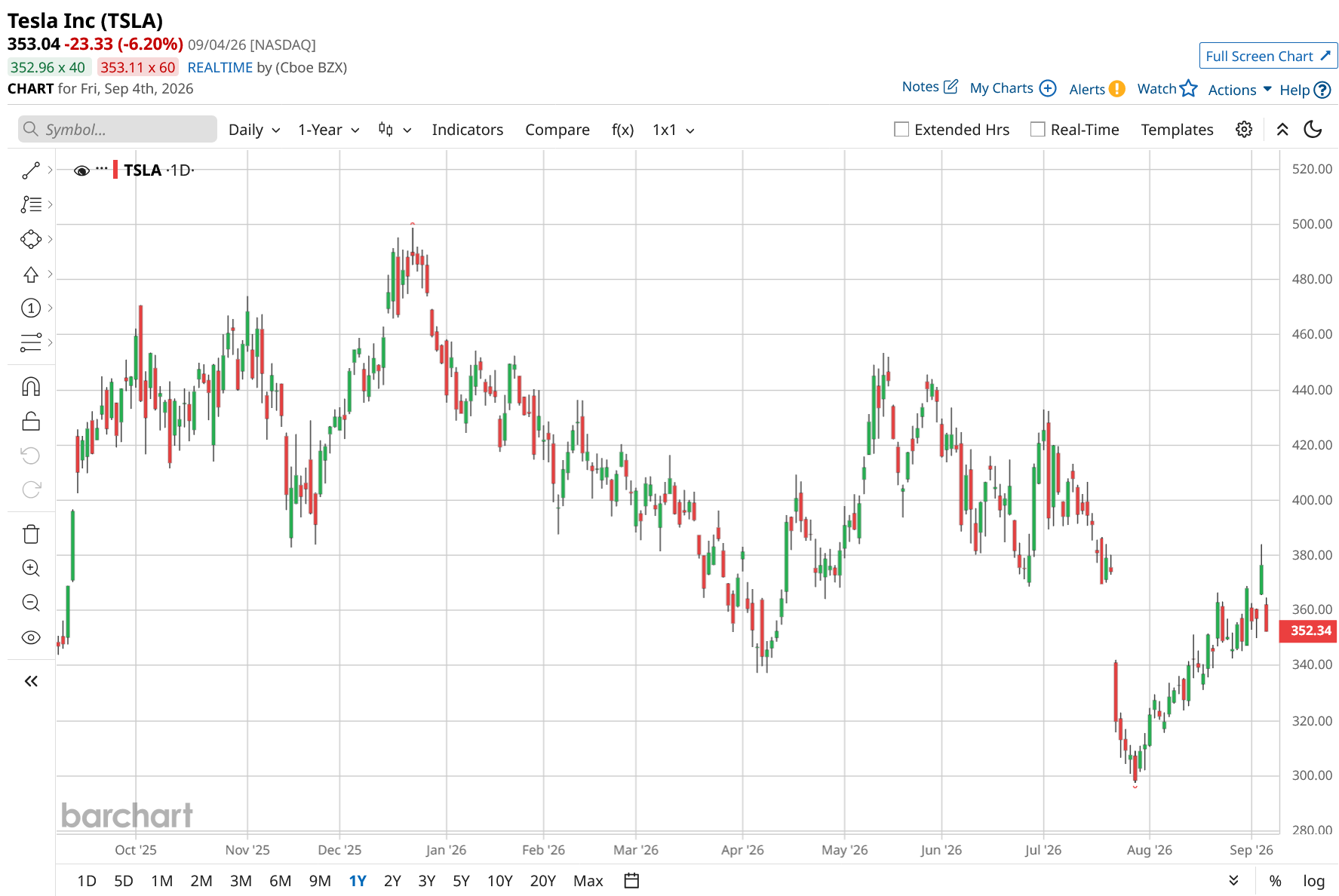
Investors have been weighing softer growth prospects, intensifying competition, pressure on profitability, and Tesla’s substantial investment in AI and autonomous-driving technology. As a result, performance has been mixed. Shares have risen 5% over the past year but remain down 21% in 2026.
The recent trend has been somewhat stronger, with the stock advancing 8% over the past month as expectations around robotaxis, Cybercab, vehicle deliveries, and the electric Semi have improved sentiment.
Tesla’s valuation remains the bigger consideration. At 201.83 times forward adjusted earnings and 14.87 times sales, the stock commands a substantial premium to both industry peers and its own five-year averages, reflecting a rich premium.
A Closer Look at Q2 Earnings
Tesla’s Q2 FY2026 results, released July 22, showed a business still growing at a healthy pace but also one spending heavily to build what it believes comes next. Revenue rose 25.5% year-over-year (YoY) to $28.24 billion, comfortably beating the $25.71 billion analyst estimate.
The automotive business remained the backbone, bringing in $20.52 billion, up 23.1% from a year earlier. Energy revenue increased 12.5% YoY to $3.14 billion, while Services and Other was the standout, surging 50.4% from the last year’s quarter to $4.58 billion.
The pressure came from costs, which rose faster than sales as Tesla stepped up spending on AI, R&D, and other technology initiatives. Operating expenses jumped 47.3% to $4.35 billion, sending the operating margin down to 1.4% from 4.1% a year ago.
Profitability took another hit. Following aggressive price cuts and heavy capital spending across the business, adjusted net income declined 17.1% from the previous year’s period to $1.16 billion, while adjusted EPS fell 17.5% YoY to $0.33, well below the Street’s $0.51 forecast.
Free cash flow swung to a $1.1 billion deficit from $146 million a year ago, while capital expenditures soared 141.8% to $5.79 billion. With 2026 capex expected to exceed $25 billion, Tesla is continuing to spend heavily on Cybercab, Optimus, autonomous driving, and proprietary chip development, even as management warns of negative free cash flow.
That makes the near-term picture difficult, but the longer-term case rests on what these investments can deliver through 2027. Wall Street expects Q3 EPS to fall 29.7% YoY to $0.26 and full-year FY2026 EPS to decline 19.3% to $0.88. For FY2027, however, EPS is projected to rebound 56.8% to $1.38.
What Do Analysts Expect for TSLA Stock?
Tesla is making a determined push to evolve from a traditional automaker into a broader AI, robotics, and autonomous mobility platform.
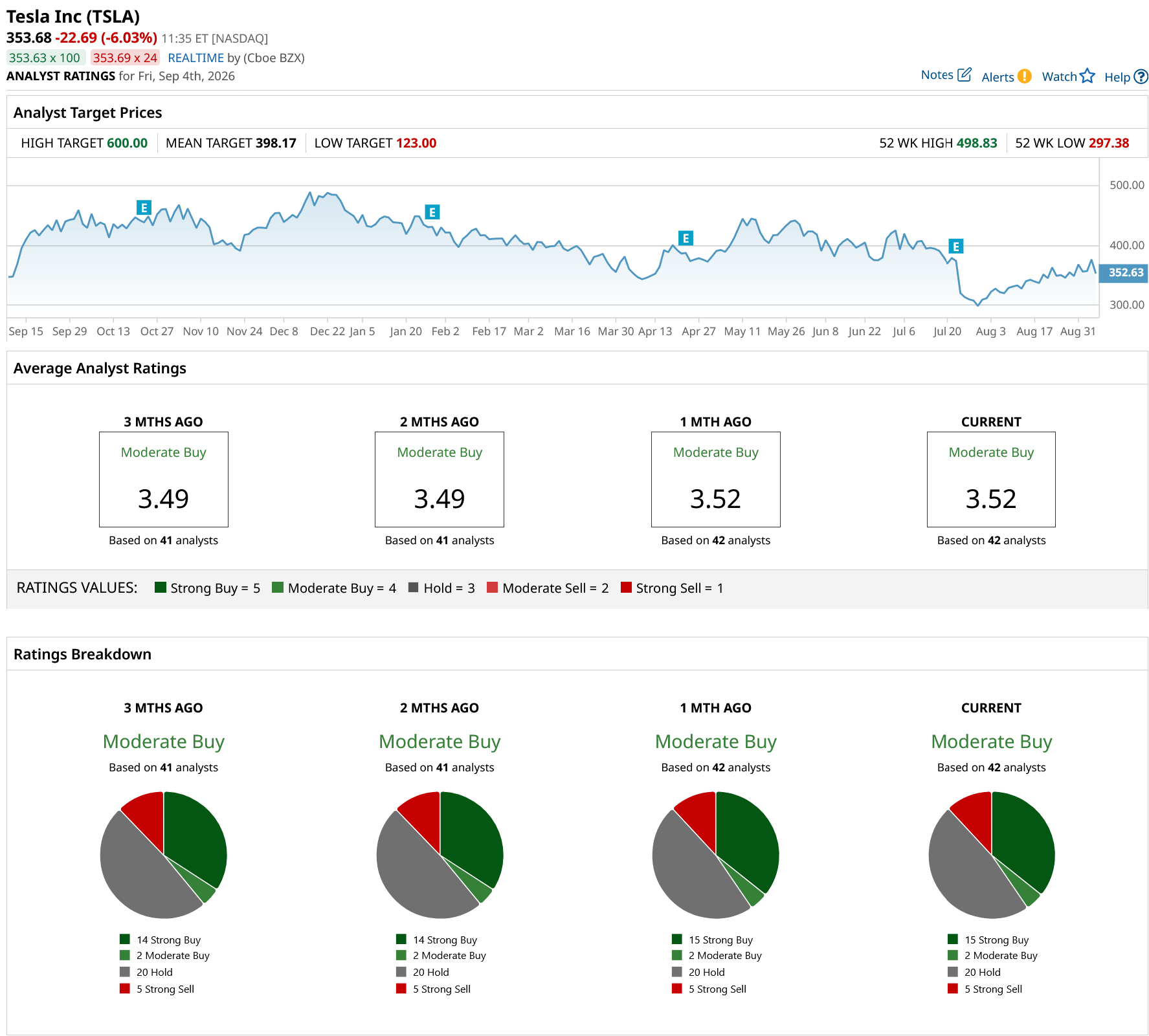
Despite execution challenges and several near-term headwinds, Wall Street remains broadly constructive on the stock, which carries an overall “Moderate Buy” consensus rating. Of the 42 analysts covering TSLA stock, 15 rate it a “Strong Buy,” two recommend a “Moderate Buy,” 20 maintain a “Hold” rating, and five issue a “Strong Sell” call.
Price targets have strengthened alongside the broader outlook. The average price target is $398.17, implying an upside of 12% from current levels. Meanwhile, the Street-High target of $600 points to a potential gain of 69%.
On the date of publication, Aanchal Sugandh did not have (either directly or indirectly) positions in any of the securities mentioned in this article. All information and data in this article is solely for informational purposes. For more information please view the Barchart Disclosure Policy here.