
Why Is Newborn Town (SEHK:9911) Back On Investor Radar?
Why Newborn Town stock is back on investor radar
Newborn Town (SEHK:9911) has drawn fresh attention after reporting half year sales of US$606.86 million and net income of US$99.33 million, compared with US$442.85 million and US$68.11 million a year earlier.
The recent half year earnings update and board reshuffle, including the appointment of Mr. Song Pengliang as an executive director, have arrived alongside a 10.83% 90 day share price return from Newborn Town and a 3 year total shareholder return of 369.17%. However, the share price is still down 23.72% year to date and the 1 year total shareholder return is down 25.47%, suggesting long term investors have seen large gains even as shorter term momentum has been rebuilding.
Scan beyond Newborn Town's rebound and review hand picked 616 high quality undiscovered gems that also pair growing revenue with expanding earnings.
After Newborn Town's sharp three year run and recent share price recovery, the question is simple: does it make sense to buy after this rebound or wait for a cheaper entry based on what the valuation shows next?
Price-to-Earnings of 9.6x: Is it justified?
On traditional metrics, Newborn Town looks inexpensive compared with many peers. The stock trades on a P/E of 9.6x, while the Asian Interactive Media and Services industry average is 21.2x and the peer group average is 17.1x. That gap suggests the market is pricing Newborn Town more conservatively than both its immediate competitors and the broader industry despite the recent share price rebound.
The P/E ratio compares what investors are paying today for each unit of current earnings. For a social networking entertainment company like Newborn Town with multiple platforms and revenue streams, this is a common yardstick because earnings capture both scale and profitability in a single figure. A lower P/E can indicate that investors are cautious about the durability of current earnings, or that they have yet to re-rate the stock after strong profit growth.
Here, the context matters. Newborn Town is trading at a P/E of 9.6x compared with an estimated fair P/E of 11.5x. That implies the current multiple sits below a level our fair ratio work suggests the market could shift toward if earnings forecasts and business quality indicators hold. When compared with the 21.2x industry average and 17.1x peer average, the discount is even more clear. This points to the possibility that the market is assigning a lower earnings multiple than both sector norms and the fair ratio estimate.
Explore the SWS fair ratio for Newborn Town.
Result: Price-to-Earnings of 9.6x (UNDERVALUED).
However, Newborn Town still carries risk if revenue growth of 11.7% or net income growth of 15.4% slows, or if social networking platforms lose user engagement.
Find out about the key risks to this Newborn Town narrative.
Another view on Newborn Town’s value
The P/E work suggests Newborn Town looks inexpensive, but our DCF model presents a different perspective. At around HK$9.06, the stock trades well below an estimated future cash flow value of HK$30.58. That gap implies a very wide margin. Is the market mispricing the cash flows, or are the assumptions too generous?
For investors who want to see how this cash flow based view is built step by step, Look into how the SWS DCF model arrives at its fair value.
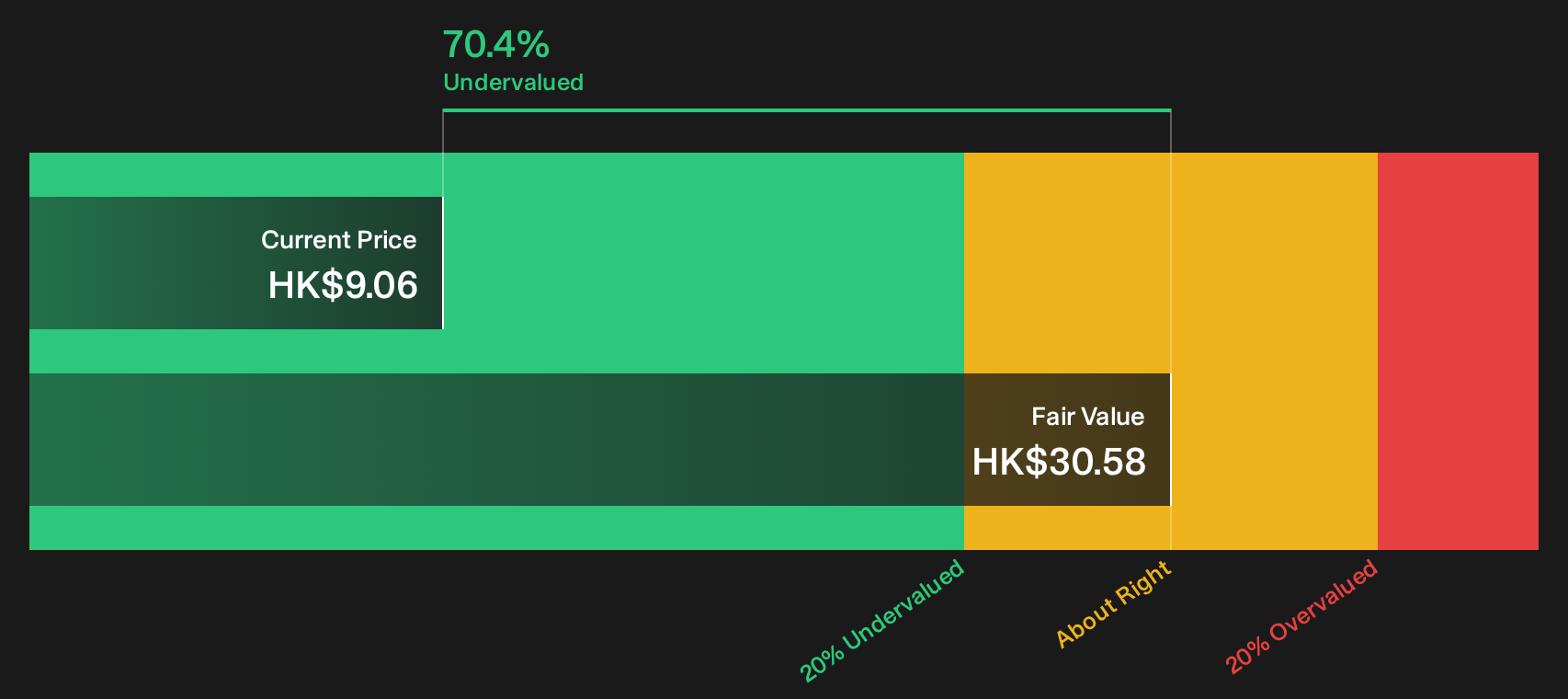
Simply Wall St performs a discounted cash flow (DCF) on every stock in the world every day (check out Newborn Town for example). We show the entire calculation in full. You can track the result in your watchlist or portfolio and be alerted when this changes, or use our stock screener to discover 254 high quality undervalued stocks. If you save a screener we even alert you when new companies match - so you never miss a potential opportunity.
Next Steps
The mix of upbeat and cautious signals around Newborn Town is clear, so move quickly, review the data, and weigh both sides using 5 key rewards and 1 important warning sign.
Looking for more investment ideas beyond Newborn Town?
If you are reassessing Newborn Town, this is also the moment to widen your watchlist and uncover other stocks that fit your risk and return preferences.
- Target higher income potential by reviewing companies in the 423 dividend fortresses that may suit a steadier cash flow focus.
- Strengthen your downside protection by scanning the 308 resilient stocks with low risk scores that score well on resilience and business quality.
- Get ahead of the crowd by checking the 215 elite penny stocks with strong financials that combine smaller market sizes with more speculative upside.
This article by Simply Wall St is general in nature. We provide commentary based on historical data and analyst forecasts only using an unbiased methodology and our articles are not intended to be financial advice. It does not constitute a recommendation to buy or sell any stock, and does not take account of your objectives, or your financial situation. We aim to bring you long-term focused analysis driven by fundamental data. Note that our analysis may not factor in the latest price-sensitive company announcements or qualitative material. Simply Wall St has no position in any stocks mentioned.
Have feedback on this article? Concerned about the content? Get in touch with us directly. Alternatively, email editorial-team@simplywallst.com