
Amazon Layoffs Continue: How to Play AMZN Stock Now in September 2026
The artificial intelligence (AI) boom has been a gold mine for tech giants, with companies pouring billions of dollars into the technology to fuel their next wave of growth. For many employees, however, the picture has been far less upbeat. Amazon (AMZN) is the latest example. The e-commerce giant is once again trimming its workforce in Washington state, with a new filing showing 121 jobs being permanently cut across its corporate technology teams and fulfillment operations. But the latest reductions are hardly an isolated event. They are part of a much bigger workforce shake-up at Amazon.
Amazon has already gone through several rounds of layoffs. Last year, the company announced nearly 14,000 corporate layoffs, representing roughly 4% of its corporate workforce at the time. In January 2026, the company eliminated roughly 16,000 corporate positions worldwide, marking its second major layoff round in a matter of months. In July, Amazon also eliminated an unspecified number of artificial general intelligence (AGI) positions.
The layoffs are unfolding alongside a massive push in the opposite direction. Amazon is spending heavily to build its AI future. The company is investing in AI infrastructure, foundation models, and cloud-based AI services, while executives have said generative AI could automate portions of white-collar work over time. That could reduce the need for some corporate roles even as Amazon creates new positions focused on AI, a fundamental shift in how its workforce is structured.
For investors, the layoffs are about more than just a shrinking headcount. The real test is whether Amazon can turn a leaner workforce and heavier AI investment into better productivity, stronger margins, and faster growth. With another round of cuts now underway, here’s a closer look at what the latest developments mean for AMZN stock.
About Amazon Stock
Based in Seattle, Washington, Amazon may have started out by reshaping the way people shop online, but its transformation into a broad-based technology powerhouse has been remarkable. What began as an e-commerce disruptor has grown into a sprawling business spanning cloud computing, AI, data centers, and digital media, putting Amazon at the center of how consumers shop, businesses operate, and people consume content. Amazon's growing presence in entertainment has added yet another dimension to the company’s reach.
Through Prime Video, Amazon Music, gaming, and Twitch, Amazon has carved out a meaningful position in the global streaming and digital content ecosystem. At the same time, Amazon Web Services (AWS) remains a critical pillar of the business, sitting at the heart of the cloud and AI boom by providing infrastructure that powers startups, enterprises, and large-scale organizations around the world. Now, Amazon is pushing even deeper into AI, ramping up investments as it looks to strengthen its position in the next wave of technological transformation.
But Amazon’s AI ambitions come with growing concerns for investors. While its push into AI through the AWS segment has been impressive, heavy capital spending on AI and mounting regulatory pressure have weighed on sentiment.
Earlier this week, the Federal Trade Commission (FTC) and 22 states filed a lawsuit alleging that Amazon’s advertising practices have overcharged its roughly 1.2 million advertising customers. FTC Chairman Andrew Ferguson said the alleged practices could have a “staggering” impact given Amazon’s size, while Amazon rejected the allegations, arguing that the FTC has relied on oversimplified communications to portray its actions as a company-wide effort to deceive and calling that characterization false. Whatever the outcome, the lawsuit has added another layer of uncertainty around Amazon’s highly lucrative advertising business, raising fears that a key profit center could become less profitable in the future.
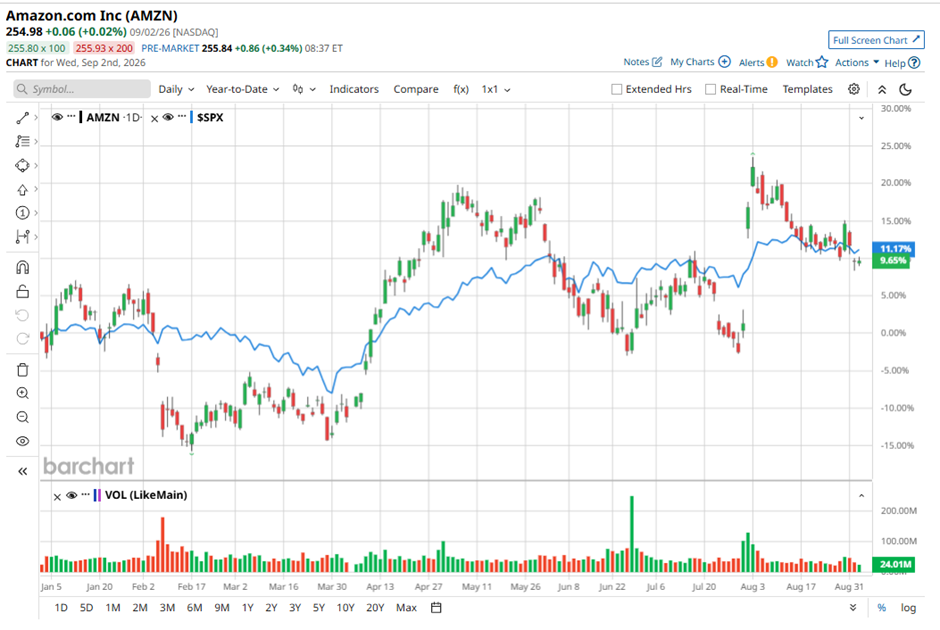
Against this backdrop, investors have been selling Amazon shares. With a market capitalization of about $2.79 trillion, AMZN stock has slipped almost 7% over the past month and is down about 10% from its record high of $287.20. Amazon stock is up roughly 12% year-to-date ((YTD) but has slightly lagged the S&P 500 Index ($SPX), which has gained about 13% so far this year.
Inside Amazon’s Q2 Earnings Report
Amazon dropped the curtain on its second-quarter earnings on Jul. 30, and the results left little room for disappointment. The e-commerce and cloud giant blasted past Wall Street’s top- and bottom-line estimates, sending shares soaring more than 15% in the following trading session. Net sales jumped 20% year-over-year (YOY) to $200.6 billion, comfortably ahead of Wall Street's $196.8 billion forecast.
Digging deeper, Amazon delivered solid growth across all of its major segments, but AWS was the clear standout. AWS revenue surged 37% YOY to $42.2 billion in Q2, marking its fastest growth in 18 quarters and putting the cloud business at a $169 billion annualized revenue run rate (ARR). Amazon also revealed that its AI business and custom chips business, anchored by Trainium and Graviton, each surpassed $25 billion in ARR. Meanwhile, North America sales climbed 16% YOY to $116.2 billion, while International sales increased 15% YOY to $42.2 billion.
Amazon’s consumer and advertising businesses also kept the momentum going. In Stores, the company set record delivery speeds for Prime members during the first half of the year, with “over 40% more items delivered same-day or overnight,” according to CEO Andy Jassy. Grocery and Everyday Essentials grew “meaningfully faster than the rest of the business,” while advertising revenue jumped 26% YOY. On the profitability front, operating income rose to $27.5 billion, compared with $19.2 billion in Q2 2025.
Net income soared to $62.6 billion, or $5.75 per diluted share, versus $18.2 billion a year earlier, or $1.68 per diluted share. The bottom line also crushed Wall Street’s $1.83 estimate. However, Q2 2026 net income included $53.4 billion of non-operating pre-tax other income, primarily from Amazon’s investments in Anthropic. Amazon is showing no signs of easing its AI ambitions. CEO Andy Jassy said on the Q2 earnings call that the company expects capital expenditures to reach $220 billion this year, underscoring the scale of its AI spending.
Looking ahead, Amazon expects Q3 2026 net sales of $197 billion to $202 billion, representing YOY growth of 9% to 12%. Excluding the impact of Prime Day in both 2025 and 2026, Q3 2026 YOY growth would be almost 400 basis points higher. Finally, operating income is expected to land between $22.5 billion and $26.5 billion, up from $17.4 billion in Q3 2025.
What Do Analysts Think About Amazon Stock?
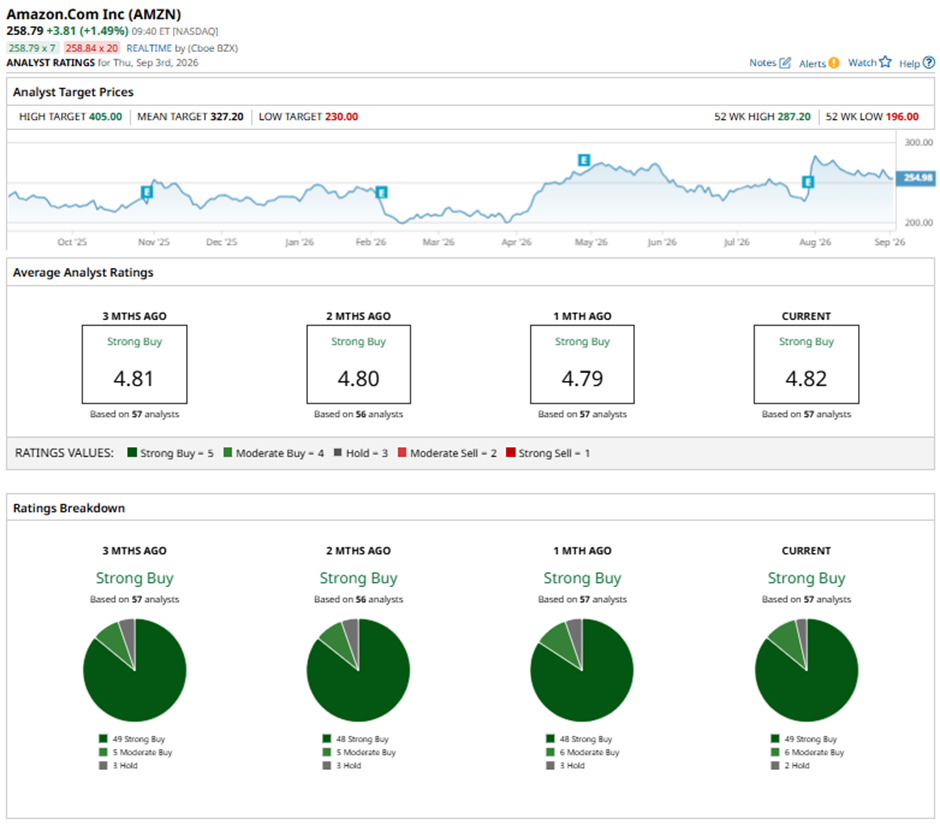
Despite the near-term pressure on shares, Wall Street isn’t giving up on Amazon. AMZN stock carries a consensus “Strong Buy” rating based on 57 analysts with coverage. Of those analysts, 49 recommend a “Strong Buy" rating, six have a “Moderate Buy,” and two have a “Hold" rating.
The bullish outlook is reflected in the price targets, too. The average target of $327.38 points to potential upside of roughly 27% from current levels, while the Street-high target of $405 suggests that Amazon could rally as much as 57% from here.
On the date of publication, Anushka Mukherji did not have (either directly or indirectly) positions in any of the securities mentioned in this article. All information and data in this article is solely for informational purposes. For more information please view the Barchart Disclosure Policy here.