
Is Harbin Electric (SEHK:1133) Cheap Following Strong Half Year Results?
Harbin Electric (SEHK:1133) has come into focus after releasing half-year results to June 30, 2026, with sales of CNY 24,799.16 million and net income of CNY 1,717.9 million.
The latest half year results arrive as Harbin Electric’s share price has eased, with a 1 month share price return of down 6.5% and a year to date share price return of down 5.9%. However, the 1 year total shareholder return is 89.3% and the 3 year total shareholder return is very large at more than 6x, which suggests long term holders have already seen substantial gains while shorter term momentum has cooled.
Scan the power and infrastructure space beyond Harbin Electric by reviewing our hand picked 39 power grid technology and infrastructure stocks for companies connected to long term grid and energy system upgrades.
The half year figures show Harbin Electric growing from a smaller base while the share price has cooled in recent months. Is it better to wait for a deeper pullback, or to start valuing what you get at today’s price?
Preferred P/E of 9.5x: Is it justified for Harbin Electric?
On the latest numbers, Harbin Electric trades on a P/E of 9.5x, which screens as inexpensive against both the Hong Kong market and its electrical equipment peers.
The P/E multiple compares the current HK$16.58 share price with the company’s earnings per share. For a manufacturer of power plant equipment and related services, this is a straightforward way to see how much investors are paying for each unit of earnings, especially when earnings have recently moved back into solidly positive territory.
Here, the 9.5x P/E sits below the Hong Kong market average of 11.3x, and well below the Asian Electrical industry average of 28.6x and the peer average of 22.9x. It is also below an estimated “fair” P/E of 12.5x, which is a level the P/E could move toward if the market placed Harbin Electric in line with that regression based reference.
Put simply, the market is currently valuing Harbin Electric’s earnings at a discount to both sector and peer benchmarks, while its earnings growth and profit quality checks are positive. That combination suggests investors are paying less per unit of earnings than they do for many comparable stocks, based on the data provided.
Explore the SWS fair ratio for Harbin Electric.
Result: Price-to-earnings of 9.5x (UNDERVALUED)
However, Harbin Electric still faces risks, such as volatility in large power equipment orders and potential policy or project delays affecting grid and clean energy spending.
Find out about the key risks to this Harbin Electric narrative.
Another view on Harbin Electric using our DCF model
There is a different message when looking at Harbin Electric through the SWS DCF model. On this view, the fair value is HK$11.29 per share while the market price is HK$16.58. That points to the stock trading above estimated future cash flows, which raises the question of how much optimism is already priced in.
Before placing too much weight on any single model, it is worth understanding how the cash flow assumptions work in practice. Look into how the SWS DCF model arrives at its fair value.
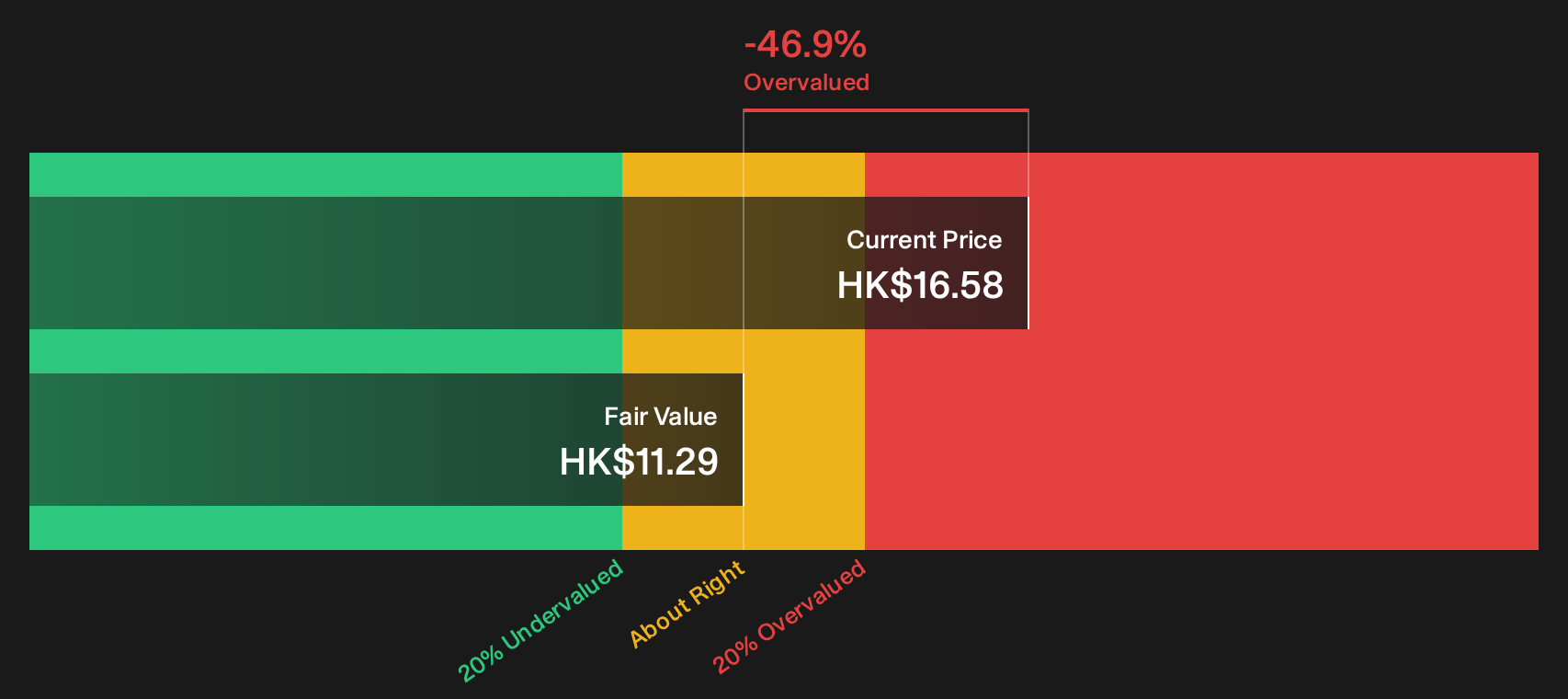
Simply Wall St performs a discounted cash flow (DCF) on every stock in the world every day (check out Harbin Electric for example). We show the entire calculation in full. You can track the result in your watchlist or portfolio and be alerted when this changes, or use our stock screener to discover 258 high quality undervalued stocks. If you save a screener we even alert you when new companies match - so you never miss a potential opportunity.
Next Steps
With mixed signals from Harbin Electric’s valuation and cash flow models, sentiment may feel finely balanced. Move quickly to test the data and shape your own view. To see what is driving optimism in the stock, review the 4 key rewards.
Looking for more investment ideas beyond Harbin Electric?
If you like what you see with Harbin Electric but do not want to rely on a single stock, consider using screeners to widen your opportunity set quickly.
- Target potential mispricing by reviewing the 258 high quality undervalued stocks that match your quality and valuation standards.
- Strengthen your income stream by scanning the 420 dividend fortresses that offer higher yields with supporting fundamentals.
- Protect your capital by focusing on the 308 resilient stocks with low risk scores that combine resilience scores with balanced financial profiles.
This article by Simply Wall St is general in nature. We provide commentary based on historical data and analyst forecasts only using an unbiased methodology and our articles are not intended to be financial advice. It does not constitute a recommendation to buy or sell any stock, and does not take account of your objectives, or your financial situation. We aim to bring you long-term focused analysis driven by fundamental data. Note that our analysis may not factor in the latest price-sensitive company announcements or qualitative material. Simply Wall St has no position in any stocks mentioned.
Have feedback on this article? Concerned about the content? Get in touch with us directly. Alternatively, email editorial-team@simplywallst.com