
The rise of the US dollar is unstable, expectations of interest rate hikes by the European and Japanese central banks are heating up, and traders are waiting for CPI data
The Zhitong Finance App learned that on Monday, although the market's expectations for the Fed's interest rate hike have risen, the trend of the US dollar is still unstable as tension in the Middle East intensifies broader inflationary pressure and may force global central banks to simultaneously tighten monetary policies. A shift in sentiment about the yen and concerns about growing US debt and policy uncertainty are also putting pressure on the dollar.
Due to the closure of the US market due to the Monday holiday, the foreign exchange market fluctuated relatively moderately in early Asian trading, making it difficult for the US dollar to maintain the brief upward trend brought about by the strong US non-farm payrolls report last Friday. As of press time, the euro had risen slightly to $1.1618, while the pound remained essentially flat at $1.3519. The dollar fell 0.07% to 99.09 against a basket of currencies, not far from a recent low of 98.558.
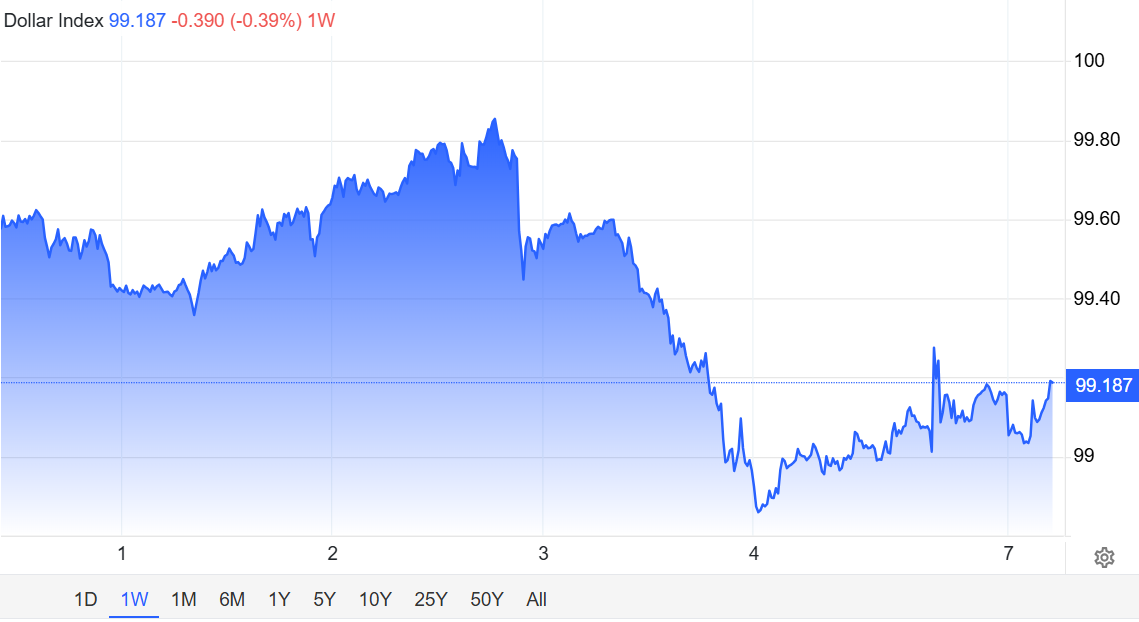
Traders expect the possibility that the Federal Reserve will raise interest rates in September after the release of non-farm payrolls data is about 60%, and now much depends on Friday's inflation data.
“If the CPI data is strong, it is almost certain that interest rates will rise in September and support the strengthening of the dollar. If the data is weak, it will reinforce the reasons for keeping interest rates unchanged and make the dollar vulnerable to the repricing of the Federal Reserve's dovish policy,” said Elias Haddad, head of global market strategy at BBH.
Haddad said, “Even though the Fed's interest rate hike in September is a foregone conclusion, we still doubt that the dollar can reach a new cyclical high. The austerity policies of other major central banks have limited policy differences.”
Inflationary pressure brought about by continued high oil prices is the main reason why the ECB will almost certainly raise interest rates to 2.75% on Thursday. The futures market also suggests that the probability of raising interest rates to 3.0% again by December is as high as 75%. Similarly, the market expects a 75% chance that the Bank of Japan will raise interest rates by 25 basis points at the September 18 meeting, and a 60% chance of raising interest rates again before December.
On Monday, the yen rose more than 0.2% against the US dollar to 155.88. Earlier, Japanese Prime Minister Takaichi Sanae's economic adviser predicted that the Bank of Japan would raise interest rates this month, and the yen continued to rise. Last week, the yen rose more than 2%, boosted by various factors such as the liquidation of arbitrage trades and expectations of capital return.
Eric Robertsen, head of global research and chief strategist at Standard Chartered Bank, said that despite the sharp rise in global borrowing costs, arbitrage trading has been one of the areas with the strongest macroeconomic performance so far this year, but the recent strength of the yen “may pose a threat to excess profits from arbitrage trading.” “If the yen continues to strengthen, this may indicate that rising interest rates in yen and dollar are beginning to trigger changes in asset allocation,” he said.
In terms of other currencies, the Australian dollar rose 0.12% to $0.7208, while the New Zealand dollar remained flat at $0.5880.
Bitcoin stabilized above $80,000, the latest report was $80,145.95. Recently, Bitcoin was supported by investors diversifying capital from the US dollar to other assets.