
Dell Stock Exploded Over 300% — Its 150% EPS Growth Could Send It Even Higher
Dell (DELL) is among the top-performing S&P 500 ($SPX) stocks over the past year, with its shares rising 310%. The massive rally reflects AI-related tailwinds and rising enterprise IT spending, both of which are supporting stronger demand for Dell’s products and translating into robust revenue and earnings growth.
Despite the stock’s dramatic ascent, Dell has further room to run. Management’s latest forecast calls for adjusted earnings per share (EPS) to rise by 150% in fiscal 2027. With exceptionally strong demand, Dell could surpass its internal guidance, suggesting the stock has additional upside despite its enormous run-up.
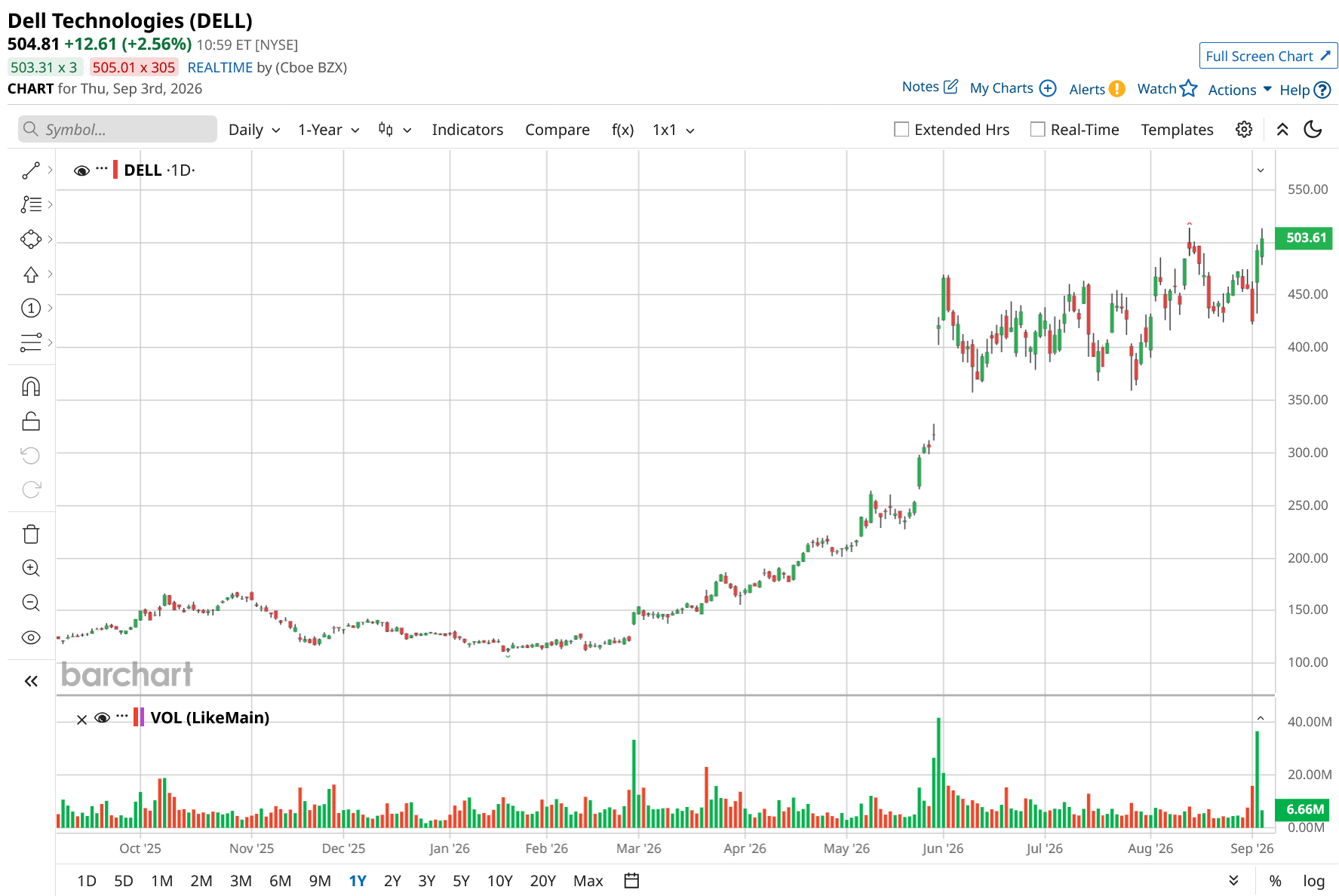
Dell’s AI Business Is Getting Bigger—Fast
Dell entered the second half of fiscal 2027 with strong momentum after posting record results during the first six months of the year. Strong demand across its infrastructure and client businesses has prompted management to significantly raise its full-year expectations.
Dell’s latest quarterly results reflect growing demand and improving operating leverage. Its top line increased 58% to $47 billion in Q2, while adjusted gross margin expanded by 240 basis points to 21.1%. Adjusted EPS jumped 203% to $7.04.
The Infrastructure Solutions Group (ISG) continued to grow at a solid pace. Revenue in the segment climbed 89% to a record $31.8 billion, producing $4.8 billion in operating income. During the second quarter, Dell booked a record $60.9 billion in AI-related orders and recognized $16.4 billion in AI server revenue.
It ended the quarter with an AI backlog of approximately $95 billion. Its pipeline continued to expand sequentially and remains several times larger than its existing backlog. Notably, over the past 12 months, Dell has converted $131.7 billion of demand into orders.
The customer base is also becoming increasingly diversified. Demand is coming from neocloud providers, sovereign customers, and large enterprises, while the number of customers using Dell’s AI infrastructure has surpassed 6,500.
Demand for Traditional Servers, as Well as Storage Are Booming, Too
Traditional server demand has also accelerated sharply, with revenue in the category increasing 122%. A significant portion of this growth is coming from existing customers upgrading and modernizing their data centers. Businesses are increasingly investing in infrastructure to support conventional workloads while also addressing higher security, resiliency, and performance requirements.
At the same time, AI and agentic workloads are creating additional demand for conventional CPU-based computing.
Dell’s storage business returned to growth and gained market share. Storage revenue increased 26%, supported by strong demand. Moreover, profitability improved. The business is seeing incremental demand from AI workloads, which is likely to accelerate storage revenue growth.
Dell Raises Its Fiscal 2027 Forecast
After a solid first-half performance, Dell’s management revised its full-year outlook upward, which should support the rally in its share price.
Management expects third-quarter revenue of $49 billion, up 80% year-over-year (YoY). ISG is expected to grow roughly 145%, with AI server revenue projected at approximately $19 billion.
For the full fiscal year, Dell raised its revenue forecast by $25 billion to $192 billion at the midpoint, implying growth of approximately 70%. The company now expects adjusted EPS of $25.50, compared with its previous forecast of $17.90. That represents expected YoY EPS growth of 150%.
Management is forecasting ISG revenue growth of roughly 120%, driven primarily by AI servers. AI server revenue is expected to triple YoY to approximately $74 billion. Traditional server revenue is projected to increase by more than 100%, while storage is expected to grow in the mid-teens. CSG revenue, meanwhile, is expected to increase in the mid-teens.
Taken together, the guidance points to strong growth across its business lines, supporting its share price.
DELL Stock Is Still Reasonably Valued
After a gain of more than 300%, DELL stock is still reasonably valued. Trading at about 24.9 times forward earnings, the valuation does not appear to be stretched relative to the company’s projected earnings expansion.
The 150% EPS growth forecast is a key factor supporting the current valuation. Further, analysts expect Dell’s earnings to continue growing at a double-digit pace in fiscal 2028, even though comparisons will become considerably more difficult after the exceptional growth expected in fiscal 2027.
The Final Takeaway
DELL’s massive rally has already reflected much of its AI-driven transformation, but the company’s latest results suggest the growth cycle may still have significant momentum. The $95 billion AI backlog, accelerating server demand, expanding storage opportunities, and stronger enterprise spending will push Dell’s revenue and earnings higher.
With adjusted EPS now projected to grow approximately 150%, Dell’s current valuation does not look stretched relative to its earnings potential, indicating room for further upside.
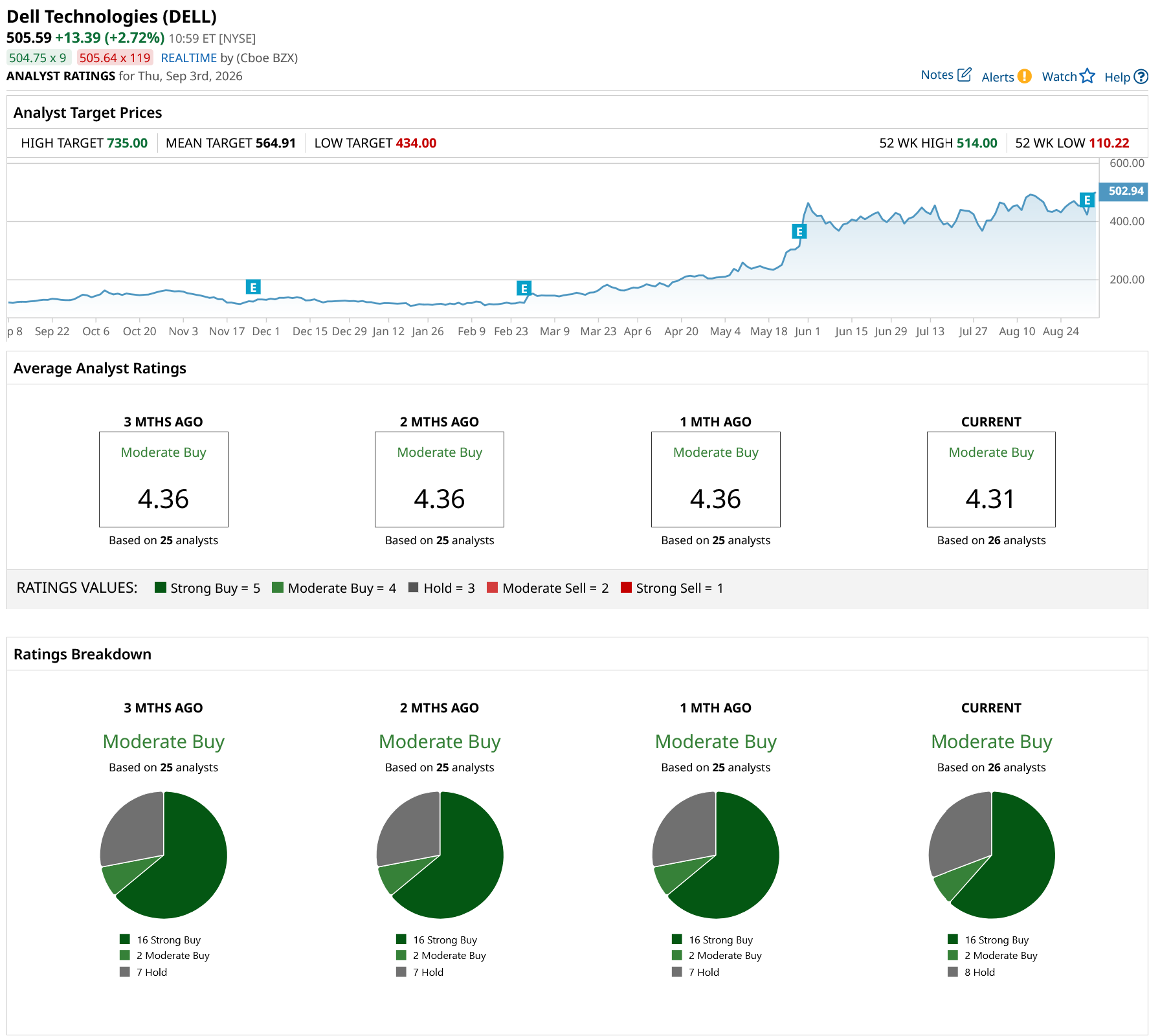
Most analysts covering DELL stock still maintain a “Strong Buy” rating.
On the date of publication, Amit Singh did not have (either directly or indirectly) positions in any of the securities mentioned in this article. All information and data in this article is solely for informational purposes. For more information please view the Barchart Disclosure Policy here.