
Shen Wan Hongyuan: A rebound in September can be expected, but it will take longer for the broad-band market to recover
The Zhitong Finance App learned that the current global stock market is still sensitive to disturbances related to US bonds, and that the medium-term problems behind high US bond yields exist objectively and still constitute a medium term suppressing factor for the global stock market. The main contradiction in technology pricing has returned to matching industrial logic and valuation. The market will inevitably diverge after computing power inflation. The performance growth rate in '27 is higher than the direction in '26, or the differentiation and strengthening in 26Q4. The bank maintained the judgment that the September rebound continued. The structural selection focused on finding a direction that could repair the decline to a greater extent in the overrun rebound. The AI chain focused on the direction of non-institutional heavy positions, domestic computing power chains and AI small-cap stocks to “cover the short term”; in the medium term, it focused on computing power inflation such as storage, high-end CCL, PCB, and capacitors.
Shen Wan Hongyuan's main opinions are as follows
1. The global stock market is still sensitive to disturbances related to US bonds: the medium-term problems behind high US bond yields exist objectively (weak US fiscal discipline, global reserve asset diversion, AI chain debt financing diversion, yen instability), and current US policies (including potential interest rate hikes) are biased towards short-term responses rather than long-term mechanisms. This continues to be a medium term suppressing factor for global stock markets.
US non-farm payrolls data exceeded expectations. The probability of interest rate hikes in September has risen again, and the stock market is still under pressure. High US bond yields and the problems behind them are still a medium term suppressing factor for global stock markets. There are objective problems in the medium term. Let's summarize 4 points:
1. US fiscal discipline is weak, the share of short-term treasury bonds financing has increased, and the share of interest has increased. 2. The reserve assets of the world's major central banks are too diversified, and US bonds continue to face loss of allocated funds during the rolling issuance process. 3. Changes in the economic structure and the increase in demand for AI chain debt financing have also diverted funds from the global allocation. 4. The fragility of the Japanese economy and the yen cycle is concentrated, and the current intervention framework will also generate pressure on US debt. In a situation where medium-term problems exist objectively, America's current policy mix favors short-term responses rather than long-term mechanisms. Under weak fiscal discipline, logic cannot be deduced over the long term. However, the Federal Reserve's monetary policy framework in the AI era is still being explored. Walsh's monetary policy framework is biased towards tradition, and there is a risk of interest rate hikes in the short term. Under this combination, global stock markets are still sensitive to disturbances related to US debt, and in the absence of medium- to long-term mechanisms, the pattern of frequent disturbances will continue for some time.
2. Technology downplays microstructural discussions and returns to the match between industrial logic and valuation: in the short term, the contradiction between capital supply and demand and market volatility declined simultaneously, and the positive 26Q2 capital cycle drove the AI chain to rise too fast has now been initially digested. The main contradiction in technology pricing returns to the matching of industrial logic and valuation. The subsequent market for computing power inflation is bound to diverge. After the initial static valuation of performance is in place (Communications '26 Quarterly Report, after Electronic '26 Annual Report), the performance growth rate in '27 is higher than in '26, and it is likely to diverge and strengthen in 26Q4.
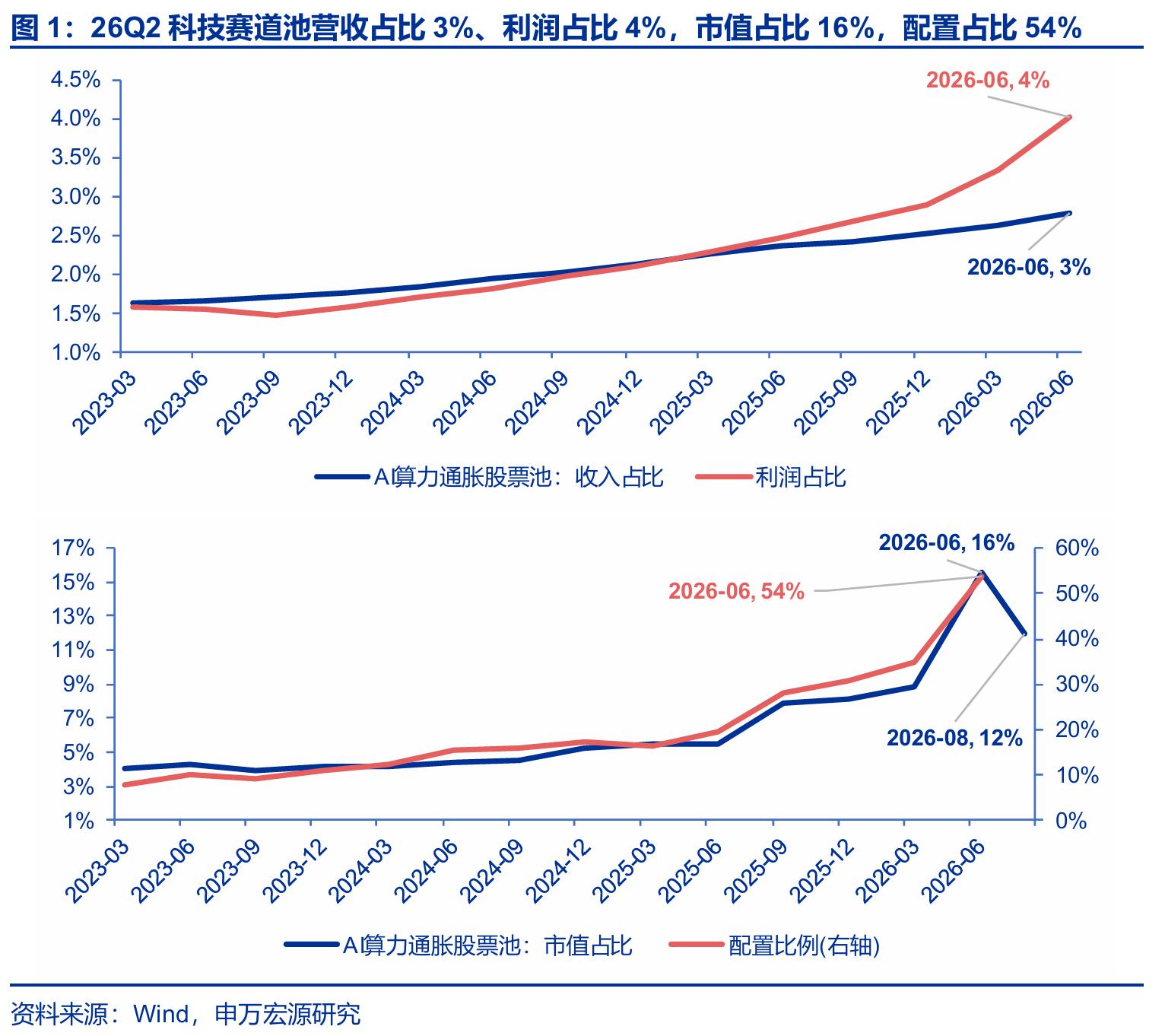
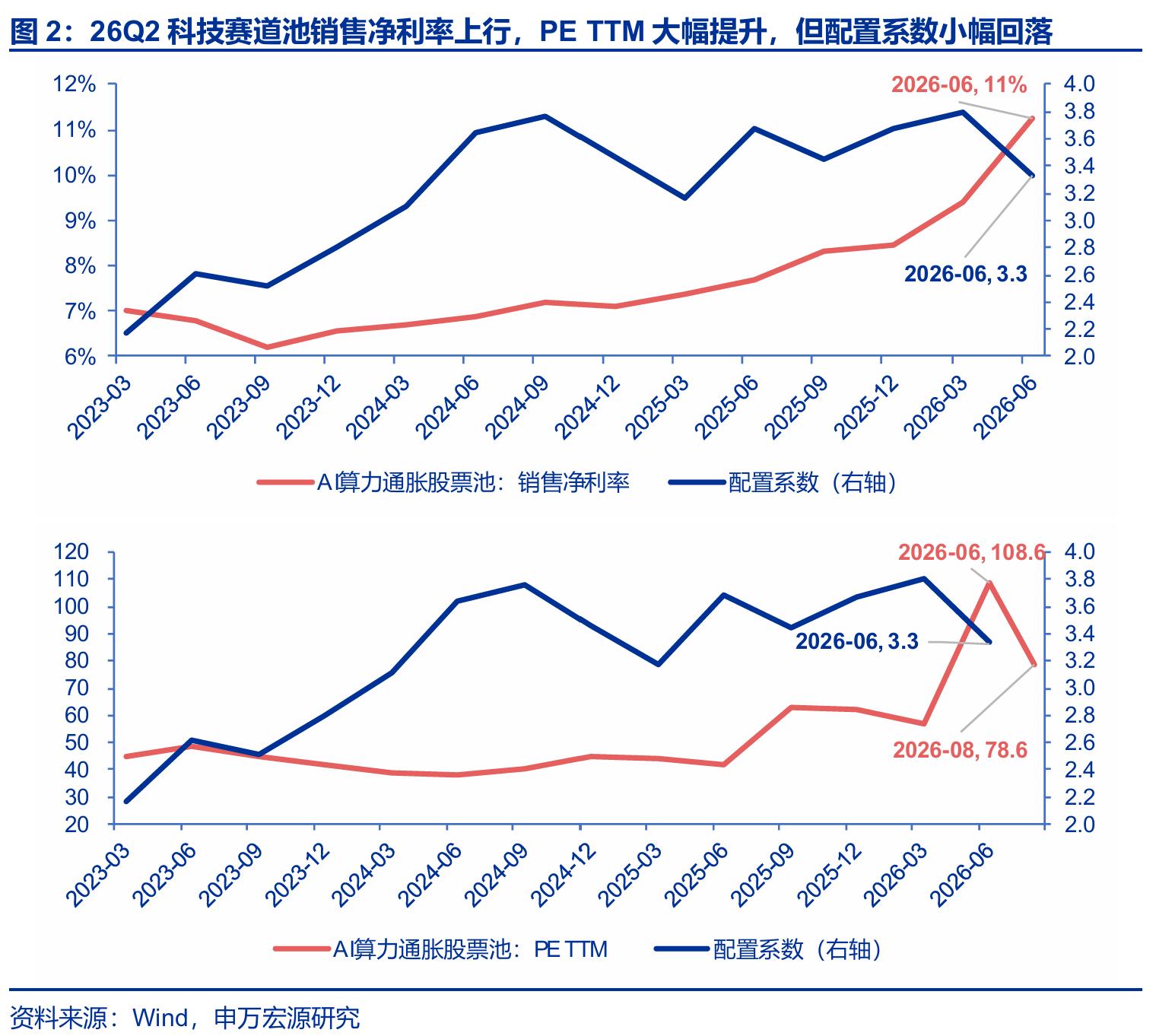
Let's talk about the microstructure of science and technology again. First, it is unrealistic to expect a significant decline in the public offering allocation coefficient in the short term. Using this as a condition to set rising conditions is too strict. We dismantle microstructural issues based on 162 technology circuit stocks that have been publicly held. At the end of 26Q2, Tech Track Pool's revenue accounted for 3%, profit accounted for 4%, market capitalization accounted for 16%, and equity allocation ratio was 54%. Seemingly, 54% is an extreme value, but when split, the 26Q2 net sales interest rate rose sharply, which is the foundation of the industry; while the static PE valuation is at an extremely high value in history, and the 26Q2 increase in the electronics industry ranked 4th in history. There is an objective problem where capital supply and demand are in a positive cycle, driving up market capitalization too fast. This is also a problem of concentrated digestion in July-August; the allocation coefficient of 26Q2 actually declined marginally. Historically, public offerings have lowered allocation factors, usually as a result of weakening fundamental trends/deteriorating asset allocation environments. Therefore, it is unrealistic to expect a significant decline in the public offering allocation coefficient in the short term. The recent downturn in allocation factors is mainly due to non-track investment managers turning to other directions to find excess income.
At the same time, during the May-June upward phase, the positive circulation of public circuit funds was marginal capital. The incremental (about 210 billion) /stock size (about 790 billion dollars) behind it was not large, and the high pricing weight depended on concentrated shareholding and high turnover rates among citizens. However, during the adjustment phase, racetrack fund holdings are resilient, and the impact of non-racetrack public offerings on position adjustments, reductions, and redemptions is relatively limited.
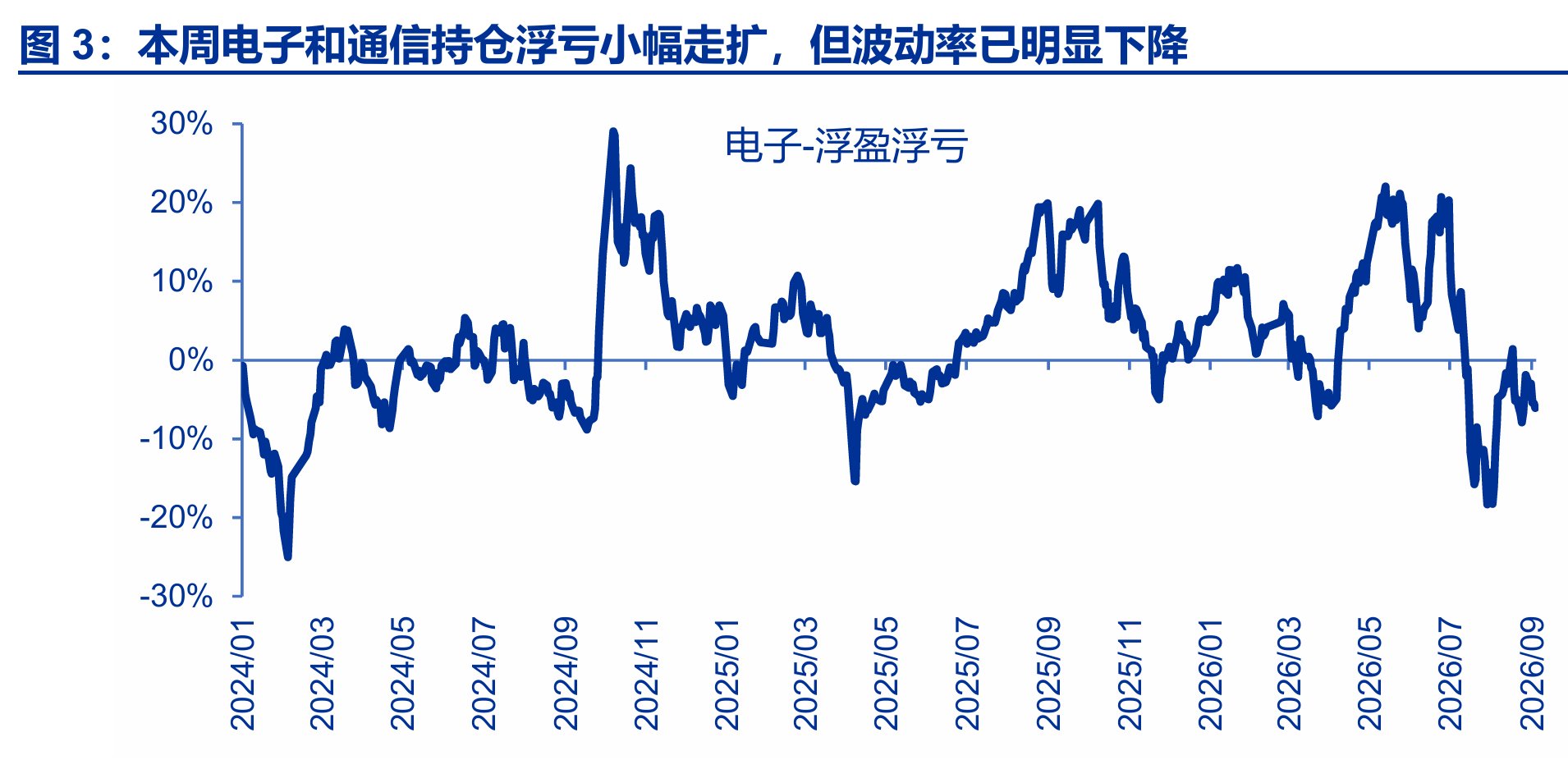
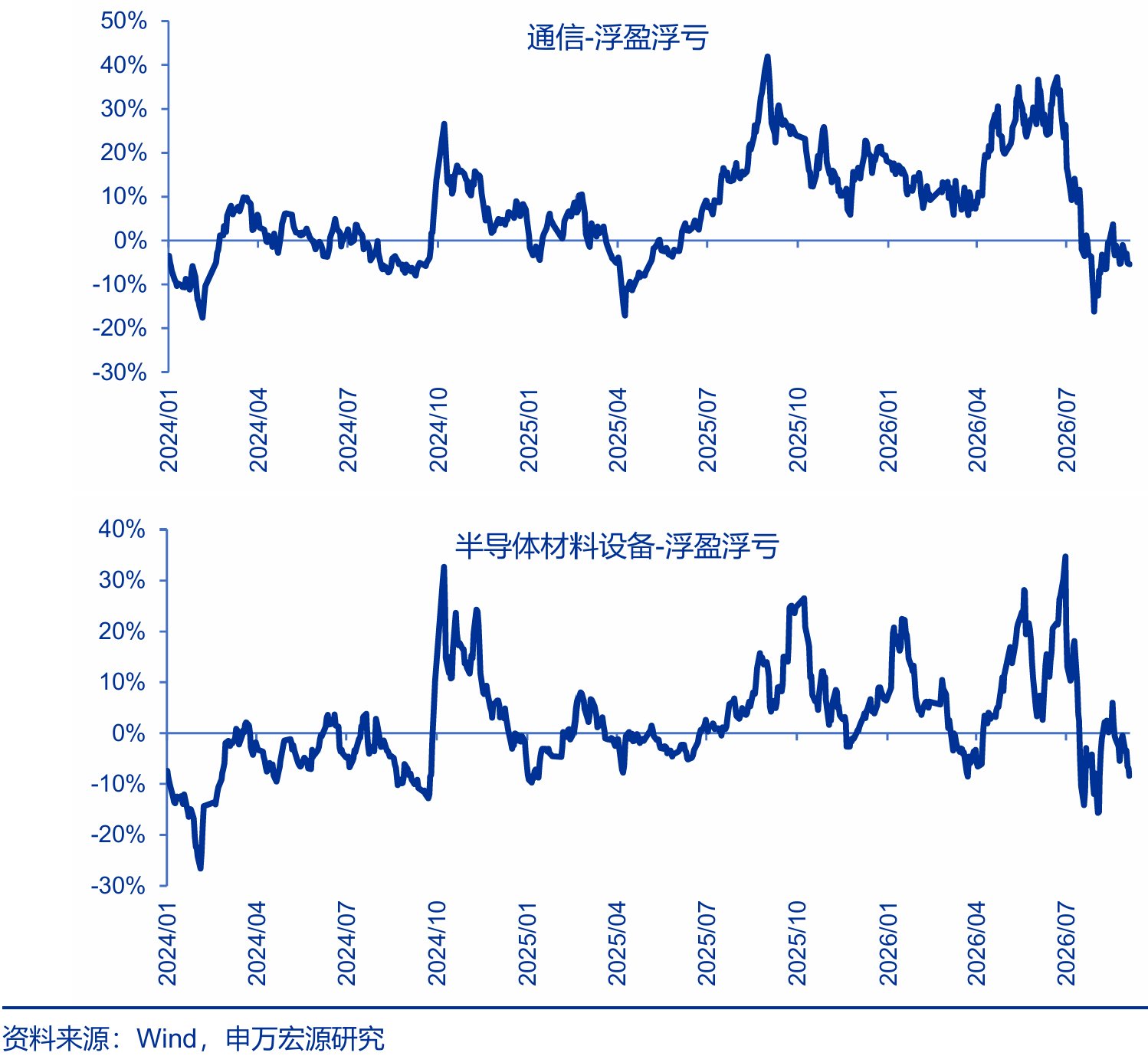
Judging from the recent tracking of capital supply and demand, capital inflows and outflows are characterized by narrow fluctuations near the break-even line of electronic and telecommunications holdings. The decline in market volatility and the decline in transaction amounts also correspond to the decline in the volatility of capital supply and demand. The weight of the impact of negative circulation pressure on capital in July-August has declined, and the main contradiction in technology pricing has returned to matching industry logic with valuation.
Under these circumstances, we deduce that subsequent market differentiation due to hashrate inflation is still a probability. The beta-level growth rate of AI capital expenditure may decline year by year in 27-28, and there will also be downward pressure in the future within 26 years. However, at the alpha level of computing power inflation, the fundamentals of computing power inflation have generally improved in '26; fundamentals may be significantly divided in '27, the conflict between supply and demand has eased in some directions, and price increases may slow down. The performance growth rate of most links in the computing power chain may have declined in '28. Before the end of June '26, industry trends were extrapolated linearly in the long run to almost no resistance. However, at this stage, it is difficult for the market to support high valuations based on the outlook for 28 years. Even so, after performance has been digested and assessed, the direction of improvement in the economy in 27 years compared to 26 years should completely resume the upward trend. We suggest that the first target for performance digestion valuation is for static valuation to return to the historical median. Without considering further adjustments, the static valuation will return to the historical median after Telecom's quarterly report in '26 and after the electronic annual report in '26. Corresponding to 26Q4 may be the starting point of the fragmentation of the computing power chain and strengthening the market.
3. Discuss the follow-up performance outlook based on the A-share second quarterly report: Beginning in 26Q3, the year-on-year net profit growth rate for all A shares declined and fluctuated repeatedly. It is difficult to reach consensus on cyclical improvements. 26Q3 cost pressure is likely to be concentrated in the financial statements. 26Q2 impairment is higher than seasonal, and 26Q4 impairment may also be higher. 27Q2 PPI grew low on a high year-on-year basis. Revenue growth was under pressure, and profit growth declined.
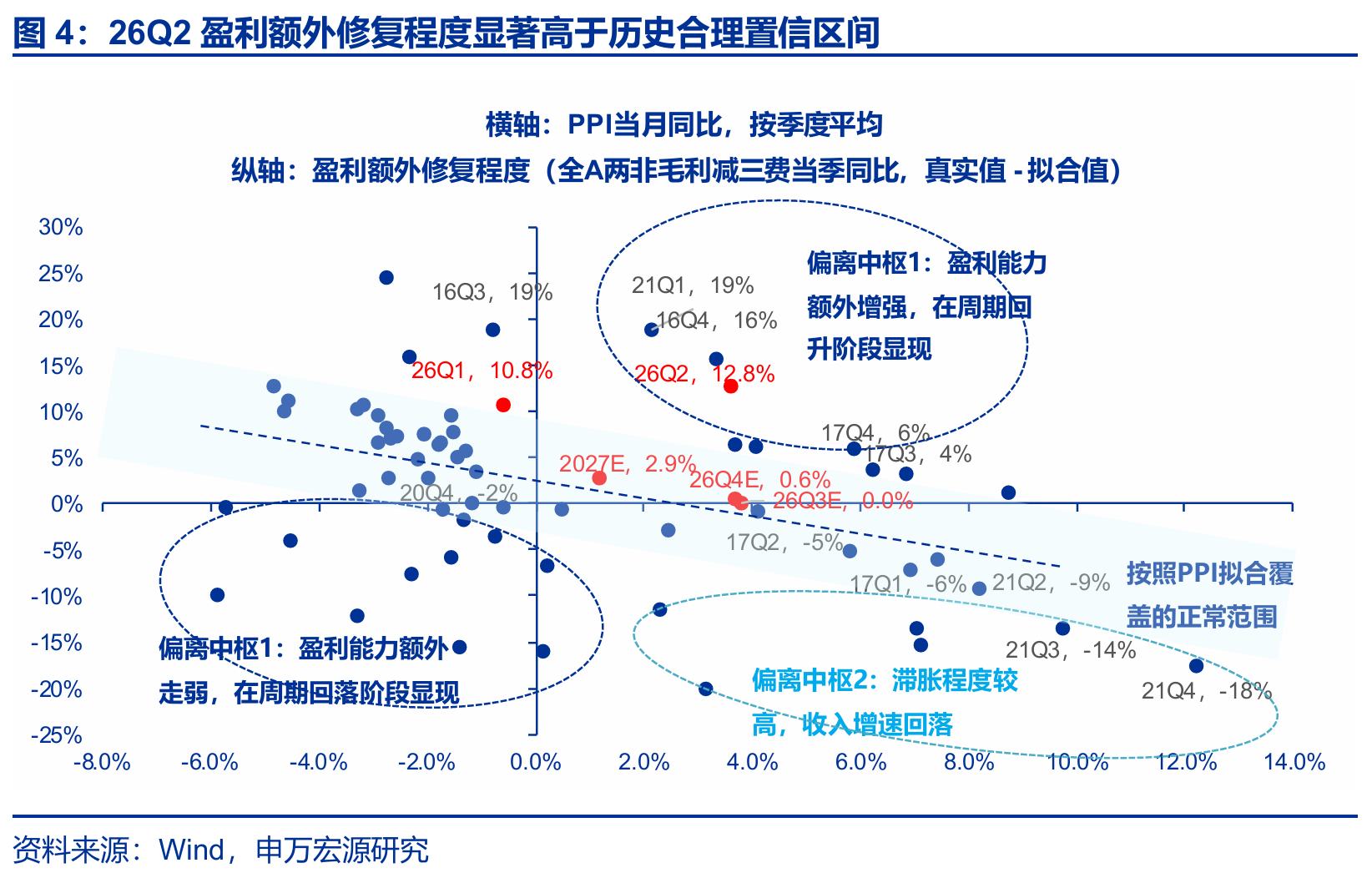
Looking at the subsequent cyclical fundamental outlook from the A-share second-quarter report. The overall growth rate for the second quarter has improved more than expected, but we still need to pay attention to 3 potential issues: 1. Supply is on schedule, but demand is weak, making the revenue growth rate lower than originally anticipated. 2. The impact of non-recurring profit and loss is high. Net investment income, fair value change earnings contribute positively, exchange losses, and negative asset value contributions. 3. Cost pressures are not fully reflected in the financial statements. The degree of additional profit improvement (the main influencing factor is the independent logic on the cost side) is significantly higher than the historical reasonable confidence range, reflecting the influence of product-side prices entering the market along with the first-in-first-out cost pricing. Many industries have achieved price increases for finished products and achieved real profit margins, but 26Q2's high cost pricing was insufficient, which brought additional profit improvements. In response to the high cost of 26Q3, pricing will begin. Combined with PPI rising month-on-month, there will be an additional decline in profit growth.
We deduce that starting in 26Q3, the year-on-year growth rate of all A's net profit declined and fluctuated repeatedly. 26Q3 cost pressure may be reflected in financial statements, and the profit growth center may decline significantly. 26Q2 impairment is higher than seasonal, and 26Q4 impairment may also be higher. The impact of high costs in 27Q1 subsided marginally, profit growth rebounded, and returned to the mid-term center. However, the 27Q2 PPI grew slowly on a high year-on-year basis. The revenue growth rate was under pressure, and the profit growth rate declined. Based on this kind of performance verification, pro-cyclical optimistic expectations are more resistant to fermentation.
4. Maintain the judgment that the September rebound continues. The focus of structural selection is still on finding a direction in which the rebound from an overrun decline can be repaired to a greater extent. Within the AI chain, more attention is being paid to the direction of non-institutional heavy positions, and domestic computing power chains and AI small-cap stocks “cover the short term in the medium term.” In the medium term, we will focus on the computing power inflation phase where the performance growth rate continued to accelerate in '27, focusing on storage, high-end CCL, PCB, and capacitors.
After September, the wave of technological shocks and adjustments continued. The time for non-technology to outperform has increased, and the time for high-dividend assets to have absolute returns has increased. Non-tech track directions, CXO, and innovative drugs have proven to be able to explain the positive cycle of racetrack funding. Precious metals have had twists and turns in the short term, but the US dollar credit weakens in mid-term pricing, and there is still room. At the same time, focus on opportunities in industrial metals and basic chemicals. Continue to search for high-dividend assets based on the “China Securities 800 Index Weight - 26Q2 Public Fund Position Weight”, focusing on banking, non-bank finance, food and beverage, and utilities. If you hold high-dividend assets, you can still observe the key verification window in the future.
Risk warning: Overseas economic recession exceeded expectations, domestic economic recovery fell short of expectations