
Building Better Commodity Portfolios – Part 2 Position Sizing: Building Exposure, Not Counting Contracts (The Next Decision After Finding the Trade)
Dual Edge Research publishes two powerful newsletters that work great individually — and even better together. The Bull Strangle Newsletter focuses on stocks and options, combining stock ownership with premium-selling strategies to generate consistent income and market-beating returns. The Smart Spreads Newsletter specializes in seasonal commodity futures spreads, offering a diversified approach with low correlation to equities. Together, they deliver a complete investment perspective — one focused on income, the other on diversification — all under one simple subscription.
Introduction
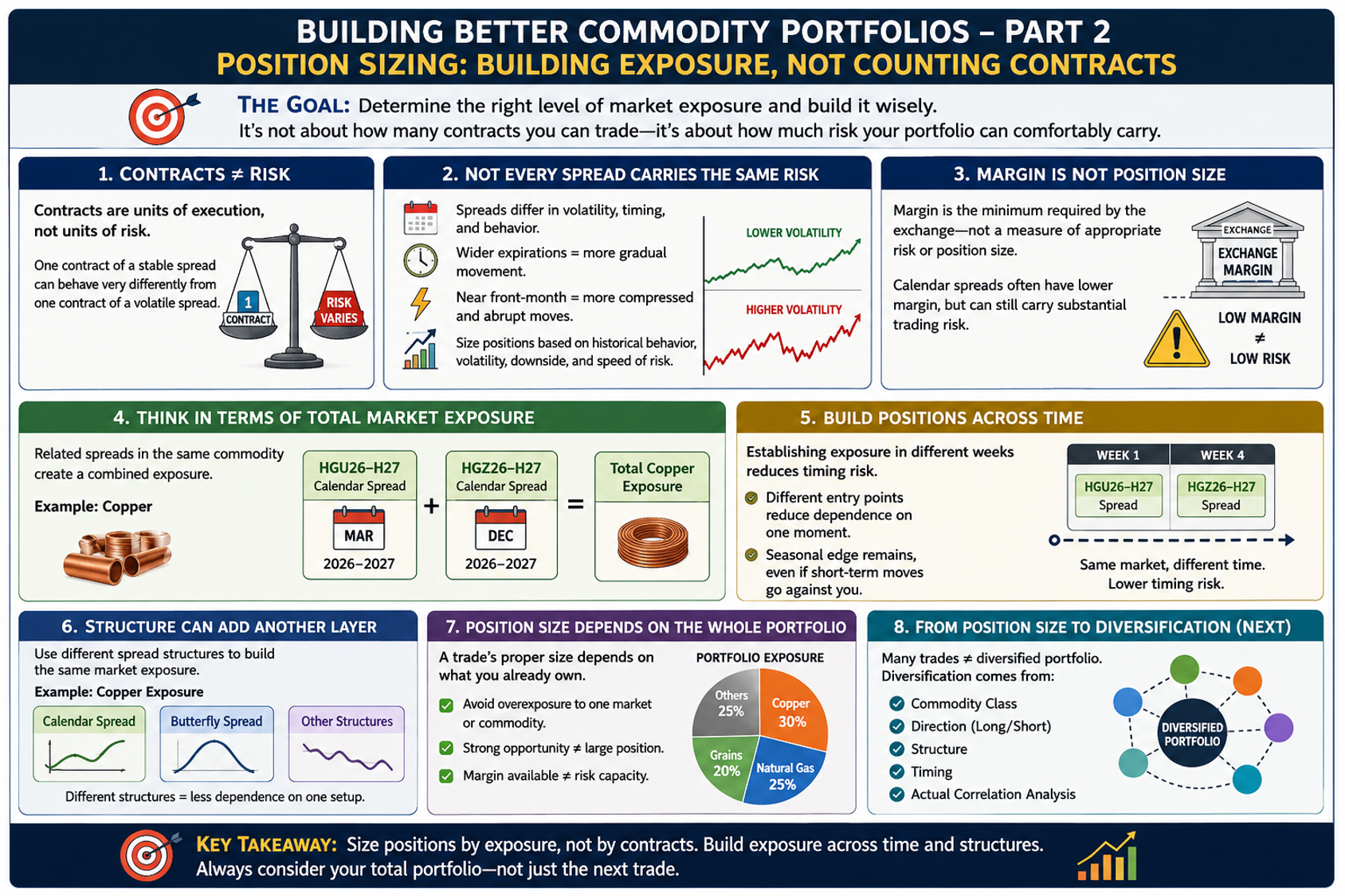
Once a commodity spread qualifies for the watch list and fits the existing portfolio, another important decision remains: How large should the position be? It is tempting to answer that question by simply counting contracts. If one contract is appropriate for one trade, why not use one contract for every trade? Or, if greater exposure is desired, why not simply trade two or three contracts of the same spread? The problem is that contracts are units of execution, not units of risk. One contract of a relatively stable calendar spread can behave very differently from one contract of a more volatile structure.
Position sizing should therefore begin with the exposure we want the portfolio to carry, rather than with the number of contracts we can trade. This distinction becomes especially important in futures because leverage and margin can make it easy to establish substantially more exposure than a portfolio can comfortably support. The objective is not to maximize the number of contracts. It is to determine an appropriate level of exposure and then decide how to construct that exposure.
Not Every Spread Carries the Same Risk
Commodity spreads can differ dramatically in their behavior. Some develop gradually over a long seasonal window with relatively modest historical fluctuations. Others can experience much larger movements over shorter periods. The time remaining until the front-month contract expires and the spacing between the legs can also influence both the speed and magnitude of movement. As discussed in Trading Commodity Spreads, wider spacing between contract expirations can allow greater differentiation between the months. In contrast, positions closer to front-month expiration can experience more compressed and abrupt movement.
These differences mean that equal contract counts do not necessarily create equal exposures. A portfolio containing one contract of several spreads may appear evenly allocated while actually deriving a disproportionate amount of its risk from one or two positions. Position sizing should therefore consider how a spread has historically behaved, its structural volatility, its potential downside, and how quickly that risk can develop. A high-volatility trade is not necessarily a poor trade. It may simply deserve a different position size than a slower, more stable opportunity.
Margin Is Not Position Size
Futures margin can complicate this decision because it provides an easy-to-use number for determining how much can be traded. But margin serves a very different purpose. Exchange margin represents the minimum capital required by the clearing system to support a position. It does not determine how much risk a trader should accept, how many positions to hold, or how large an acceptable drawdown should be.
This distinction is particularly important with calendar spreads. Because the long and short contracts offset some of each other's outright price exposure, calendar spreads often receive significantly lower margin requirements than outright futures positions. That reduction can be beneficial, but it should not be interpreted as meaning that the spread carries proportionately less trading risk. Spreads can still experience substantial adverse movement, temporary dislocations, and periods of unusually high volatility. Using available margin as the primary position-sizing tool can therefore create much larger exposures than intended.
Think in Terms of Total Market Exposure
Position sizing becomes more interesting when several attractive opportunities exist in the same commodity. Instead of thinking of each spread as an entirely separate decision, it can be useful first to consider the total exposure to that market.
Copper provides a good example. I might hold an HGU26-H27 calendar spread and later add an HGZ26-H27 spread. Both positions are ultimately copper exposures, so I would not consider them independent simply because the contract months are different. Together, they represent the portfolio's overall copper allocation.
This changes the sizing question. Rather than asking, "How many contracts of HGU26-H27 should I trade?" the better question may be, "How much copper exposure do I want, and how should I build it?" That approach opens the door to constructing an exposure rather than simply multiplying a single position.
Build Positions Across Time
In practice, I frequently establish related spread positions during different weeks rather than entering the entire desired exposure at once. If I initially establish the HGU26-H27 spread and add HGZ26-H27 during a later week, the portfolio is not only using two different calendar structures—it is also establishing the copper exposure at two different points in time.
This can reduce timing risk. Even when the seasonal research strongly supports a trade, there is no way to know whether a particular week will provide the ideal entry. A market can move sharply immediately after a position is established without invalidating the longer-term seasonal tendency. Building exposure across different weeks reduces the entire allocation's dependence on a single entry point.
This does not guarantee better entries, nor does it turn two related copper spreads into independent trades. Both remain exposed to many of the same underlying copper fundamentals. But distributing the allocation across time avoids concentrating the entire timing decision into a single moment.
Structure Can Provide Another Layer
The same principle can extend across spread structures. Rather than simply adding contracts to an existing position, qualifying calendar spreads and butterflies can sometimes be combined to construct the desired market exposure. These positions remain related because they involve the same commodity, but distributing exposure across different structures can reduce dependence on a single spread configuration. We will examine this idea more fully in Part 3.
Position Size Cannot Be Determined in Isolation.
There is one final complication: the appropriate size of a new trade depends partly on what the portfolio already owns. A new copper spread may appear appropriate at a certain size when evaluated in isolation. Still, that conclusion could change if the portfolio already has significant exposure to copper or other metals. Similarly, adding another Natural Gas structure should be viewed differently when several NG positions are already open.
This is where position sizing begins to overlap with portfolio construction. Trade characteristics help determine how much risk an individual position deserves, but existing exposure helps determine how much additional risk the portfolio should accept. A strong opportunity does not automatically justify a large position, and an available margin balance does not automatically represent unused risk capacity. The goal is to size each opportunity so that no individual trade or market becomes disproportionately important to the portfolio.
From Position Size to Diversification
Position sizing therefore involves more than selecting several contracts. It requires thinking about how much exposure is appropriate, how that exposure should be constructed, and when it should be added. Multiple qualifying spreads can sometimes be used to distribute exposure across different contract months, structures, and entry weeks. At the same time, related trades must still be recognized as related exposures rather than counted as completely independent positions.
That last distinction leads directly to Part 3. A portfolio can contain many different trades and still be poorly diversified. Conversely, several positions within the same market class can sometimes provide more diversification than their commodity labels suggest. In the next part, we will move beyond simple market counts and examine diversification through commodity class, direction, structure, timing, and—most importantly—actual correlation analysis.
Part Articles in the Series
Part 1 - Why Portfolio Construction Matters
Additional Details
The Bull Strangle Newsletter focuses on stocks and options, combining stock ownership with disciplined option-selling techniques designed to generate consistent income while managing risk.
The Smart Spreads Newsletter focuses on seasonal commodity spreads, a historically proven approach that seeks opportunities across agricultural, energy, metal, and financial futures markets.
Each strategy is designed to stand on its own, but together they provide a diversified approach that can perform across a wide range of market environments. For traders looking to deepen their education, The Bull Strangle Strategy and Trading Commodity Spreads are both available on Amazon.
Visit BullStrangle.com to subscribe for just $1 for the first month.
For a video overview of the Bull Strangle Newsletter
For a video overview of the Smart Spreads Newsletter
Darren Carlat
Dual Edge Research
(214) 636-3133
DualEdgeResearch@gmail.com
Disclaimer
This information is for informational purposes only and should not be considered as investment advice. Past performance is not indicative of future results, and all investments carry inherent risk. Consult with a financial advisor before making any investment decisions.