
Jibang Consulting: Improved CPU supply is expected to reduce the annual decline in global notebook shipments to 9.4% in 2026
The Zhitong Finance App learned that according to TrendForce Jibang Consulting's latest notebook industry research, the supply of notebook CPUs has improved significantly since the second quarter of 2026, the pace of procurement and production of brands has gradually resumed, and considering the continued rise in DRAM and SSD costs, they are willing to be more active in preparing and locking in parts in advance, driving shipments in the first half of the year to be better than expected. However, the trend of rising memory prices has not changed, and CPU prices have also risen, and the cost pressure faced by brands has further increased.
TrendForce Jibang Consulting said that in the second half of 2026, as the CPU shortage slowed down, brands continued to prepare goods ahead of schedule. Coupled with factors such as early switching by end consumers and stable business demand, it is estimated that the shipment situation will improve at the same time, and the decline in notebook shipments throughout 2026 is expected to subside to 9.4%.
Compared to the previous model where the next half of the year was the main peak shipping season, the notebook shipping structure will change markedly in 2026. Since some of the originally anticipated demand for the second half of the year was already shown ahead of schedule in the first half of the year, the shipping ratio for the first half of the year is estimated to be about 53:47, and shipping performance from the third quarter will still face a decline.
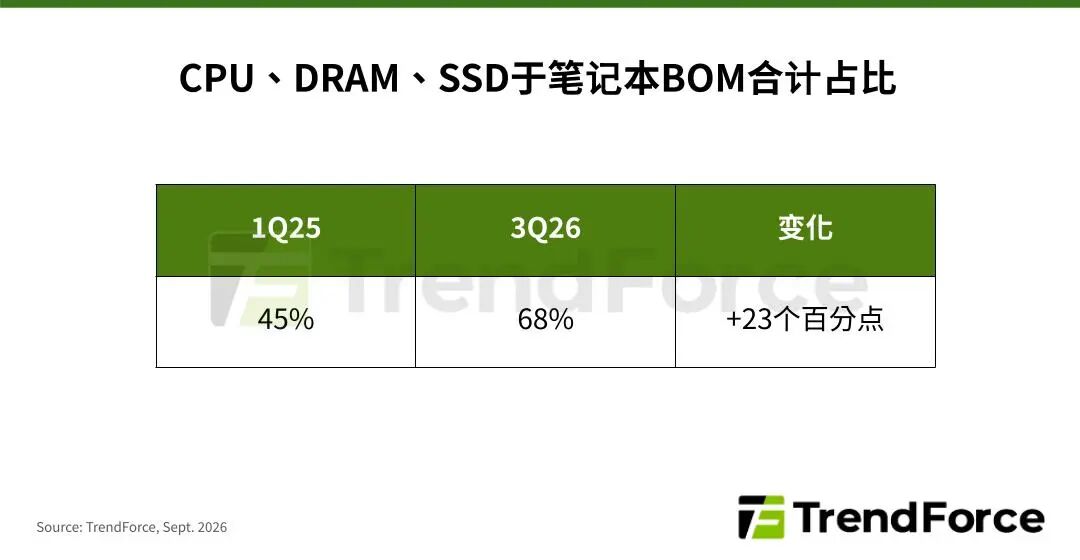
Core components account for 68% of BOM, and the cost transfer after eliminating low-cost inventories is worth paying attention to
To assess the impact of component price increases on the cost structure of notebooks, TrendForce Jibang Consulting observed mainstream models with a recommended selling price (MSRP) of $900 in the first quarter of 2025, when memory supply was stable. At that time, core components such as CPU, DRAM, and SSD together accounted for about 45% of the BOM. After more than a year of price increases, the share of these three items has risen to 68% in the third quarter of 2026, indicating that memory and CPU are rapidly changing the cost structure of notebooks.
From the perspective of brand gross profit, due to the quarterly increase in the prices of CPUs, DRAM, SSDs, etc., it is estimated that until the third quarter of 2026, manufacturers will have to raise 80% of product prices in the first quarter of 2025 in order to maintain the same gross profit level as at that time. This means that the impact of rising component prices on notebook terminal prices has gradually changed from increasing the cost burden to pressure to expand the increase.
TrendForce Jibang Consulting pointed out that in the short term, the brand will maintain a relatively active shipping strategy, which is mainly supported by factors such as market share competition, new product launches, commercial markets, and existing low-cost inventory. Brands can also temporarily delay the impact of rising costs on terminal prices and gross margins through advance preparation and existing inventory.
However, as low-cost inventories in various regions gradually disappear, the cost buffer accumulated by brands in the past narrows. Subsequent products may reflect the latest prices of CPUs, DRAM, and SSDs to a greater extent, and brands will also have to face the test of cost transfer and demand elasticity more directly. The increase in terminal prices, changes in consumer switching cycles, and trade-offs in gross margin between brands will be the key to influencing subsequent market demand.