
SoftBank trillion yen retail bonds lock in 4.75% coupon interest rate Sun Zhengyi leads Japan's savings pool to the AI supercycle
The Zhitong Finance App learned that SoftBank Group Corp. (SoftBank Group Corp.), headed by legendary investor Sun Zhengyi, has set a 4.75% coupon interest rate for a retail bond of up to 1 trillion yen (about 6.3 billion US dollars) as interest rates increase the appeal of bonds and may prompt more companies to switch to a retail financing model. This latest financing initiative highlights that SoftBank is seeking to use Japan's huge residents' savings pool to lock in long-term Japanese yen capital, diversify bank loans, institutional bonds and foreign currency financing sources, provide capital scheduling space for investment in AI application leaders such as OpenAI, AI data center construction, and existing debt refinancing, and provide important financial support for Sun Zhengyi's “Super Artificial Intelligence Vision.”
SoftBank is issuing a seven-year unsecured ordinary corporate bond for individual investors. The scale reached 1 trillion yen and a coupon interest rate of 4.75%, setting a record for issuing Japanese retail corporate bonds. The coupon interest rate is about 245 basis points higher than the 2.3% average of Japanese yen retail corporate bonds this year. It not only reflects the trend of household funds flowing from bank deposits to bonds after Japan's interest rate was normalized, but also reflects investors demanding that SoftBank pay higher returns on their leverage, asset price fluctuations, and AI investment risks.
While SoftBank is issuing a record 1 trillion yen retail bonds to Japan, AI computing power demand and actual orders from the computing power industry chain still point to strong demand: Nvidia's revenue for the second quarter of fiscal year 2027 increased 106% year over year to $96.2 billion, data center revenue increased 117% to $89 billion, and defined a growth outlook of about 70% of the 2028 fiscal year as “supply-bound”; Anthropic also recently signed a Lambda computing power agreement of about 35 billion US dollars and a six-year Nscale computing power agreement worth about 45 billion US dollars. South Korea's semiconductor exports surged 209% year on year to 46.65 billion US dollars in August, and computer exports increased by 419.5%. Officials clearly attributed this to hyperscale cloud vendors expanding AI computing power infrastructure such as HBM and rising prices for enterprise-grade high-performance DRAM and SSDs.
SoftBank uses Japan's huge savings pool to sustain AI ambitions
According to the latest news, SoftBank Group set a record coupon interest rate of 4.75% on the 1 trillion yen retail bond. Not all of the capital raised in this period was directly invested in OpenAI, but was also used for AI-related investments and repayment of existing bonds.
This 1 trillion yen bond is the largest single retail corporate bond issue in the history of a Japanese company, breaking SoftBank's previous record of 600 billion yen. Furthermore, as of September 4, Japan's yen-denominated retail corporate bonds have reached 2.88 trillion yen since this year, more than the annual issuance volume of any previous year.
According to documents submitted by the company, the pricing of this batch of seven-year bonds on Friday was at the higher end of the 4.3% to 4.9% range announced by the company last month. According to data compiled by Bloomberg, the average coupon interest rate for yen-denominated retail corporate bonds issued in Japan this year was 2.3%.
The issuance comes at a time when the yield on Japan's 10-year treasury bonds has broken the 3% mark for the first time in about 30 years, making bonds more attractive for investors who have traditionally kept most of their financial assets in bank deposits.
Kazuma Ogino, senior credit analyst at Nomura Securities, said, “This level of yield and issuance scale of 1 trillion yen may attract new individual investors to the Japanese corporate bond market.” He said that retail investors who hold bonds until maturity are less affected by price fluctuations during the period and can also benefit from higher yields; this is a “smooth wind” for the retail bond market.
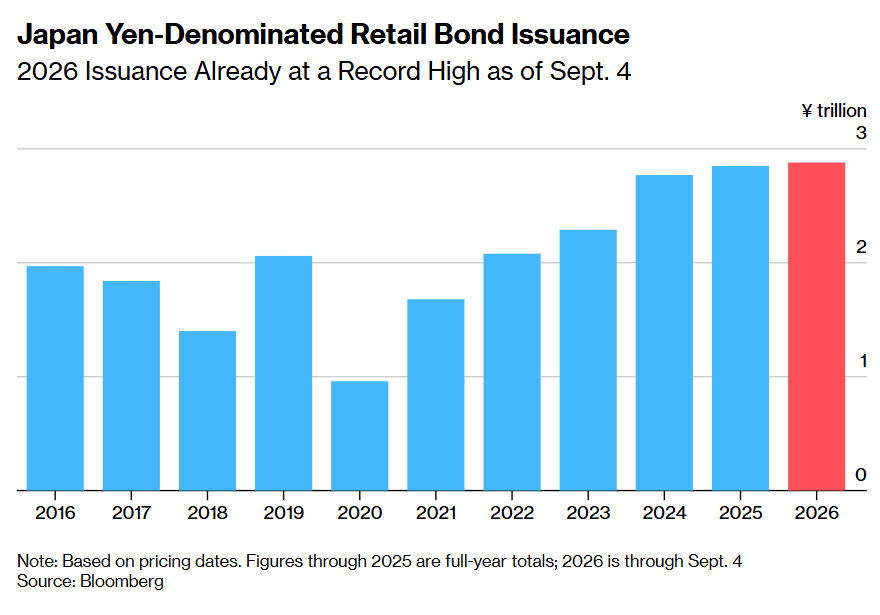
As shown in the chart above, Japan's yen-denominated retail bond issuance scale — as of September 4, 2026 has reached a record high. Note: Based on the pricing date. The data for 2025 and earlier is the total for the full year; the 2026 data is as of September 4.
According to the latest data compiled by the agency, as of this year, the issuance scale of Japanese yen-denominated retail corporate bonds has reached 2.88 trillion yen, including the SoftBank Group's 1 trillion yen transaction; as of September 4, this scale has already exceeded the total amount issued in any previous full year.
As companies' demand for financing for mergers and acquisitions and growth investments rises, large-scale bond issuance to institutional investors may put pressure on interest spreads. Ogino from Nomura said, “Attracting many retail/retail investors can diversify funding sources and ease this pressure. This could be a win-win situation and help broaden the retail bond market.”
Masayoshi Sun's “Big Picture of Super Artificial Intelligence”
This important trillion-yen retail bond issue also fits and strongly supports Sun Zhengyi's strategy of moving from “investing in AI companies” to building an ASI (Super Artificial Intelligence) full-stack platform. However, this coupon of up to 4.75% also shows that SoftBank must rely on a higher return on AI assets to cover capital costs.
Looking at the industrial structure, SoftBank is splicing together an ASI integrated stack of “chip architecture-processor-datacenter-cloud computing-power-model and enterprise application”. SoftBank hopes not only to share the rise in OpenAI's valuation, but also to capture multi-tier profit pools for chip IP, server processors, data center energy, computing power leasing, and model applications; once ASI technology comes out of nowhere, it will push all layers to collaborate with internal demand and customers, and its value may be significantly higher than single-point shareholding.
However, “full stack” will also simultaneously amplify capital expenses, technology integration, capacity utilization, and OpenAI concentration risks — the trillion yen bond issue proves that SoftBank still has strong financing capabilities, but it does not mean that the project economy has been verified; ultimately, victory or loss depends on computing power utilization and whether AI cash flow can continue to outperform 4.75% of debt costs.
The AI superplatform that SoftBank is now building is no longer a single point bet, but an increasingly complete “ASI integrated stack”: the bottom layer includes Arm architecture and Armself-developed data center CPUs; the middle layer includes GraphCore Ltd., a British AI chip design company fully acquired by SoftBank Group, and Ampere, which was officially acquired recently; the upper layer includes OpenAI, Stargate (or “Stargate”), and the enterprise-grade cloud AI computing power platform layout with Oracle, plus SB Neo, a new cloud power ( Neocloud); Meanwhile, Sun Zhengyi himself has already publicly stated that SoftBank's goal is to become the largest AI computing power and application-level basic platform provider under the “Super Artificial Intelligence” (ASI) era in the next ten years, and has adopted an almost “all in” aggressive investment attitude for ChatGPT developer and global AI model leader OpenAI. Oracle is mainly Stargate's cloud and infrastructure partner, while SoftBank's joint venture platform for enterprises is SB OpenAI Japan, which was co-founded with OpenAI.