
Following CrowdStrike and Palo Alto, the AI reasoning era added another cybersecurity winner! Zscaler (ZS.US) competes for the trillion-dollar circuit with a 75% surge in sales pipeline
The Zhitong Finance App learned that the stock price of US cybersecurity technology leader Zscaler (ZS.US) surged more than 11% after the market on Thursday. After the market, the company gave a strong performance report that exceeded market expectations and future performance prospects, highlighting that after generative AI moved from the trial deployment stage to large-scale deployment of AI agents, the cybersecurity budget was being transformed from optional expenses to a precondition for deploying AI technology, and that the cybersecurity product line was ushering in the momentum for cybersecurity software product orders driven by the drastic expansion of the artificial intelligence reasoning market. After artificial intelligence moves to the stage of large-scale inference and AI intelligent agent workflow (Agentic AI), cybersecurity requirements are not simply “growing faster as cutting-edge AI technology is updated and iterated,” but it is likely that there will be a structural incremental expansion far higher than traditional IT spending.
Zscaler's revenue for the fourth fiscal quarter was US$898.2 million, up 25% year over year, higher than market expectations of US$877 million; adjusted earnings per share were US$1.19, higher than the forecast of US$1.09; and annual recurring revenue (ARR) increased 25% to US$3.771 billion. More importantly, “Security for AI (Security for AI)” bookings increased by more than 50% month-on-month, and sales pipeline increased by 75% — the former reflects already closed commercial orders, and the latter reflects strong future order reserves. As models call data, applications, and tools more frequently, the need for zero-trust access, identity governance, and data leakage prevention becomes stronger.
Zscaler management expects revenue of US$935 million to US$939 million for the first quarter of fiscal year 2027, higher than market expectations of US$927 million; adjusted earnings per share of US$1.15-1.16, higher than the forecast of US$1.08. The overall revenue range guide for the full fiscal year was $3,908 million to $3,938 million, slightly higher than the forecast of $3.9 billion; adjusted earnings per share were $4.86 to $4.90, which was significantly higher than the forecast of $4.60, but ARR is expected to grow by only 16.6% to 17.4%, which is a significant slowdown from 25% in FY2026.
After the financial report and future outlook data were released, Zscaler's stock price once rose by more than 11% after the market, but as it switched to a slight drop of 1% after the market, its stock price still fell by about 20% during the year. This strong rebound essentially meant that the market re-evaluated the sharp expansion trend and stronger monetization capacity of its cybersecurity business in the AI reasoning era, rather than the risk of overvaluation and sustainable growth completely disappeared.
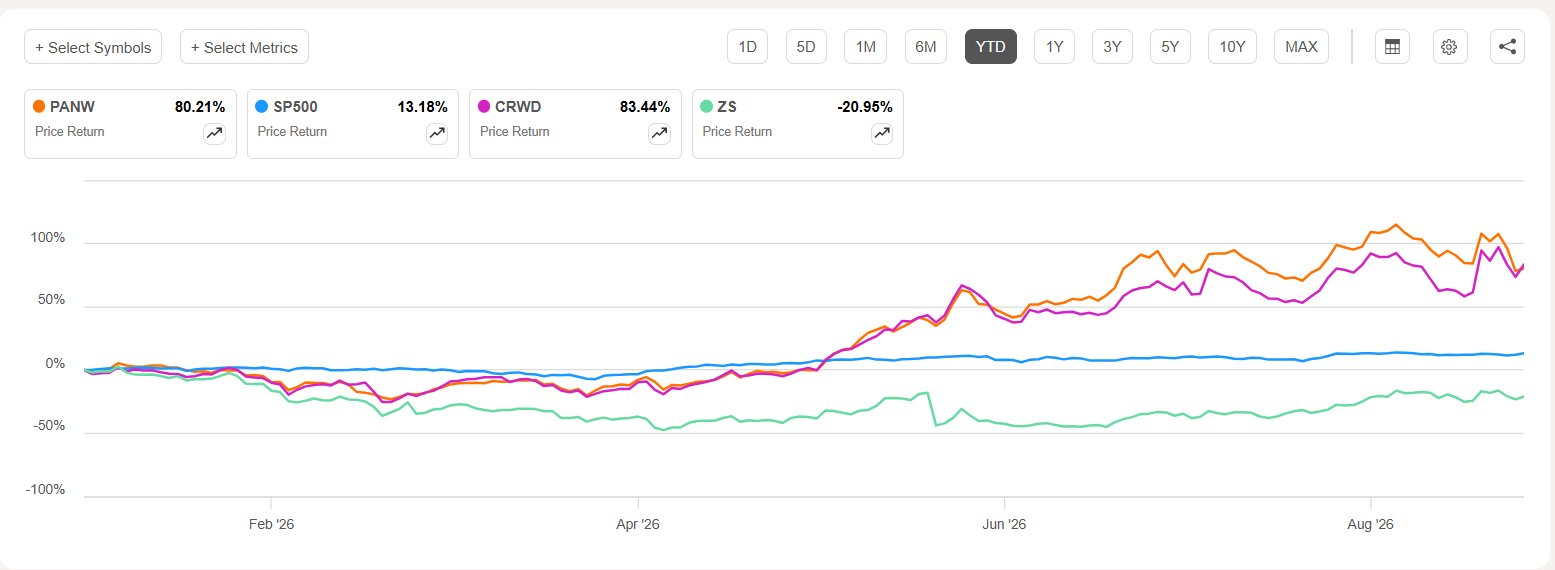
The cybersecurity industry's performance further confirms the intensity of demand. CrowdStrike's second-fiscal quarter revenue was US$1.47 billion, up 26% year on year; ARR increased 25% to US$5.84 billion, net addition of ARR reached a record high of US$333 million, up 51% year on year, and free cash flow reached US$377 million. After the earnings report was released, it rose by about 10.4%. Another cybersecurity giant, Palo Alto Networks, had fourth-quarter revenue of US$3.41 billion, up 34% year over year, above expectations of US$3.35 billion; adjusted earnings per share of US$1.02, higher than expectations of US$0.98; next-generation security ARR increased 63% to US$9.1 billion, with revenue guidance for fiscal year 2027 of US$14.1 billion to US$14.2 billion also exceeding market expectations of US$13.79 billion. CrowdStrike and Palo Alto Networks both increased by more than 80% during the year, which can be described as a clear divergence from Zscaler's previous weakness.
The underlying logic behind it is unquestionably that AI reasoning, especially the fully autonomous proxy AI workflow dominated by AI agents (Agentic AI), is no longer just generating text, but continuously calling models, application interfaces, databases, and enterprise tools, and accessing sensitive data and performing operations at machine speed. As a result, risks such as machine identity, permission crossing, reminder injection, data leakage, lateral movement of agents, model supply chain pollution, and autonomous attacks have been added. The security architecture must shift from traditional border protection to continuous authentication, minimum permission access, inline traffic inspection, and run-time governance. Training computing power requirements may fluctuate on a project-by-project basis, but every inference, tool call, and data access of an intelligent entity requires security control and AI security tool protection, so that the revenue of the cybersecurity product line can continue to grow as AI usage expands.
During the Q&A session, Palo Alto Networks' management further assumed the AI capital expenditure scenario of $5 trillion over the next five years, while pointing out that the world's cybersecurity technology debt needs to be modernized urgently. Palo Alto CEO Nikish Arora said in a conference call that the latest developments in the AI field are pushing cybersecurity to the top of the corporate CIO priority list and will be a “enduring tailwind.” He highlighted that the global cybersecurity infrastructure of about $1 trillion is unprepared to deal with AI threats, and this gap will provide the industry with room for long-term growth.
How sacred is Zscaler? What are the differences between cybersecurity giants CrowdStrike and Palo Alto Networks compared to their main business?
zScaler is a high-purity target for zero trust and AI agent traffic growth. It is more flexible but is more dependent on sales execution and the implementation of new ARR; CrowdStrike has the advantages of massive terminal behavior telemetry and security operation automation, and directly benefits from AI-driven attack detection requirements; Palo Alto Networks has the most complete product line and the strongest cross-selling capability, and is more suitable for undertaking the “platform-based integration” trend of enterprises reducing the number of suppliers. In other words, Zscaler is betting on “removing cyber trust,” CrowdStrike is betting on “finding and stopping attacks,” and Palo Alto is betting on “using one platform to unify the entire security system.”
Zscaler is a cybersecurity company with cloud-native zero trust as its core. Its “Zero Trust Exchange Platform (Zero Trust Exchange)” is located in the enterprise traffic path and connects users, workloads, branch offices, or AI agents to applications that have been granted access without directly connecting them to the internal network.
The company's main business covers secure service edge, secure access service edge (SASE), internet access security, zero-trust access to private applications, data leak prevention, cloud workload and branch security, digital experience monitoring, and expansion into AI agent communication, model access control, and agent security operations (Agentic SecOps).
Zscaler is a “traffic and access control layer” that replaces traditional VPNs, network boundaries, and some security devices; CrowdStrike is a “terminal telemetry and detection response layer”, based on the Falcon platform and terminal agents, and focuses on terminal detection and response (EDR), extended detection and response (XDR), cloud workloads, identity protection, threat intelligence, and next-generation security information and event management (Next-Gen SIEM), and is good at identifying “what attacks are happening” on devices and workloads and quickly terminating Attack; Palo Alto Networks is the “full-stack security platform” with the widest coverage. It started with a next-generation firewall (NGFW). Currently, it also spans networks and SASE, Prisma cloud security, Cortex security operations, and identity security, and combines hardware, software subscriptions, and cloud platforms.
AI risk turned into an urgent security order, and Zscaler, which focuses on “zero trust”, handed over answers that exceeded expectations
As cybersecurity risks rise in the era of artificial intelligence reasoning, which spurred urgent demand for cybersecurity tools, the cloud security company's fourth-quarter results and future prospects surpassed Wall Street analysts' unanimous expectations. This is also a sharp rise in Zscaler's stock price after the Thursday market.
The company's revenue for the fourth fiscal quarter was US$898.2 million, up 25% year over year, higher than market expectations of US$877 million; adjusted earnings per share were US$1.19, higher than the forecast of US$1.09. zScaler reported a GAAP net loss of $3.4 million, or GAAP loss of $0.02 per share; a year ago, a net loss of $17.6 million, or $0.11 per share.
Zscaler's overall revenue for the 2026 fiscal year was US$3.353 billion, up 25% year on year; excluding Red Canary, revenue was US$3.209 billion, up 20% year over year. Non-GAAP operating profit increased to $767.1 million, and operating margin rose to 22.9% from approximately 21.7% the previous year; non-GAAP earnings per share increased from $3.28 to $4.21.
Operating cash flow for the year was US$1,130 million, up from US$972.5 million last year; free cash flow increased to US$779.1 million, but the free cash flow rate fell from 27% to 23%. Free cash flow for the fourth fiscal quarter fell to US$60.8 million from US$171.9 million in the same period last year, mainly due to capital expenditure and internal software investment rising from US$78.7 million to US$218.5 million, so profit quality and capital investment are still variables that need to be tested in valuation.
At the results conference call, management revealed that the net increase in ARR reached US$246 million, up 24% year on year; excluding Red Canary, it was US$232 million, up 17% year on year. Remaining performance obligations (RPO) increased 27% to $7.365 billion; Z-Flex's total contract value for the fourth fiscal quarter exceeded US$770 million, an increase of more than 60% month-on-month, and over US$1.7 billion for the full year.
The company's management said that 70% of AI security transactions also include data security products. Zero Trust Everywhere enterprise customers jumped from more than 700 in the previous quarter to more than 950, and non-seat products have contributed about 30% of the annual contract value of new additions and additional sales.
For the first fiscal quarter, the company's estimated revenue range is US$935 million to US$939 million, with adjusted earnings of US$1.15-1.16 per share, both higher than the consistent market revenue forecast of US$927 million and the adjusted earnings forecast of US$1.08 per share.
At the same time, the company will restructure about 3% of its employees and accrue expenses of 30 million to 33 million US dollars; management expects revenue of 3,908 billion to 3,938 billion US dollars for the 2027 fiscal year, which is higher than the consensus market expectations. ARR expectations are 4.396 billion to 4.426 billion US dollars, and the growth rate will slow to about 17% from FY2026. Therefore, whether the stock price can continue to be revalued will depend on whether the AI security pipeline can be converted into additional ARR and offset the higher turnover rate of Red Canary.
Cybersecurity is getting stronger but stock prices are divided. Zscaler is betting on repricing cybersecurity in the age of AI agents
Whether the closed source model or the open source model ultimately dominates, cybersecurity is one of the most “model path neutrality” beneficiaries: closed source models need to address third-party interfaces, data boundaries, and vendor concentration risks; open source and open weighting models pose the risk of fragmentation of model sources, dependent components, self-hosted environments, and patches. In other words, the more inference, the more agent autonomy, the more identities (identities), endpoints (endpoints), APIs, cloud workloads (cloud workloads), data, and runtimes (runtimes) the enterprise needs to protect.
The “approximately $1 trillion global cybersecurity debt” that Palo Alto CEO Nikos Arora highlighted during this week's earnings call is essentially a potential renewal cycle formed by a large number of pre-AI era architectures that must be upgraded.
The company's CEO Jay Chowdhury emphasized that the popularity of the company's zero-trust cloud security architecture and innovative technology were the main forces driving quarterly results beyond expectations.
In an interview at the performance conference, he told the US Consumer News and Business Channel that he is “very optimistic” about the company's recently launched next-generation zero-trust products for AI agents. The product is showing early initial growth momentum and is expected to accelerate rapidly in the 2028 and 2029 fiscal years.
“This is a longer-term opportunity, but I think it's a very attractive one with significant barriers to entry,” Chaudhry said.
The annual recurring revenue data increased 25% from the same period last year to US$3.77 billion, slightly exceeding the agreed market expectations of about US$3.75 billion.
Cybersecurity stocks have surged sharply this year as increasingly sophisticated cyber attack models and agent-led attacks rise, forcing companies to adopt new security tools.
Despite rivals hitting new highs this year and rising more than 80% during the year, Zscaler's stock price has plummeted 20%. In the previous quarter, after two sales executives left their jobs, management adopted a “prudent strategy” for performance guidance, and the stock then recorded its worst single-day performance in history.
However, Chaudhry said that the market did not grasp the key to Zscaler's differentiation strategy. “The core competencies we bring are quite unique; as AI agents become more popular, the market will increasingly recognize Zscaler as a critical player,” he said. Like other cybersecurity industry executives, Chowdhury sees AI security as one of the greatest opportunities. Over the past year, the total number of bookings for this business reached $100 million and increased by more than 50% over the current quarter.