
Down 15% in the Past 2 Months, Texas Instruments (TXN) Stock Could be Due for a Comeback
While Texas Instruments (TXN) doesn’t always get the attention it deserves when it comes to relevance for the artificial intelligence boom, the semiconductor specialist — which focuses on analog chips and embedded processors — remains a pivotal cornerstone entity. Year-to-date, TXN stock is up nearly 47%. However, a recent downturn may be setting up a mean-reversion play.
To be sure, the print isn’t very encouraging at the moment. In the past two months, TXN stock has lost roughly 15% of equity value. At the same time, the fundamental underpinning is vital for AI applications. Because AI servers and data centers consume massive amounts of electricity (and thus run extremely hot), they require specialized analog chips — that’s where Texas Instruments fills the gap.
Further, the financial performance underscores the company’s strengths. According to Google Finance’s summary sheet, Texas Instruments posted second-quarter revenue of approximately $5.46 billion, beating out Wall Street’s consensus target. Additionally, management provided robust Q3 sales guidance between $5.65 billion and $6.15 billion.
These numbers suggest that an analog semiconductor cycle recovery is underway, especially for the company’s core automotive, data center and industrial end markets. Over the long run, there’s good reason to be optimistic toward Texas Instruments stock.
However, the most recent downturn appears to be tied to cyclical risks and high valuation concerns. Because 95% of Texas Instruments’ business is directly derived from semiconductors, TXN stock is naturally exposed to broader economic challenges, along with industry-specific headwinds.
Nevertheless, analysts generally are bullish on the semiconductor specialist’s prospects, rating TXN stock a Moderate Buy. It’s just that the near-term picture isn’t pleasant, with the Barchart Technical Opinion indicator warning readers that TXN is a 24% Weak Sell.
It’s important to realize, though, that this is a static label that applies today. The question is, what is more likely to happen tomorrow?
TXN Stock is Compelling But Also Imposes Risks
Although a temptation may exist to go contrarian on Texas Instruments stock, it’s worth heeding the warning signs. We’re still talking about a security that carries a 60-month beta of 1.33. That’s not terrible but it’s conspicuously more volatile than the benchmark S&P 500.
So, there will be risks. I’m just making the argument that TXN stock might not be as risky as advertised.
According to the weekly technical chart, the 20-day exponential moving average currently sits just shy of $270. I’m going to presuppose that this is a psychological upside target. It’s also plausible because the rate of negative price action has slowed down in recent sessions. Therefore, if a reversion to the mean materializes, the aforementioned price level would seem realistic.
Granting these assumptions, I would initially look at the 260/270 bull call spread expiring Oct. 16. That should give a decent amount of time and it’s four days prior to the company’s Q3 disclosure. As such, Texas Instruments stock may benefit from the buy-the-rumor, sell-the-news effect.
Unfortunately, there’s a nagging problem with this trade: Wall Street doesn’t assign high odds of success.
Right now, the breakeven price for the above call spread is $264.50, which is 3.81% above Wednesday’s close. However, the probability of profit (breakeven) is modest at only 38.5%. Further, in order for the trade to be fully profitable, TXN stock must rise through the $270 second-leg strike price at expiration. Only then would the $450 net debit (cash outlay) be converted to a maximum profit of $550, a payout of over 122%.
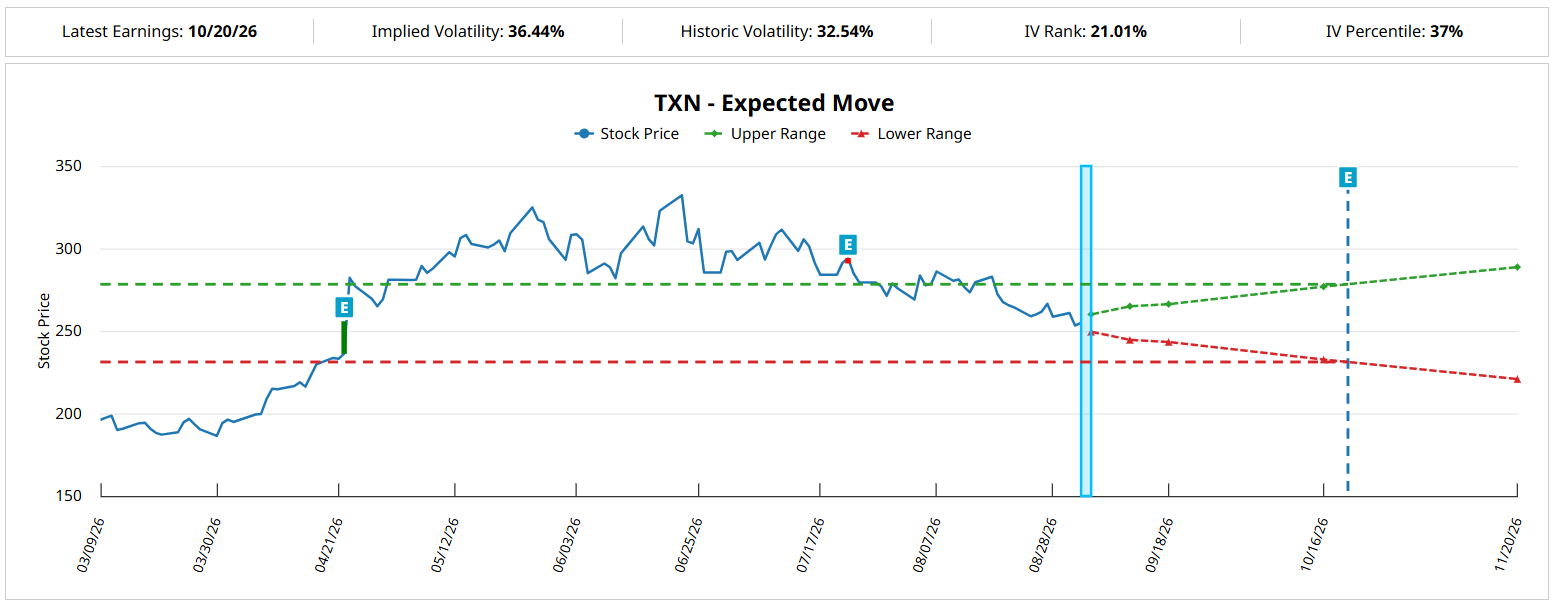
What is the chance that Texas Instruments stock triggers the $270 strike on Oct. 16? When you reverse engineer Barchart’s Expected Move calculator, you get a lowly 30.84%.
In other words, if you run an expected value (EV) calculation, you would end up losing more money than winning over the theoretical long run. At this point, most financial experts would have you turn away from this spread. However, there’s one important aspect to keep in mind.
A Clash of Presuppositions
Any time you deal with the unknown future, your forecast is going to be presuppositional. Basically, that’s a high-brow way of saying that the above probabilities are not necessarily the Gospel truth. They are the truth but within a presupposed framework. If you presuppose another framework, you may get entirely different odds.
That’s why I believe TXN stock might not be as risky as Wall Street’s numbers make it appear to be. Because these implied probabilities are based off the assumption that TXN will undergo a random walk between now and the expiration date (with the current implied volatility serving as the constant “fuel” across the journey), the framework that is being used is purely random and risk-neutral.
Personally, I believe that Texas Instruments stock will undergo a risk-biased journey to expiration. That’s because in the past 10 weekly sessions, only three of the candlesticks were positive, thus leading to an overall downward slope across the period. While there’s nothing intrinsically special about this discretized 3-7-D quantitative sequence, the static snapshot indicates bearish order flow imbalance.
As it turns out when analyzing historical data, the aforementioned signal has materialized 30 times on a rolling basis since January 2019. Of this tally, there have been 15 instances where TXN stock has triggered the equivalent of the $270 strike on week 6 (roughly coinciding with the Oct. 16 expiration date).
Admittedly, the sample size is quite small. Still, based on the data, we can inductively infer that the odds of Texas Instruments stock hitting $270 at expiration may be 50%.
That’s not an overwhelmingly great ratio. But it’s a lot better than 30.84%, which suggests that the TXN stock call spread may be more rational than it might initially appear.
On the date of publication, Josh Enomoto did not have (either directly or indirectly) positions in any of the securities mentioned in this article. All information and data in this article is solely for informational purposes. For more information please view the Barchart Disclosure Policy here.