
Initial jobless claims in the US rose slightly to 206,000, and the “low recruitment and low sanctions” pattern in the labor market has not changed
The Zhitong Finance App learned that according to data released by the US Department of Labor on Thursday, the number of seasonally adjusted initial jobless claims for the week ending August 29 was 206,000, an increase of 2,000 over the previous week's revised value, slightly higher than the 205,000 expected by economists. Although the data is at a new high since the week of August 15, the number of initial applicants continued to hover at the lower end of the range of 189,000 to 230,000 this year, which is in line with what economists describe as “slow recruitment and slow dismissal” labor market conditions.
Meanwhile, for the week ending August 22, the number of renewed jobless claims (an indicator measuring willingness to hire) increased by 8,000 to 1.779,000, lower than market expectations of 1.795,000. The moderate rise in the number of renewals indicates that the cycle for the unemployed to find new jobs has been extended, but overall it is still at a historically low level.
The pattern of “slow recruitment and few layoffs” in the US job market has not changed
According to an independent report by Challenger, Gray & Christmas, US companies announced 52,881 layoffs in August, an increase of 58% over the previous month, but a 38% year-on-year decline, the lowest level since August 2022. A total of 529,914 workers were laid off in the first eight months of this year, down 41% from the same period in 2025.
However, recruitment has not kept up. Despite a 37% year-on-year increase in recruitment plans announced by companies in the first eight months, Challenger notes “these positions don't seem to be being filled quickly.” The Beige Book report released by the Federal Reserve on Wednesday also confirmed this judgment: the number of employed people rose “slightly” in August, with the highest demand for labor in manufacturing, construction, and some service industries, while demand in the retail and hospitality industries declined.
The report shows that overall employment across the US showed a “very slight” increase. Of the 12 Federal Reserve regions, 3 reported a moderate increase in employment, 4 a slight increase, and 5 no change. The report collected data as of August 24. The Beige Book also pointed out that the US economic growth is increasingly dependent on a few projects such as AI data centers, while inflationary pressure is still stubborn.
Non-agricultural data became a “key variable” for interest rate hikes, and the market focused heavily on Friday's report
Federal Reserve Chairman Kevin Walsh made it clear at the Jackson Hole Global Central Bank Annual Meeting last week that if policymakers do not get enough confidence that the inflation rate is falling to the 2% target level, the Federal Reserve will “have a lot of work to do.” The CME FedWatch tool shows that the market's probability of raising interest rates by 25 basis points in September has soared from about 34% before Walsh's speech to more than 60%.
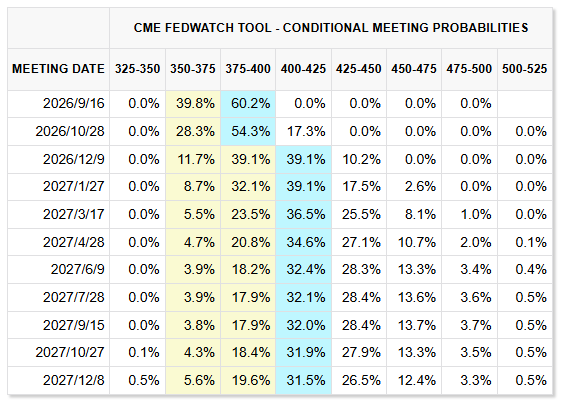
The August non-farm payrolls report to be released on Friday will be a key variable in the decision to raise interest rates. Market focus has turned to the August non-farm payrolls report released on Friday. According to the survey, economists expect non-farm payrolls to increase by about 56,000 in August, and the unemployment rate will remain unchanged at 4.1%. The number of non-agricultural accidents decreased by 23,000 in July, when combined with a total of 103,000 repairs in May and June, indicating a marked cooling of the labor market.
ADP data further strengthened the judgment on a moderate recovery in employment. The private sector added only 38,000 jobs in August, below expectations of 48,000, the slowest growth rate since January this year. Among them, education and health care increased by 45,000, but manufacturing decreased by 17,000, and professional and commercial services decreased by 16,000.
Bank of America analysts pointed out that non-farm payrolls data “is unlikely to be a decisive factor in whether to raise interest rates in September,” but a clearly weak report may reduce the possibility of interest rate hikes.
Analysts expect that the rebound in non-farm payrolls in August will be partly reflected in the recovery of wages in local government education departments, but given the recent expiration of temporary protection status for hundreds of thousands of Haitians, affecting their work permits, the possibility of a second consecutive month of decline in employment cannot be ruled out. With no significant deterioration in the labor market, economists expect the Federal Reserve to raise interest rates as early as this month to deal with continued inflationary pressure caused by import tariffs and the war with Iran.