
Is the “butterfly effect” of the foreign exchange market about to be staged? 41% hedging lays a script to accelerate the depreciation of the US dollar, and the $230 billion sales market is ready to go
The key logic surrounding the current “wave of depreciation transactions” surrounding the US dollar is not the expectation that the Fed will cut interest rates, but rather that the two traditional pillars of the US dollar are loosening at the same time: on the one hand, interest spreads between the US and other economies have narrowed, reducing foreign exchange hedging costs; on the other hand, the US Treasury's actions to reduce the US Treasury's long-term US bond yield benchmark financing costs and concerns about monetary policy independence are weakening the dollar's credibility as a safe-haven asset during the crisis. The US dollar has fallen by about 2% this quarter, and its trend is increasingly decoupled from nominal and real returns, indicating that the market's pricing focus is shifting from “interest rate advantage” to “policy and fiscal credit.”
The Zhitong Finance App observed that what is really worth being wary of recently is the abnormally low dollar hedging ratio of global institutional investors. As of June 30, institutional investors in six markets, including Japan, Canada, and Taiwan, had only hedged 41% of their foreign currency exposure, the lowest level since at least 2015; based on their 4.6 trillion US dollar foreign currency assets, only a 5 percentage point increase in the hedging ratio could form a large-scale sales transaction of about 230 billion US dollars.
This does not actually mean that investors will immediately sell off US stocks or US bonds worth 230 billion US dollars. Instead, they may sell US dollars and buy local currency through derivatives such as foreign exchange forwards and swaps while retaining US assets. Therefore, it is a potential selling pressure on the US dollar exchange rate; it is not a spot sell-off that has occurred or is inevitable. However, this data also poses an asymmetric risk: the current low hedging does not directly depress the dollar, but once the dollar stops appreciating in a safe-haven environment in the market, pension and insurance institutions may concentrate on selling dollar forward contracts, forming a negative feedback cycle of “falling dollar — additional hedging positions — further decline in the dollar.”
This doesn't mean that global investors must sell off US stocks or US bonds. Institutions can fully continue to hold US assets and at the same time hedge the exchange rate by selling the US dollar through derivatives, so demand for US assets and the trend of the US dollar may further diverge. Japan may potentially be the biggest trigger for the surf wave, and the euro may become the main beneficiary currency; however, from a long-term investment perspective, the relative policy path of the Federal Reserve and other central banks is still the basic pricing variable for the US dollar, and hedging is more likely to amplify the existing decline rather than create a new round of dollar bears alone.
Low hedging lays down potential sales, and the risk of open US dollar positions has risen to historical extremes
Looking through the reporting documents of pension funds and insurance companies around the world, one thing stands out: some of the largest holders of US assets provide little hedging protection against the weakening dollar; once market sentiment suddenly reverses, the US dollar index may face the risk of a sharper decline.
As of June 30, these investors had only hedged 41% of their foreign currency exposure in markets such as Japan, Canada, and Taiwan — the lowest level since at least 2015, according to the agency's estimates using data from six markets where relevant data is available. Although this is not a complete picture, it gives a glimpse: Last year, the crazy short-term hedging boom against the risk of dollar depreciation triggered by US President Donald Trump's extreme tariff policies around the world subsided as the dollar gradually stabilized.
As hedging ratios decline, investors are readopting strategies that have worked for most of the past decade. When market volatility intensifies, the US dollar index tends to rise, or at least stay strong, to cushion the loss of these assets when US stocks and bonds are converted back to investors' native currency. At the same time, investors have little incentive to pay for this protection due to the long-term high cost of hedging.
The risk today is that the two pillars underpinning this strategy — high hedging costs and the dollar's safe-haven currency status — are being challenged simultaneously.
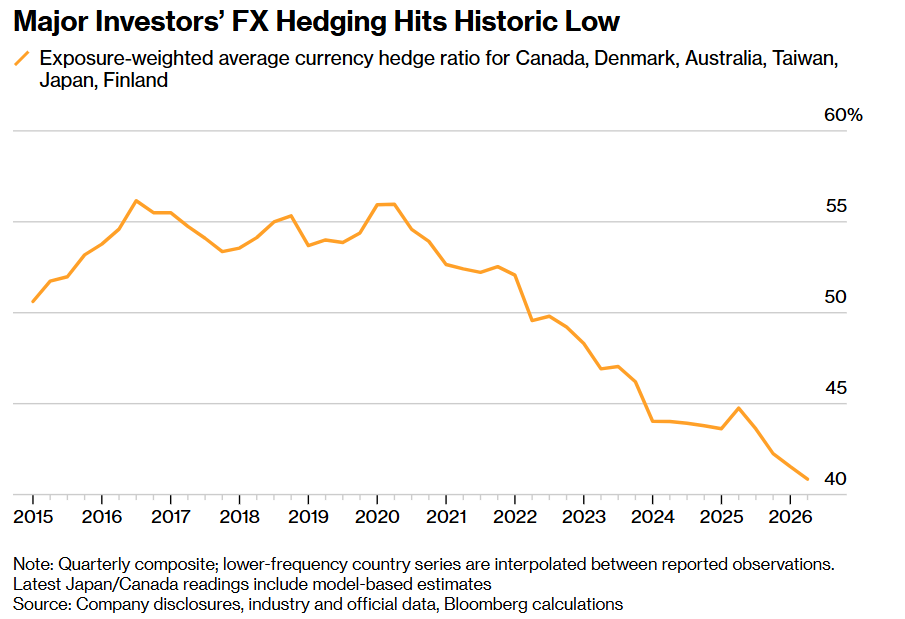
As shown in the chart above, the foreign exchange hedging ratio of major investors fell to near the lowest level in history. Note: Quarterly comprehensive data; less frequent major holding data are interpolated between published observations. The latest readings from Japan and Canada include model-based estimates.
As investors re-aggressively bet on “currency depreciation deals” — that is, the US policy will erode the value of the dollar — the dollar has fallen by about 2% this quarter, weakening against most G10 currencies. US Treasury Secretary Scott Bessent's support for the yen and measures to curb the rise in US Treasury yields can be described as further fueling these concerns; at the same time, the market also doubts whether Walsh will curb inflation by raising interest rates as Trump pushes Federal Reserve Chairman Walsh to actively reduce borrowing costs.
Foreign exchange hedging protects investors from exchange rate fluctuations by selling dollars and buying investors' local currency through derivatives. Since US assets account for a large share of global investment portfolios, an increase in the size of hedging actually means an increase in dollar sales.
Laura Cooper, head of macrofinance at Nuveen in London, a subsidiary of Invesco, which manages $1.4 trillion in assets, said: “Considering the size of US assets held by foreign investors, positions do not need to change drastically; it is enough to have an impact on the market. Foreign investors hold large US assets, so even a slight change in hedging ratios may result in substantial foreign exchange capital flows.”
According to Bloomberg's estimates based on these six markets' total foreign currency assets of 4.6 trillion US dollars, every 5 percentage point increase in institutional investors' hedging ratio will translate into about 230 billion US dollars in currency sell-off transactions.
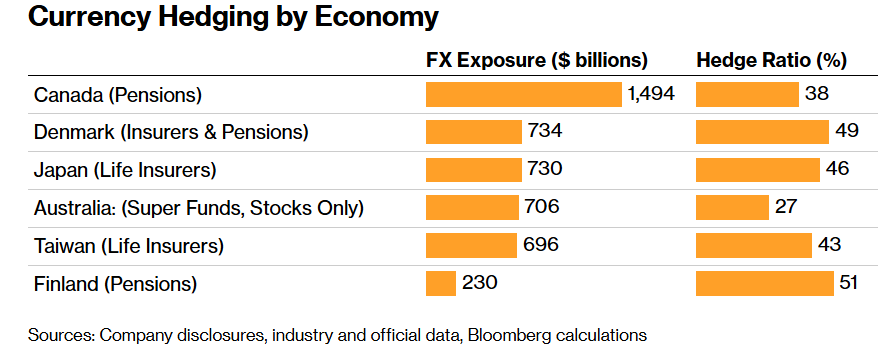
The picture above shows the currency hedging situation of major economies.
This latest estimate does not cover major markets such as the UK and the Eurozone, but the countries covered still account for a significant portion of foreign holdings of US assets. Japan is the world's largest overseas holder of US Treasury bonds, accounting for about 10% of foreign holdings; Canada and Taiwan also rank among the top ten holders.
Hedging costs have declined, safe-haven attributes have wavered, and the US dollar's two lines of defense rarely loosened at the same time
The factors that drove the hedging ratio to continue to decline from more than 50% over the past four years are now beginning to change.
Interest spreads that once made hedging expensive are narrowing. For investors using yen as the local currency, the three-month dollar hedging cost has dropped from a high of 6% in October 2023 to a four-year low of 2.75%; for investors using the euro as the local currency, the hedging cost has dropped to 1.32%, a two-year low.
Demand for hedging has also reversed in the past. According to Deutsche Bank data, a year ago, the inflow of funds received from dollar-hedged exchange-traded funds that invested in US assets surpassed non-hedged funds for the first time in ten years. Today, the war in Iran and soaring energy prices are increasing inflationary pressure, driving central banks around the world to shift to higher interest rates, and narrowing the spread between them and the US.
The outlook for US interest rates is less clear, and Walsh's policy communication makes it difficult for investors to judge how hard he will fight inflation. He promised at Jackson Hole last Friday to contain price pressure, driving the market to raise expectations for interest rate hikes. But investors are also weighing the Trump administration's pressure to control borrowing costs, especially as the midterm elections approach.
Nathan Tuft, chief investment officer of the multi-asset solutions team from asset management giant Manulife Investment Management, said, “If the market continues to reverse pricing on the Fed's interest rate hike while interest spreads narrow further, investors may begin to rebuild these hedging positions. This will create continuing pressure on the dollar to sell.”
“The trend of the dollar has increasingly been decoupled from nominal and real returns as policy and fiscal credibility have replaced interest spreads.” Tatiana Darri, senior market live strategy expert at Bloomberg Strategists, said.
Stewart Simmons, head of multi-asset solutions at QIC Ltd., one of Australia's largest state-owned asset management agencies, said that using a foreign currency basket with a US dollar exposure of up to 70% as a defensive tool may no longer work.
Simmons said, “In an age of heightened geopolitical uncertainty, are you really so sure that the US dollar will still be the main vehicle for defensive transactions in the future? Our recommendation is to examine other alternatives in the market and ensure greater diversification within the foreign currency basket.”
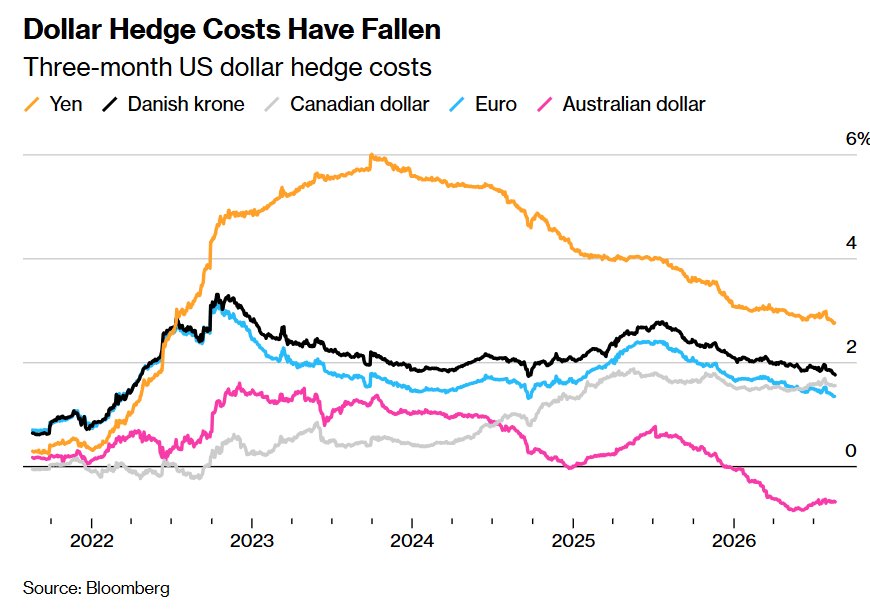
As shown in the chart above, the dollar hedging cost has declined — the three-month dollar hedging cost has declined rapidly.
The strong position of the US dollar is also being questioned. The US Treasury's plan to increase purchases of long-term treasury bonds to curb borrowing costs, and the coordinated intervention of the US and Japan in the yen raised market concerns about whether the authorities would be willing to support the market and other currencies at the expense of the dollar.
Nuruddin Alhamuri, chief market strategist from Dubai Equiti Group, said: “If investors' confidence in whether the dollar can reliably appreciate during periods of market pressure declines, they may no longer be willing to tolerate huge unhedged exchange rate exposure.”
Investors are not required to sell their US assets. They can continue to hold stocks or US Treasury bonds while increasing exchange rate hedging by selling dollars forward. He added: “This difference is important because it means demand for US assets can remain relatively strong even when the dollar is under pressure.”
Japan may become another hedging tipping point, and the euro is waiting to handle the dollar spillover
As home to some of the largest overseas holders of US assets, the potential for Japanese investors to shift to increased hedging is probably the most significant. Deutsche Bank's estimates of Japanese investors show a similar trend: in the first half of this year, they only hedged 41% of new overseas market treasury bonds or corporate bond purchases, far lower than 62% in 2024.
Shoki Omori, the chief fixed income strategist at Deutsche Bank based in the Japanese market, said, “The last time hedging positions were so thin was in 2013, when the US dollar was entering a 10-year bull market. Today's macro environment is more like a mirror image of that time, that is, an image that is reversed or completely corresponding to the left and right, as reflected by a mirror.”
Omori believes there are three potential catalysts: the Bank of Japan raised interest rates further, thereby narrowing interest spreads; the sharp decline in the US dollar, which led to increased losses and prompted risk committees of large institutions such as Japan Life Insurance to demand increased protection; and a new solvency regulation system that made Japanese insurance giants less tolerant of exchange rate fluctuations.
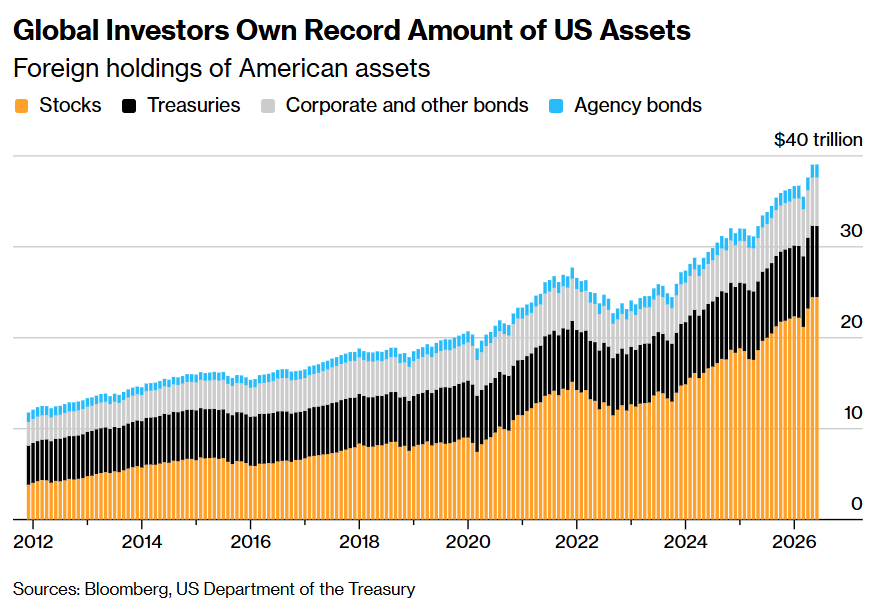
The chart above shows that US assets held by global investors have reached a record high — based on US assets held by foreign investors.
Eric Nelson, a senior strategist from Wells Fargo, warned that hedging should not be viewed as a fundamental driver of the dollar, as monetary policy is likely to remain dominant in the longer term. However, he believes that as the cost of shorting the US dollar falls, investors still have room to increase their exposure to the US dollar hedging allocation.
Nelson expects the euro to be the main beneficiary given European funds buying large amounts of US stocks without exchange rate hedging. He said, “Once there are signs that the US dollar is not performing well in a safe-haven environment, foreign exchange hedging behavior may quickly shift, thereby exacerbating the sharp decline in the US dollar index.”