
Wendy’s Just Cut Its Dividend in Half. Consider It a Warning Sign, Not a Reset.
Wendy’s (WEN) dividend cut has transformed a familiar restaurant-income story into a test of management’s turnaround strategy. The fast-food chain recently reduced its quarterly cash dividend by half to $0.07 per share, and withdrew its 2026 financial outlook after a difficult second quarter that included a 7% decline in U.S. same-restaurant sales.
At first glance, the decision appears to be a sensible financial reset. New CEO Bob Wright did not sugarcoat the company’s problems, saying Wendy’s is “not performing at [its] potential” as its quality differentiation eroded, its value proposition weakened, and customer-experience consistency slipped.
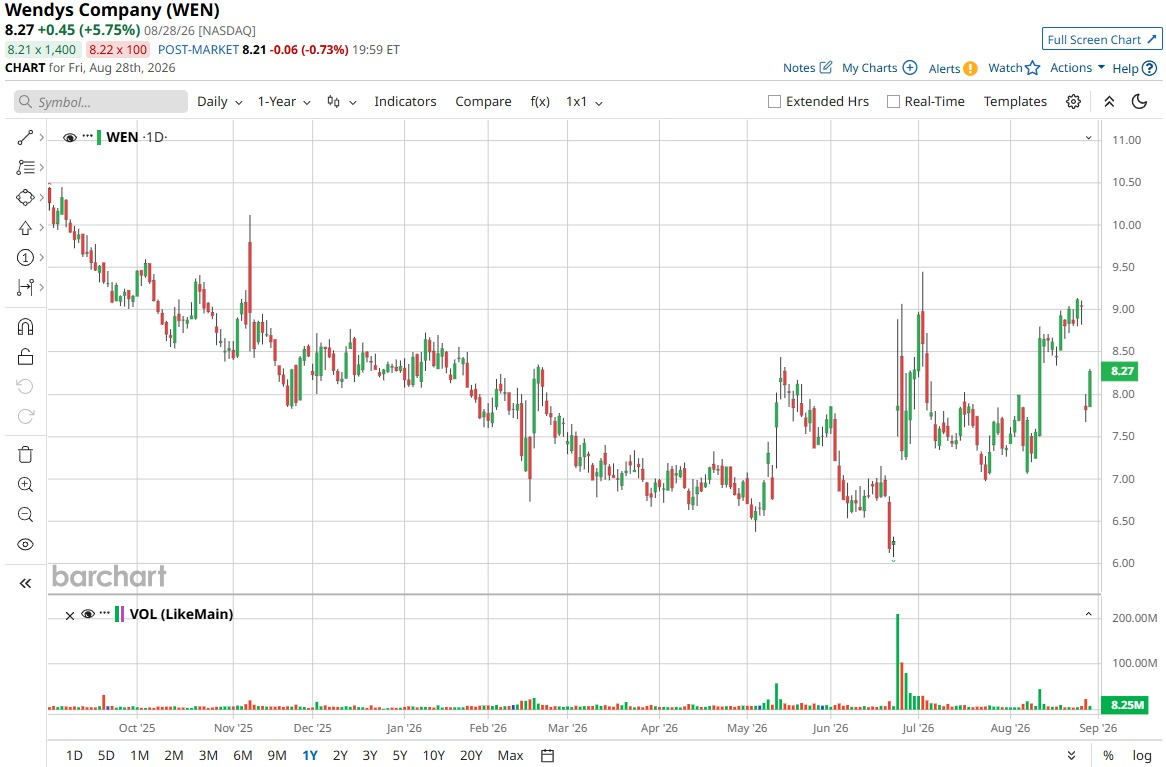
Even so, the market’s response has been mixed rather than uniformly supportive. WEN stock climbed to $9.14 per share in the weeks after the news but has fallen 8% over the past five trading days.
That leaves investors with a more complicated question. Is this dividend cut a disciplined reset that gives Wendy’s the resources to rebuild its business? Or is it a warning that the iconic fast-food brand faces a more difficult road ahead? Let’s dive in.
Wendy’s Numbers
Based in Dublin, Ohio, Wendy's operates and franchises quick-service restaurants serving made-to-order burgers, chicken sandwiches, nuggets, Frosty desserts, and more. Founded in 1969, the company and its franchisees employ hundreds of thousands across more than 7,000 restaurants globally. Wendy's has a market capitalization of roughly $1.57 billion.
WEN stock closed at $8.27 on Sept. 1. Shares are relatively flat year-to-date (YTD) but down 19% over the past 52 weeks.
At 11.8 times trailing earnings and 4.6 times cash flow, WEN stock trades below the sector medians of 15.2 times and 9.6 times, respectively.
The newly listed forward annual dividend is now $0.28 per share, which equates to a 3.4% yield. The next $0.07 quarterly payment is due on Sept. 15, 2026, to shareholders of record on Sept. 1, 2026.
Wendy’s released its second-quarter results on Aug. 7, covering the period ended June 28. The company reported $570.6 million in revenue, exceeding the consensus estimate and rising 1.7% year-over-year (YOY). Adjusted revenue slipped 1.4% to $443.2 million as franchise royalty revenue fell. The company reported adjusted EPS of $0.18, topping the $0.16 consensus estimate but still down 38% from $0.29 a year earlier.
Wendy's generated $124.1 million in adjusted EBITDA during the quarter, edging the $121.6 million analyst estimate by 2.1%. The company's 21.7% adjusted EBITDA margin showed the franchise model’s cash-generative capacity. However, adjusted EBITDA declined more than 15% YOY, revealing the strain beneath the earnings beat. Operating margin also fell to 13.9% from 18.6% a year earlier. This deterioration reflected lower traffic, commodity inflation, higher labor rates, and weaker franchise royalty revenue.
Net income sank 41% to $32.6 million. That said, first-half operating cash flow rose about 10% to $160 million, while Wendy’s produced $37.1 million in net cash flow during the June quarter. This cash-generation cushion supports management’s decision to retain capital for its turnaround.
Wendy’s Dividend Cut Changes the Investment Case
The dividend cut was not an isolated decision. On Aug. 7, the company reduced its quarterly cash dividend from $0.14 to $0.07 per share. That 50% reduction lowered its annualized payout to $0.28 per share and came with the withdrawal of its 2026 financial outlook.
The company has competing demands for its cash. CEO Bob Wright is developing a turnaround plan after identifying weaker menu differentiation, value perception, and customer experience consistency. His priorities include menu quality, compelling value, marketing, restaurant operations, digital engagement, and domestic unit growth.
Those investments are needed because Wendy’s U.S. business is losing momentum. U.S. same-restaurant sales fell 7% during Q2. Domestic systemwide sales declined 8.2%, while global systemwide sales fell 6.5% to about $3.4 billion.
Restaurant closures add further urgency. Wendy’s opened 21 U.S. restaurants during the quarter, but its domestic system contracted by 81 locations on a net basis. Net domestic closures reached 245 restaurants through the first half of 2026.
Wendy’s can still generate meaningful cash. Free cash flow increased 9.9% to $120.3 million, while cash and equivalents totaled $341.2 million as of June 28. Meanwhile, long-term debt stood at $2.72 billion at quarter-end, and net interest expense increased to $33.9 million from $30.9 million a year earlier.
The company has also suspended share repurchases, making no buybacks during Q2. Roughly $35 million remained under its existing authorization as of July 31.
Wendy’s can likely fund the reduced dividend, but restoring the old payout would be difficult to justify before the core business improves. A larger dividend would again become a recurring commitment. That could limit investment in value, marketing, restaurant modernization, and franchisee support.
So, is the Wendy’s dividend cut a reset or a warning sign? The dividend cut is a necessary reset, but it remains a warning sign until the company proves that retained cash can improve results.
Wall Street Remains Skeptical
Wall Street’s cautious stance reflects the uncertainty surrounding Wendy’s turnaround. The company is scheduled to report Q3 results on Nov. 6, and analysts expect quarterly earnings of $0.10 per share. That would represent a 58% decline from $0.24 in the prior-year period.
That low earnings bar has kept individual analysts cautious. KeyBanc maintained a “Sector Weight” rating on WEN stock after Wendy’s withdrew its 2026 guidance and cut its dividend. BMO Capital Markets also maintained a “Market Perform” rating with an $8 target, reflecting potential downside of 2% from current levels
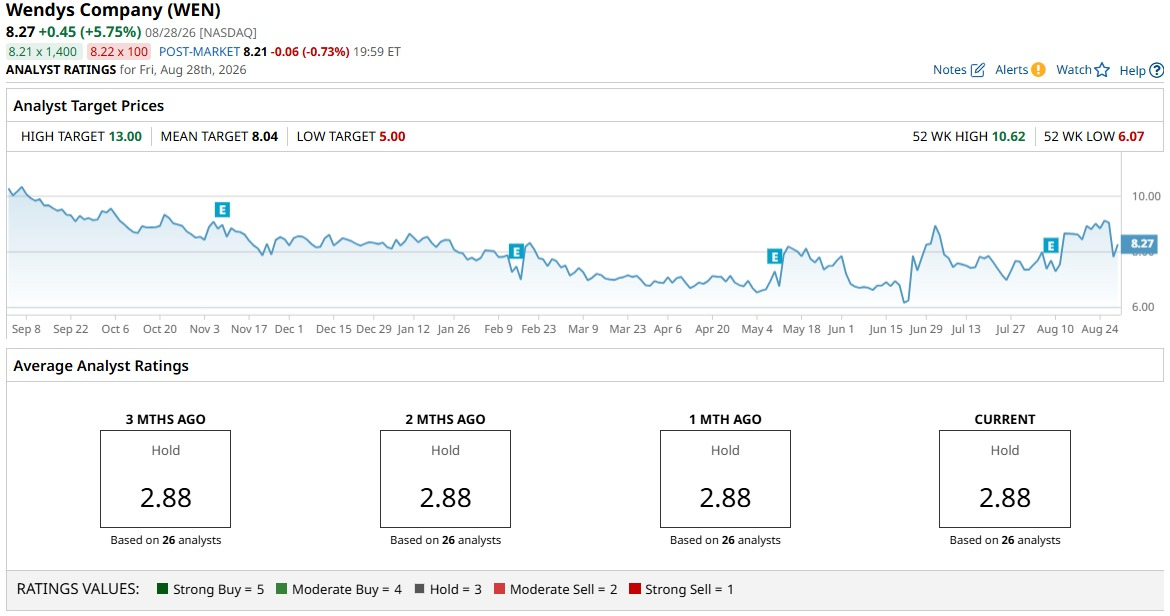
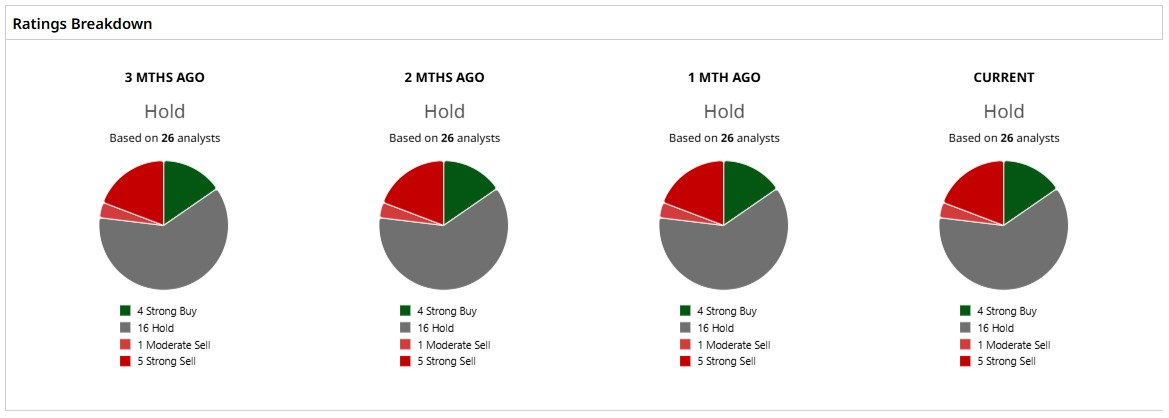
The broader consensus is a “Hold” rating based on 26 analysts covering the stock. The average price target of $8.06 implies potential downside of almost 2% from where WEN stock trades today.
Conclusion
Wendy’s dividend cut is more warning sign than clean reset, even if preserving cash is the sensible move. The company still generates cash, but declining U.S. sales, weaker margins, and restaurant closures leave little room for missteps. A slow turnaround appears more likely than a quick recovery. WEN stock may reward patient turnaround investors, but income-focused buyers should wait until sales and margins show lasting improvement.
On the date of publication, Ebube Jones did not have (either directly or indirectly) positions in any of the securities mentioned in this article. All information and data in this article is solely for informational purposes. For more information please view the Barchart Disclosure Policy here.