
Sonos (SONO) Stock Looks Fairly Valued On Cash Flow But Overvalued On Earnings
Sonos stock has delivered a steep decline over five years, yet the current market price sits close to an intrinsic value estimate from a Discounted Cash Flow (DCF) model while earnings based multiples still make the shares look expensive.
- Over the past five years, Sonos has fallen about 61%, which means long term holders have faced a heavy drawdown that now frames how attractive any future upside might look.
- The key support for the valuation is the company’s ability to convert product demand into steady cash generation. The main risk is that profitability or cash flow timing underwhelms and leaves limited room to justify today’s pricing.
- The broader checks give Sonos a low value score, with only 2 of 6 indicators screening it as cheap, which leans more toward an expensive stock than a clear bargain today.
The issue now is whether Sonos offers enough long term value from this starting point to compensate investors for the mixed valuation signals.
Compare Sonos with a curated group of companies by scanning 50 high quality undervalued stocks that also blend cash generation potential with what currently screens as attractive pricing.
Is Sonos Fairly Priced on Cash Flow?
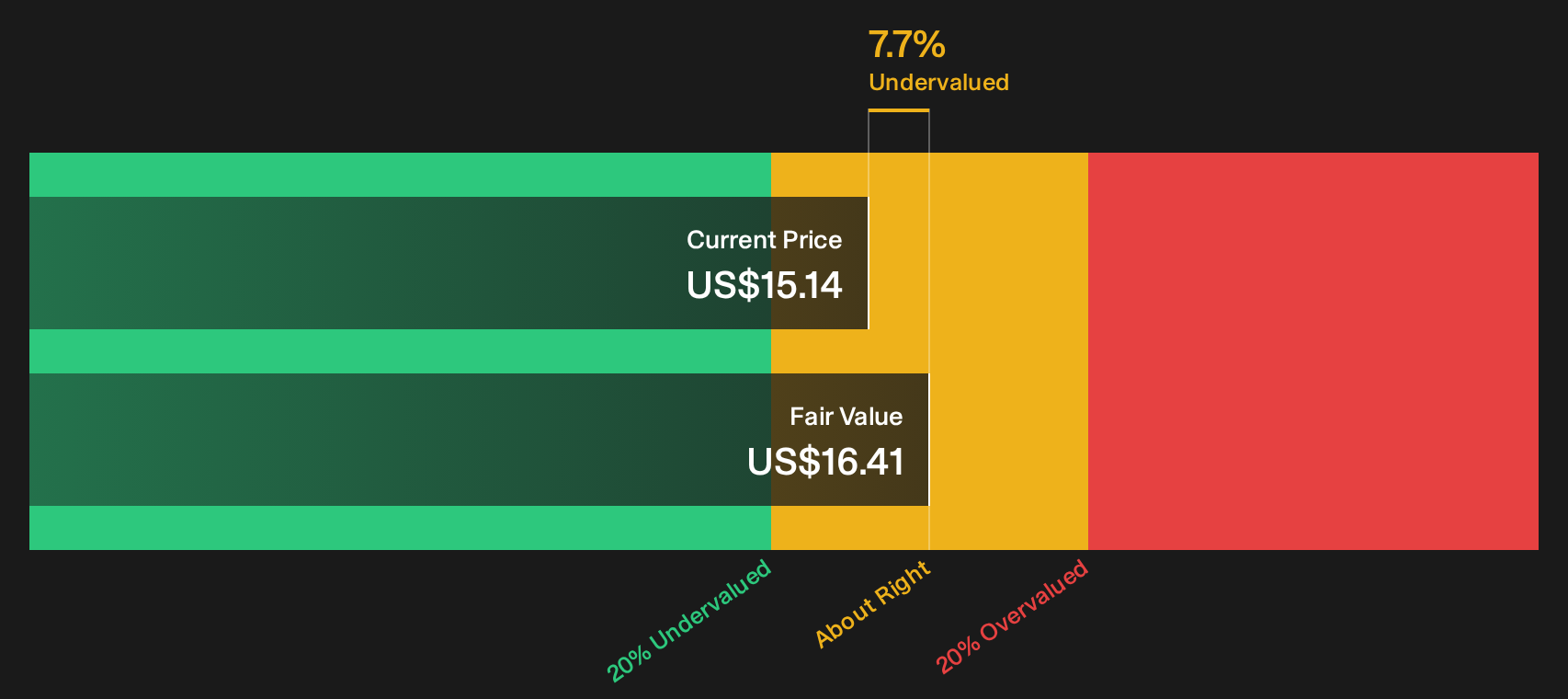
The Discounted Cash Flow (DCF) approach here focuses on the cash Sonos can generate for shareholders over time. The latest twelve month free cash flow is about $110.1 million, which gives the model a cash based foundation rather than relying only on accounting earnings. Projections assume Sonos continues to produce growing free cash flow over the coming years, with estimates extending into the early 2030s.
On these assumptions, the DCF model points to an intrinsic value of about $16.41 per share. That is only a modest 7.7% gap to the current market price, which suggests Sonos stock is roughly in line with what its projected cash generation supports rather than offering a clear margin of safety.
Overall, the DCF work up indicates Sonos looks fairly valued at today’s share price.
Sonos is fairly valued according to our Discounted Cash Flow (DCF), but this can change at a moment's notice. Track the value in your watchlist or portfolio and be alerted on when to act.
Has Sonos Run Too Far on Earnings?
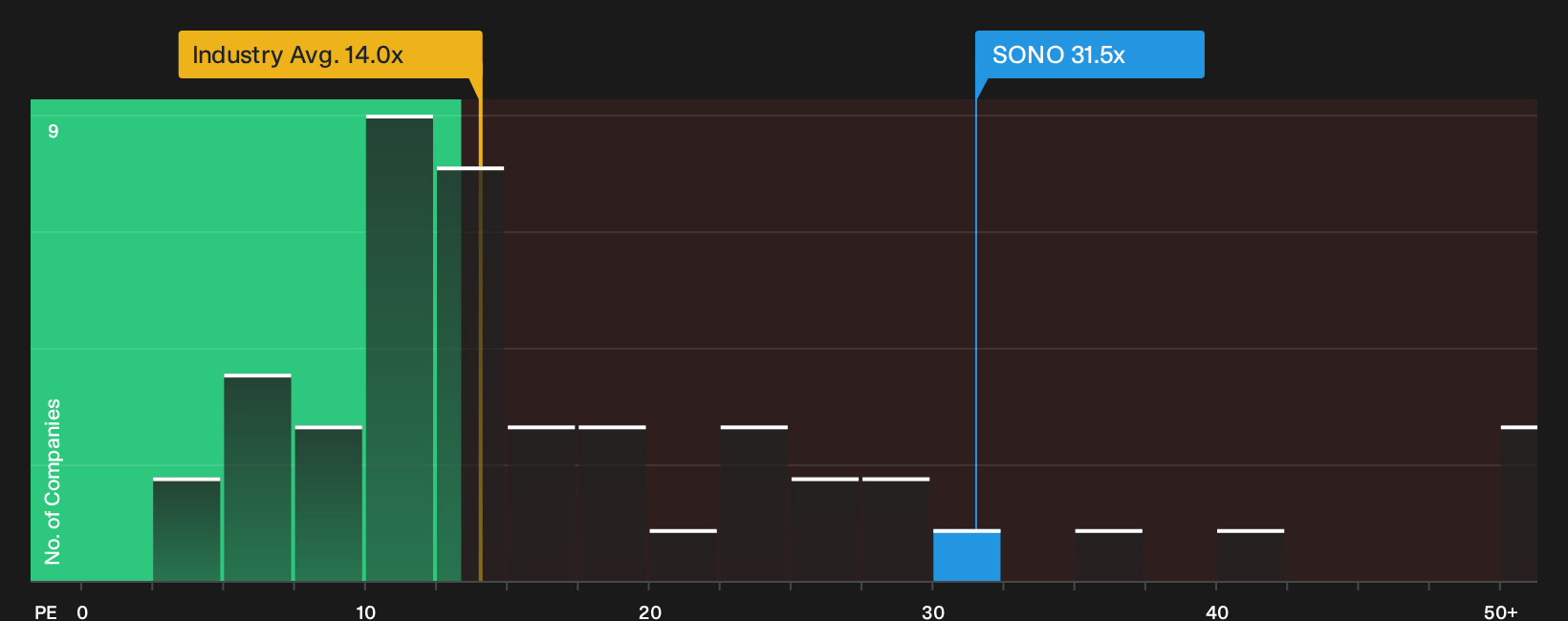
The P/E multiple suits Sonos because the company is now being valued primarily on its earnings power rather than only on sales or assets. On this basis, Sonos trades on a P/E of about 31.5x, which is well above the Consumer Durables industry average of roughly 14.0x and also above the selected peer group average of about 17.8x. That puts the stock on a clear premium earnings multiple compared with many similar companies.
A tailored fair P/E ratio for Sonos, which blends its growth profile, margins, size and risk, comes out at about 22.4x. The current 31.5x level therefore sits materially higher than this fair ratio and indicates a meaningful valuation gap. To close that gap, Sonos would need either a lower share price or stronger earnings than are currently implied by this framework.
On the P/E test, Sonos stock currently appears overvalued relative to what its earnings and risk profile would typically justify.
See what the numbers say about this price — find out in our valuation breakdown.
The Sonos Narrative: What Would Justify Today's Price?
Simply Wall St Narratives for Sonos give you a clear bridge from this valuation puzzle to the specific future paths that could make Sonos' stock worth materially more or less than it is today, and they sit on the company's Community page. Where a single ratio or model offers one outcome, these narratives describe the growth, margin and earnings patterns that outcome relies on so you can watch how the real business compares over time.
One of the top community narratives on Sonos: roughly fairly valued
"Sonos's focus on software-driven platform expansion, operational efficiency, and customer retention is boosting profitability, differentiation, and financial resilience despite cyclical challenges..."
Read one of the top narratives on Sonos
Do you think there's more to the story for Sonos? Head over to our Community to see what others are saying!
The Bottom Line
Sonos looks close to its intrinsic value on a Discounted Cash Flow (DCF) view, while the earnings multiple still screens as overvalued compared with peers and a tailored fair P/E. The low overall value score underlines that most cross checks do not flag the stock as cheap despite the DCF support. What really separates bulls and bears from here is whether Sonos can sustain cash generation strong enough to validate both the intrinsic value estimate and the premium earnings multiple investors are currently paying.
This article by Simply Wall St is general in nature. We provide commentary based on historical data and analyst forecasts only using an unbiased methodology and our articles are not intended to be financial advice. It does not constitute a recommendation to buy or sell any stock, and does not take account of your objectives, or your financial situation. We aim to bring you long-term focused analysis driven by fundamental data. Note that our analysis may not factor in the latest price-sensitive company announcements or qualitative material. Simply Wall St has no position in any stocks mentioned.
Have feedback on this article? Concerned about the content? Get in touch with us directly. Alternatively, email editorial-team@simplywallst.com