
The Reserve Bank of New Zealand raised interest rates twice in a row, and global central banks entered “data-dependent austerity”! “Higher and Longer” returns to the main pricing line of the market
The Zhitong Finance App learned that the New Zealand Federal Reserve adjusted the benchmark interest rate twice in a row at the central bank's monetary policy meeting with the aim of shifting to less stimulating policy settings to prevent potential inflationary pressure. The Reserve Bank of New Zealand's monetary policy committee raised the official cash rate by 0.25 percentage points to 2.75% in Wellington on Wednesday, in line with economists' general expectations. The New Zealand Federal Reserve's new forecast shows that interest rates may be raised by another 0.25 percentage points before the end of this year, and the possibility of pushing interest rates to a neutral level of around 3% will continue to rise.
It is worth noting that the New Zealand Federal Reserve members' latest official cash rate average forecast for the fourth quarter unexpectedly showed a slight drop to 2.81% from the previous 2.84%, and core inflation remained stable at 2.7%. Therefore, this was a “hawkish interest rate hike and relatively cautious forward guidance” decision, driving the New Zealand dollar down to 58.59 cents and the two-year treasury yield down 6 basis points to 3.59%. It highlights that the New Zealand Federal Reserve's policy focus has shifted from stimulating the economy to preventing overall inflation of 4.1% from solidifying, but it does not predict a continuous rapid rate hike to fight inflation.
As of September 2, against the backdrop of deteriorating geopolitics in the Middle East, the intensification of energy shocks, the accelerated expansion of fiscal deficits in Western countries, centralized debt issuance by the government and technology companies triggered an expansion of maturity premiums, and global central banks re-tightened inflation constraints, which can be described as recently jointly triggering a new round of sell-off of global long-term treasury bonds of 10 years or more.
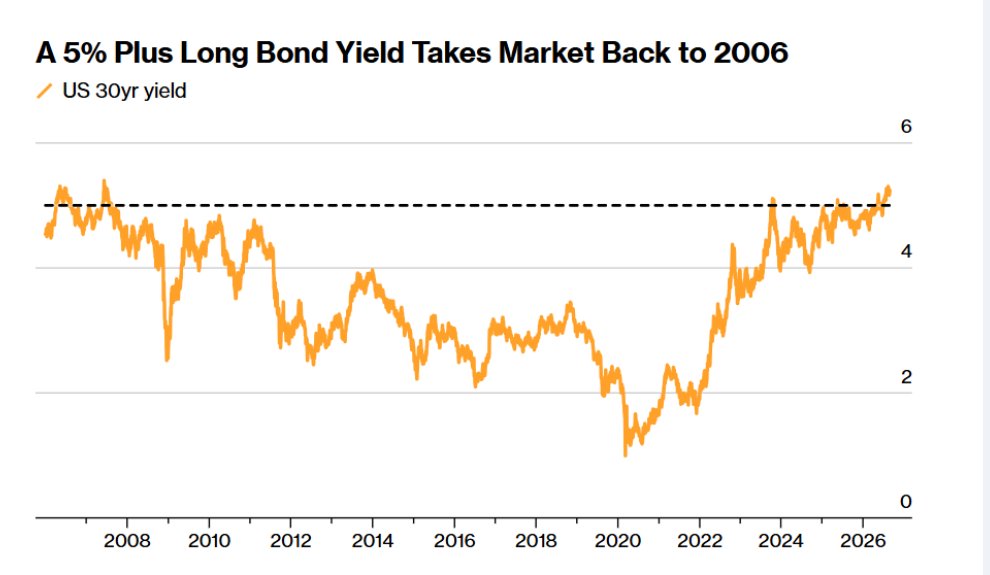
According to LSEG statistics, US 10-year Treasury yields rose to 4.798%, 30-year Treasury yields rose to 5.27%; Japan's 10-year Treasury yield exceeded 3%, the first time since 1996; German 10-year Treasury yields rose to 3.35%, while the UK 10-year Treasury yield rose to 5.25%. Brent crude oil returned above $92 per barrel, and the US-Iran conflict further strengthened the transmission chain of “energy inflation — expectations of interest rate hikes — rising term premiums.”
The longer-term US 30-year Treasury yield of 5% or more has been the highest since 2006. The US-Iran conflict has escalated from “US military bombing of Larak Island — Iran attacks US military bases in Jordan” over the weekend to the second round of direct fire in three days.
The US military intensively attacked Iran's Revolutionary Guard's air defense, radar, naval combat, mine-laying and communications facilities on Tuesday. Iranian media also reported explosions at Ahwaz, Giloft Airport, Chabahar, Bandar Abbas, the energy hub of Assaruyeh, and near Qeshm Island; Iran then attacked US military facilities in Jordan with ballistic missiles and drones, and claimed to attack US military targets in Bahrain. The Strait of Hormuz, which is essential for global energy transportation, has become a real center of combat. Two supertankers each carrying about 2 million barrels of Saudi crude oil were hit by UFOs within minutes near Oman.
From Jackson Hole to Wellington, the central bank's “hawk voice” breaks through global long-term debt
The Reserve Bank of New Zealand raised interest rates by 25 basis points for the second time in a row, raising the official cash rate to 2.75%, with the aim of removing monetary stimulus and curbing overall inflation, which had risen to 4.1%; however, its average interest rate forecast for the fourth quarter was lowered from 2.84% to 2.81%, and did not promise to continue raising interest rates in October.
Although the inflation forecast for the third quarter was raised to 3.9%, and the return to the 2% midpoint target was delayed until the beginning of 2028, core inflation stabilized at 2.7% and long-term expectations were still well anchored, which means that the New Zealand Federal Reserve is more likely to discuss the next rate hike in December after observing the continuation of economic recovery, rather than act continuously in October and December; this policy direction, along with Australia's renewed interest rate hike and Walsh's strengthening of US inflation vigilance, shows that central banks around the world are rapidly shifting from a one-way interest rate cut narrative to “data-dependent and cautious monetary tightening” to maintain high interest rates for longer ( This is the so-called higher-for-longer (higher and longer) stage.
Walsh stressed in Jackson Hole that the Federal Reserve must ensure that inflation clearly returns to the 2% target. If confidence cannot be established, policy makers still have work to do; at the same time, weaken forward-looking guidance and require the market to set its own prices based on economic data rather than the Fed's promises. Walsh said that the Federal Reserve's current “primary focus should be on prices”. If underlying inflation does not fall fast enough, policymakers “still have work to do”; this latest hawkish statement pushed the probability of interest rate hikes in September rapidly rising from 35.4% to 55.7%, then further rising to about 70%.
Societe Generale and Barclays turned hawkish after Walsh's speech. They both believed that the Federal Reserve would raise interest rates by 25 basis points in September and December, while their previous expectations had remained on hold for the whole of 2026. Barclays has switched from “no change in the benchmark interest rate during the year” to two rate hikes, and the federal funds rate range is expected to rise to 4.00% — 4.25% at the end of the year. However, Wall Street did not agree on interest rate hikes. Goldman Sachs economists believe that recent employment and inflation data are insufficient to support the September action. It is expected that the military will remain on hold throughout 2026, and the first rate cut will be postponed until June 2027.
Walsh's speech compounded the impact of oil prices in the Middle East, driving the interest rate futures market's pricing probability of a 25 basis point rate hike in September to about 68.2%. Spot gold fell to $4,304.01 an ounce on Wednesday, after another escalation in the geopolitical situation, rising yields on long-term treasury bonds, and hawkish shocks from central banks around the world. Spot gold fell to a three-week low and fell below the 200-day moving average; silver, platinum, and palladium fell by about 1%, 1%, and 1.4%, respectively. The Dow, S&P 500, and Nasdaq fell 0.79%, 0.71%, and 1.03%, respectively, while the Philadelphia Semiconductor Index fell 2.1%, showing a typical combination of “rising oil prices leading to falling bonds+pressure on precious metals and growth stocks.”
The Reserve Bank of New Zealand raised interest rates twice in a row to curb inflation, but continuous rate hikes are not tantamount to putting on the brakes
In line with the general expectations of the market. The New Zealand Federal Reserve's new forecast shows that interest rates may be raised by another 0.25 percentage points before the end of this year. The New Zealand Federal Reserve said in a statement after the meeting: “The Committee believes that the gradual removal of monetary stimulus is an appropriate move, which can not only push inflation back to the midpoint of the 2% target, but also support economic growth and employment.” “Future policy decisions will depend on the Commission's judgment on the medium-term inflation risk balance.”
The Reserve Bank of New Zealand began a monetary policy tightening cycle in July, sending a signal that it wants to gradually remove the stimulus policy. Previously, the overall inflation rate had risen above the target range of 1% to 3%. Although the economy may recover in the second half of the year, which may further increase price pressure, policymakers on that day seemed less urgent to push the official cash interest rate back to a neutral level of 3% or higher.
Kelly Eckhold, chief New Zealand economist at Westpac Bank in Auckland, said: “The New Zealand Federal Reserve is still determined to further raise the official cash interest rate, but for now, this is more like an issue left to be discussed in December, rather than something that necessarily has to be discussed separately at the October and December meetings.” “The Monetary Policy Committee would like to see more evidence about the sustainability of the economic recovery before committing to a significant increase in the number of rate hikes.”
After the resolution was announced, the New Zealand dollar fell by nearly 0.5 cents; at 3:02 p.m. Wellington time, 58.59 cents per New Zealand dollar was exchanged. The yield on policy-sensitive two-year government bonds fell 6 basis points to 3.59%.
David Croy, senior interest rate strategist at ANZ Group Holdings Limited in Wellington, said that it is currently difficult to determine whether short-term interest rates will change further and whether the New Zealand dollar will continue to fall.
He said, “The market performance up to now is completely consistent with the direction and magnitude of today's dovish surprise.” The pricing previously included in the market was: including the current rate hike on the same day, the cumulative rate hike was 33 basis points before the end of the year; however, “given that the rate hike indicated by the New Zealand Federal Reserve's forecast path was lower than this level, and the bank did not promise to raise interest rates in October, it is appropriate for the market to respond in this way.”
The New Zealand Federal Reserve stated in the “Minutes” that the six-member committee made this decision by consensus.
According to the New Zealand Federal Reserve's forward-looking guidance, the average official cash rate for the fourth quarter will rise to 2.81%, lower than the 2.84% forecast in the May statement. However, the bank expects the average official cash interest rate to reach 3.07% by mid-2027.
The committee said, “Under the condition that the benchmark economic outlook is established, the committee members have determined that the official cash interest rate may need to be raised further.” “However, the future path of official cash interest rates is not predetermined.”
Before the resolution was announced, investors were betting that the probability that the New Zealand Federal Reserve would raise interest rates by 0.25 percentage points at the next meeting in October was about 65%, and the rate hike before December had been fully factored into the price by the market.
As the center-right government prepares to run for November's general election with better economic governance capabilities, rising borrowing costs will be a situation they are extremely unwilling to see. Prime Minister Christopher Laxson is in a difficult position in the polls, and the main opposition Labour Party promised that if it wins the general election, it will give the New Zealand Federal Reserve the dual mission of maintaining price stability and achieving maximum employment.
Compared to Australia's monetary policy cycle across the Tasman Strait, New Zealand's interest rate adjustments are more continuous. The Reserve Bank of Australia cut interest rates by a total of 75 basis points last year, but due to inflationary pressure rising again, all of these declines were recovered during the first three meetings of this year. As inflation continues to show stickiness, Australia is currently facing calls for further interest rate hikes.
In the US, Federal Reserve Chairman Kevin Walsh delivered an important speech in Jackson Hole, Wyoming last week, warning that inflation has not substantially slowed, and said that if price pressure does not ease quickly, policymakers need to take action. Since then, market expectations for interest rate hikes have heated up. This statement prompted investors to increase their bets, believing that the Federal Reserve may raise interest rates as early as this month.
In New Zealand, the sharp rise in fuel and other raw material prices triggered by the Middle East conflict spread to the global economy, driving the inflation rate to 4.1% in the second quarter. However, the core inflation rate measured by the New Zealand Federal Reserve remains at 2.7%, and inflation expectations are still well anchored.
The New Zealand Federal Reserve predicted on the same day that the inflation rate would slow to 3.9% in the third quarter, but higher than the previous forecast of 3.3%. Inflation is currently expected to return to the midpoint of the target range of 2% in early 2028, rather than the previous forecast for the third quarter of 2027.
“The forward-looking indicators of inflation and the economy's idle production capacity are consistent with achieving medium-term targets,” the committee said. “Long-term inflation expectations are still close to 2%, while most indicators of inflation expectations for the next year and two have declined since May.”