
The hawkish Federal Reserve and energy inflation “hunted” gold, and the increase in gold prices during the year was almost zero! Deficit anxiety still pushes Wall Street to look towards $5,000
The Zhitong Finance App learned that recently, the spot price of gold rose to a three-month high of more than a three-month high of 4,696.18 US dollars per ounce, driven by the US Treasury's expansion of long-term treasury bond repurchases, the disorderly expansion of the US dollar index, and the wave of “sovereign currency devaluation transactions.” However, since Federal Reserve Chairman Walsh made hawkish remarks at the Jackson Hole Global Central Bank Conference last Friday, the price of gold continued to weaken. Coupled with the subsequent escalation of the US-Iran war, the gold trend has become even more sluggish recently. The short-term pricing chain of “hawkish Walsh position+rising oil prices — rising inflation expectations — rising probability of interest rate hikes — rising real yield” temporarily overwhelmed gold's geographic safe-haven attributes, dollar credit anxiety, and fiscal deficit credit safe-haven attributes.
As soaring energy prices reinforce expectations of interest rate hikes and push up global risk-free returns, non-interest-bearing gold has been hit by both opportunity costs and technical sell-offs. Walsh reactivated the interest-rate hike deal, but the fiscal deficit, the dilution of the dollar's purchasing power, and the central bank's purchase of funds meant that the long-term currency depreciation logic did not collapse. The structural upward direction of gold prices is still supported by Wall Street, but the future path will continue to shift from the upward trajectory of the unilateral bull market to broad fluctuations driven by policies, oil prices, and the yield on long-term treasury bonds of 10 years or more.
Walsh stressed in Jackson Hole that the US personal consumption expenditure price index (PCE index) has risen 3.7% in the past 12 months and 4.1% in the past six months. Inflation is still clearly above the 2% target. The Federal Reserve's “primary focus should be on prices”. If underlying inflation does not fall fast enough, policymakers “still have work to do.” This latest hawkish statement quickly raised the probability of interest rate hikes in September from 35.4% to 55.7%, and then further to 66%.
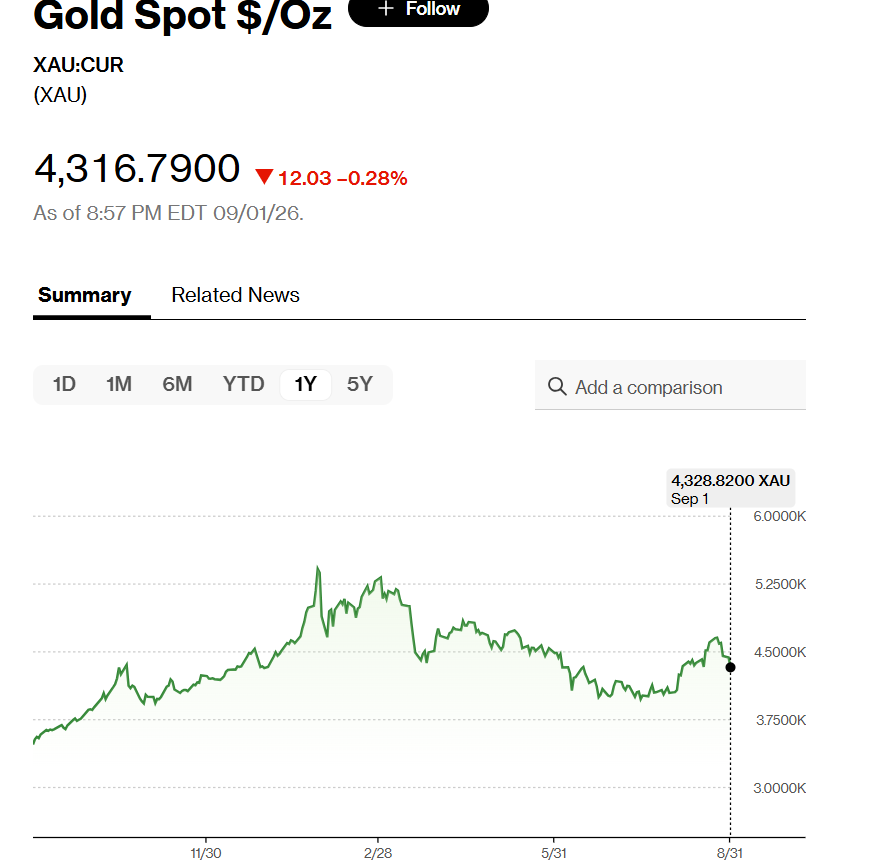
On the day of Walsh's speech, spot gold fell 3.19%, spot silver fell 4.3%, US two-year and ten-year treasury yields rose to 4.36% and 4.728%, respectively, the S&P 500 index fell 0.25% and the Nasdaq Composite Index fell 0.52%; crude oil declined slightly on the same day, but the war between the US and Iran escalated again. Brent and US crude oil surged 4.6% and 5.2% respectively on Tuesday, closing at $94.65 and $90.22, driving global bond yields to soar further. Farewell It fell again by 0.71% and 1.03%. Spot gold finally fell to $4,342.20 on Tuesday, remaining below the 200-day moving average.
Rising bond yields and oil prices put pressure on gold almost all of its gains during the year
Gold futures prices fell for three consecutive trading days on Tuesday. As the war between the US and Iran escalates across the board again, the yield on global treasury bonds with a term of 10 years or more has soared, and market inflation expectations have further increased, thus increasing the possibility that interest rates in the financial market will rise in the next few months.
According to statistics from the London Stock Exchange Group (LSEG), the yield on US ten-year treasury bonds recently rose sharply to 4.798%, and the yield on US two-year treasury bonds climbed to 4.369%. Both yields hit the highest level since January 2025, reflecting a growing market bet that the Federal Reserve will raise interest rates in September. The longer-term US 30-year Treasury yield of 5% or more has been the highest since 2006.
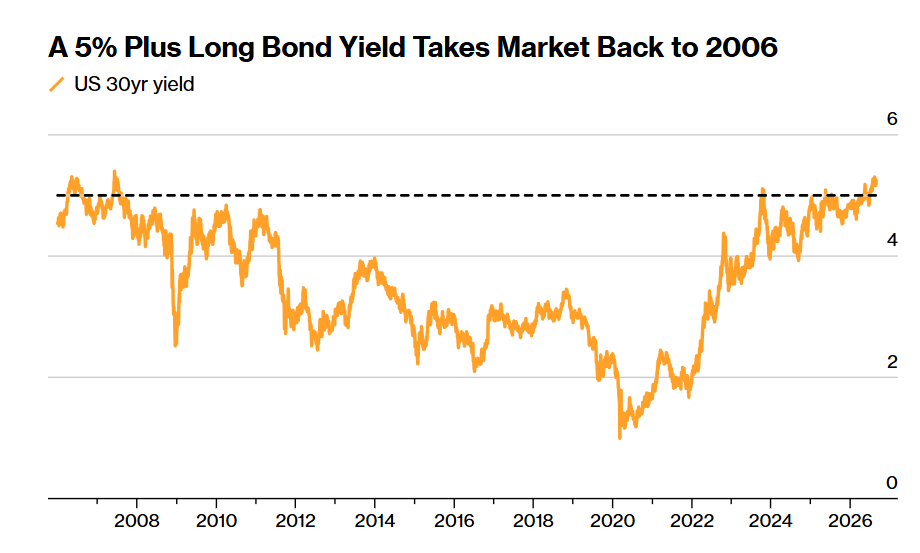
Japan's 10-year Treasury yield broke through 3%, hitting a 30-year high; German 10-year Treasury yields rose to 3.364%, a 15-year high; British 10-year Treasury yields jumped to 5.255%, the highest level since 2008, while British 30-year Treasury yields rose to their highest level since 1998.
The rise in oil prices has raised market concerns about inflation and its impact on the Fed's policies, especially after Federal Reserve Chairman Walsh expressed concerns about inflation last week. According to the Chicago Mercantile Exchange's US Federal Reserve observation tool, interest rate futures traders currently believe that the probability of interest rate hikes this month is 66%.
Jim Wyckoff, senior analyst at American Gold Exchange, said in a report: “We are seeing some technical selling pressure... global bond yields are at a high level not seen in years. As a result, all of these factors are working together to suppress the gold market.” He added that gold has continued to fall below the 200-day moving average, “this is an important technical sign.”
Wyckoff said, “Looking at it now, the path of least resistance in the gold market in the short term may be a sideways arrangement, or a weak sideways trade trajectory... the same goes for silver.”
The price of recent monthly gold futures for September delivery on the New York Mercantile Exchange fell 1.9% on Monday EST to close at $4,348.00 per ounce, the lowest settlement price since August 7; recent month silver futures for September delivery on the New York Mercantile Exchange plummeted 2.4% to close at $64.618 an ounce, the lowest closing price since August 18.
So far this year, the spot price of gold has risen by only 0.5%, while silver has fallen by 7.8%.
Missile overflew Jordan, oil tanker stuck in the strait: the three-day war between the US and Iran rewrote the global risk premium
The US-Iran conflict has escalated from “US military bombing of Larak Island — Iran attacks US military bases in Jordan” over the weekend to the second round of direct fire in three days. The US military intensively attacked Iran's Revolutionary Guard's air defense, radar, naval combat, mine-laying and communications facilities on Tuesday. Iranian media also reported explosions at Ahwaz, Giloft Airport, Chabahar, Bandar Abbas, the energy hub of Assaruyeh, and near Qeshm Island; Iran then attacked US military facilities in Jordan with ballistic missiles and drones, and claimed to attack US military targets in Bahrain.
Jordan confirmed that 13 ballistic missiles had entered its airspace, 10 of which were intercepted and 3 fell into remote areas; the US side initially reported no casualties, so Iran's claim of a “large number of US military deaths and injuries” has yet to be independently confirmed. Trump used “the final attack in preparation” to establish an escalating deterrent, while Iran responded by “locking the Strait of Hormuz,” which meant that the two sides were competing for control of the upgrade rather than actually getting close to a cease-fire.
The Strait of Hormuz, which is critical to global energy transportation, has become a real center of warfare: two supertankers each carrying about 2 million barrels of Saudi crude oil were hit by UFOs one after another within a few minutes near Oman. The US claims that the main waterway has been cleared of mines does not mean that commercial shipping has returned to normal, because the risk of attacks, escort capabilities, war insurance, and crew intentions still constitute real navigation restrictions; at the same time, the US maritime blockade has prevented Iran from exporting crude oil on a large scale through this strait for about seven consecutive weeks.
There is currently no evidence that the Mander Strait has been completely closed, but the Houthis previously announced a blockade of Saudi shipping and attacked a freighter in August, causing death, indicating that it is a “second maritime battleground” that Iran can activate. If Hormuz and the Strait of Mande are blocked at the same time, the former will restrict the export of crude oil, liquefied natural gas, fertilizer, and petrochemical products from the Gulf, while the latter will cut off the Red Sea-Suez Canal route and force ships to bypass the Cape of Good Hope; this “double gate shock” will nonlinearly push up oil prices, diesel cracking spreads, freight and insurance costs, and reinforce upward pressure on global re-inflation and bond yields.
The so-called “two-year bypass” plan proposed by US Treasury Secretary Bessent is a long-term risk reduction project. It cannot replace the current limited pipeline capacity, let alone solve the transportation problems of liquefied natural gas and non-energy commodities.
Can't the “hawkish” Fed hold back the long-term gold bull market? Wall Street expects another $5,000 mark
According to the latest public forecast, Citi will raise the target price of gold from $4,500 to $4,800 for the next six to three months and maintain the target of $5,000 for the next six to twelve months; Goldman Sachs expects to rise to $4,900 at the end of 2026, and predicts that the central bank will buy 50 tons of gold per month in 2026, far higher than the monthly average of 17 tons before 2022; Deutsche Bank is relatively cautious and expects the average price for the third and fourth quarters to be 4,300 US dollars and 4,800 US dollars respectively. At the same time, it warns that if the Federal Reserve continues to raise interest rates, the price of gold may drop by $3,800 ; Morgan Stanley, on the other hand, believes that its target of $4,450 for the fourth quarter has been achieved ahead of schedule, and sees a path of breaking through $5,000 in 2027.
The real consensus of Wall Street analysts is not that gold only rises or falls in the short term, but that high real interest rates and the hawkish Federal Reserve will cause a sharp retreat, yet the US fiscal deficit continues to expand in a disorderly manner over a long period, the US fiscal deficit, the long-term dilution of the purchasing power of the US dollar, diversification of central bank reserves, and seriously underallocation of gold assets in private investment portfolios still form the four core bullish pillars of the medium- to long-term gold structural bull market.
Dalio, founder of the Bridgewater Fund, recently issued another warning about the US financial situation. He believes that US Treasury Secretary Bessent announced an expansion of long-term treasury bond repurchases this week, combined with phenomena such as the sharp rise in long-term US bond yields and Japan's reduction in exposure to the US bond market, which may mean that the US treasury is nearing a critical turning point; if the debt problem is not addressed in a timely manner, the US may face a more serious debt crisis in the next few years, and Dalio suggests investors increase their gold holdings.
The “Bull & Bear Indicator” (Bull & Bear Indicator), compiled exclusively by Bank of America, has risen to 9.5 and is in the “sale” range, so the Bank of America strategy team framework led by Bank of America senior strategist Michael Hartnett, who has the title of “Wall Street's Most Valid Strategist,” advocates using gold to hedge against dollar credit dilution and the commodities and natural resources needed for AI construction, while shorting AI bonds, and wary of highly leveraged hyperscale cloud vendors, private credit, and cyclical financial assets.
The “niche market” paradox of gold is the most explosive part of this long-term bullish logic: although the total value of gold on the ground exceeds 30 trillion US dollars, and the average daily transaction volume exceeds 300 billion US dollars, large stocks belong to central bank reserves, jewelry, and long-term holdings. The huge transactions in the London market also mainly come from repeated exchanges between banks, market makers, and algorithmic transactions. The free circulation market that can actually absorb new long-term capital is far less than the nominal market value. Goldman Sachs statistics show that gold exchange-traded funds (or gold ETFs) only accounted for 0.17% of the US private finance portfolio in December last year; strictly speaking, for every 0.01 percentage point, or 1 basis point increase in the share of gold assets allocated by institutions or retail investors under any logic, the gold price estimated by the Goldman Sachs model increased by about 1.4%.
Another Wall Street financial giant, J.P. Morgan Chase's May 2025 scenario analysis shows that foreign investors hold about 57 trillion US dollars of US assets. If 0.5%, or about 273.6 billion US dollars, is converted to gold within 4 years, this is equivalent to about 70 billion US dollars per year. The model corresponds to an annualized increase of about 18%, and may push the price of gold to 6,000 US dollars in early 2029. These projected Wall Street figures can be described as revealing the extremely high elasticity of capital flows.
The demand structure provided realistic support for this revaluation, not just theoretical assumptions: the net inflow of global gold exchange trading funds in July was about 3 billion US dollars, the total holdings rebounded to 4068 tons, and the asset management scale reached 530 billion US dollars; the central bank's net gold purchase volume also rebounded significantly from 57 tons in the first quarter of 2026 to 289 tons in the second quarter, indicating that the official sector has a clear countercyclical ability when prices fall.