
Revenue doubled, but the stock price plummeted by more than 10%! Credo (CRDO.US), which has the label of “AI Optical-Copper Co-Explosion”, hits a profit margin speed bump
The Zhitong Finance App learned that Credo Technology (CRDO.US), a product line focusing on high-speed copper cables and optical modules in AI data centers, announced its latest performance report and future outlook during the post-market session of the US stock market on Tuesday (Wednesday morning Beijing time). The company achieved a year-on-year increase in revenue of 114.7% to US$479 million in the first fiscal quarter of the 2027 fiscal year ending August 1, 2026, which is higher than the recent continuous increase of US$471.7 million by Wall Street analysts. Credo Technology's latest performance and outlook, combined with the latest tens of billion dollar cloud computing power resource agreement signed by AI application leader Anthropic and South Korea's strong semiconductor export data, highlights that global demand for artificial intelligence computing power is still far from peaking.
In addition, the company's second-fiscal quarter revenue guidance range was $525 million to $535 million. The median range of $530 million was equivalent to a year-on-year increase of 97.8%, higher than analysts' unanimous expectations of US$516.5 million. However, the company's GAAP gross margin fell 290 basis points year on year and 370 basis points month-on-month to 64.5%. The median guidance value for the second fiscal quarter fell to 63.9%. The relatively weak gross margin data caused the company to weaken once after the market even though it announced strong core performance indicators and revenue prospects It plummeted by more than 10%.
Although the stock price plummeted after the announcement of Credo Technology's results, global investors still had a strong risk appetite for the AI computing power industry chain after experiencing a sharp decline after experiencing AI deleveraging and de-crowding in July. As of September 1, the Philadelphia Semiconductor Index reported 11,288.61 points, up about 59.4% during the year; the index once retreated nearly 29% from its June high to its July 29 low, then crossed the technical bull market threshold of 20% in mid-August. Korea's KOSPI Index reported 6,835.80 points, up 62.2% during the year; after experiencing a sharp drop of 22% in July, it rebounded 22% from a low of July 30 on August 13, officially returning to the technical bull market. In other words, July was closer to closing positions in highly crowded AI transactions, rather than peaking the AI computing power capital expenditure cycle at the fundamental level.
Demand for AI computing power infrastructure is changing from the budget intentions of big manufacturers to multi-year computing power capacity locking. Market research agency TrendForce predicts that the capital expenses of major cloud service providers will increase by 98% in 2026 and 50% in 2027; the combined share of DRAM and NAND in their capital expenses will rise from 47% in 2026 to 68% in 2027. Server DRAM contract prices are expected to increase cumulatively by about 270% in 2026, enterprise-grade SSDs by about 235%, and HBM contract prices may still rise 70% to 140% in 2027.
According to media reports, Anthropic and Nvidia-supported Lambda signed a cloud computing agreement of about 35 billion US dollars covering about 350 megawatts of capacity in Texas; previously, they also reached a six-year lease arrangement with Nscale for 45 billion US dollars and about 460 megawatts of Vera Rubin computing power. South Korea's exports surged 68.7% year on year to US$98.26 billion in August, rising for the 15th consecutive month and exceeding expectations of 62.6%. Among them, chip exports reportedly rose to a record 46.65 billion US dollars, about three times that of the same period last year.
Performance doubled, but the stock price “broke the line” first: Credo's copper cable and AI interconnection bullish market hit a deceleration belt in profit margins
Credo's current core revenue mainly comes from AEC (active copper cable) and high-speed optical interconnect chips within data centers. Nvidia is one of the company's largest customers, but the company's revenue generation level cannot simply be directly defined as a “Nvidia NVL rack internal copper cable supplier.”
The main AEC applications disclosed by Credo to the SEC focus on server-top-of-rack high-speed switches (Server-TOR), leaf-ridge-router connections, and “GPU-to-network switches.” More strictly speaking, the physical cable usually connects the NIC, DPU/SuperNIC port on the GPU server or accelerator tray to the TOR or back-end switch port, not directly to the bare GPU chip. Credo's 7-meter-long ZeroFLAP AEC can be used for high-speed connections from GPUs to network switches and servers to rack-top switches in liquid-cooled AI racks; the company also recently showcased NVIDIA's Rubin-based NVL144 rack products and next-generation AI GPU cluster-Rubin Ultra NVL576 architecture, which are fully wired with 1.6T zeroFlap AEC.
In addition to AEC, Credo also has PAM4 DSPs for 400g/800g/1.6T optical modules, ZeroFLAP optical transceiver module series products, data center silicon photon/PIC, PCIe 6.0 and CXL 3.x retimers and PCIe AEC, OmniConnect and Weaver memory fan-out chips for memory expansion and scale-up/scale-out, SerDes core/IP, and microLEDs up to 30 meters long Active cable, and PILOT link diagnostic platform.
According to the latest performance data, Credo Technology's revenue for the first fiscal quarter increased 114.7% year over year to US$479 million, 1.5% higher than analysts' expectations of US$471.7 million; adjusted earnings per share increased 130.8% yoy to US$1.20, 2.6% higher than the forecast of US$1.17. Revenue guidance for the second fiscal quarter was US$525 million to US$535 million. The median value of US$530 million is equivalent to a year-on-year increase of 97.8%, 2.6% higher than the forecast of US$516.5 million. However, GAAP gross margin fell 290 basis points year over year, down 370 basis points from month to month to 64.5%, and the median value of the second fiscal quarter guidance fell to 63.9%. Therefore, the core of the post-market stock price decline was not weakening AI demand, but investors began to demand that “rapid growth and profit margin quality” be realized simultaneously.
This sell-off is likely to reflect pressure on profitability amid rapid sales growth. GAAP gross margin fell to 64.5% from 68.2% in the previous quarter and 67.4% in the same period last year. GAAP operating expenses more than doubled from $89.6 million in the same period last year to $188.4 million. Credo continues to be a major beneficiary of AI data center spending. These systems rely on high-speed connections between the processor, memory, and network devices.
The company is still focused on increasing investment in research and development. R&D expenditure increased from $52.4 million in the same period last year to $114.5 million. Sales, general and administrative expenses increased from $37.2 million to $73.9 million.
GAAP operating profit rose to $120.7 million from $60.7 million in the same period last year, but it was lower than $155.8 million in the previous quarter. The operating margin narrowed to 25.2% from 35.7% in the previous quarter and 27.2% in the same period last year. Net profit increased from US$63.4 million or $0.34 per share in the same period last year to US$129.4 million, or $0.67 per share.
Adjusted net profit increased 140% year over year to US$236.3 million. Adjusted operating profit was US$230.6 million, up from US$96.2 million in the same period last year.
Credo's non-GAAP operating margin for the first fiscal quarter was 48.2%, up 510 basis points year over year and 140 basis points month over month; non-GAAP net profit margin was 49.3%, up 520 basis points year on year and 260 basis points month on month. These profit-level data can be described as showing that profitability is still strong after core adjustments, but the growth margins no longer continue to expand as in previous quarters.
The company expects GAAP gross margin of 62.9% to 64.9% for the next fiscal quarter. Of this, the value of 63.9% will be lower than 64.5% in the first fiscal quarter; GAAP operating expenses are expected to rise to US$199 million to US$204 million. The adjusted gross margin forecast is 67% to 69%, compared to 68% for the first fiscal quarter; the adjusted operating expenses are estimated at US$100 million to US$105 million, up from US$95.2 million in the first fiscal quarter.
Strong growth logic belonging to Credo's 10 billion dollar “optical-copper collaboration”
Nvidia's AI GPU cluster and Google's TPU computing power cluster expansion are important underlying drivers of Credo's demand. In addition to AEC copper cables, Credo also provides 400G, 800G, and 1.6T ZeroFLAP optical modules, optical communication DSP and silicon photonic integrated circuits, OmniConnect memory and inter-chip interconnects, Ethernet and PCIe retimers, SerDes cores and licensing, MicroLED active optical cables, and a PILOT software platform for monitoring link health and preventing breakage. Therefore, the more accurate positioning of Credo is “a copper-optical fusion AI interconnection platform covering chip-to-cluster and millimeter-to-kilometer” rather than a single copper cable company.
GPU racks increase copper connectivity requirements, and cluster expansion also amplifies optical connectivity requirements. Credo is expected to share both end increments at the same time. Its growth value comes not only from high-speed copper cables within NVL racks, but also from a complete product matrix covering server networks, internal optical interconnections, PCIe, and memory expansion in data centers. The company's CEO Bill Brennan said in the latest results announcement: “Our product portfolio currently covers connectivity ranges from mm to km, and spans optical and copper connectivity solutions.”
The industrial logic of high-speed interconnection within data centers is not “light replacing copper”, but rather coexists according to transmission distance, power consumption, and network hierarchical division of labor: AEC is suitable for intra-rack and short-distance rack connections, and has the advantages of low power consumption, low cost and high reliability; pluggable optical modules and optical DSP are responsible for longer distance switches — switches, leaf spine networks, and cross-rack connections; microLED active cables try to cover the mid-range between copper and traditional optical modules. As the number of GPUs increased, the number of short-range copper connectivity ports grew simultaneously; as clusters expanded, the number of long-range optical connections grew faster.
Therefore, the AI capital expenditure expansion emphasized by Wall Street financial giant Citi, and Morgan Stanley's latest judgment on “long-term coexistence of copper and light in AI data centers and phased migration to optical interconnection”, jointly support Credo to simultaneously obtain current AEC cash flow and future optical interconnection system increases, rather than betting on a single transmission medium.
The “collaborative explosive growth of optical-copper” is likely to become one of the main axes of Credo's core valuation revaluation over the next few years. The target price of 275 US dollars and the logic of “potential growth market exceeding at least 10 billion US dollars” given by BNP PARIBAS (BNP PARIBAS) is essentially the upgrade of Credo from a single strength of AEC to an interconnection platform driven by AEC, ZeroFLAP optical modules, optical DSP, ALC, and NiComconnect. Since this year, Credo's stock price has risen by more than 43%, significantly outperforming the S&P 500 index.
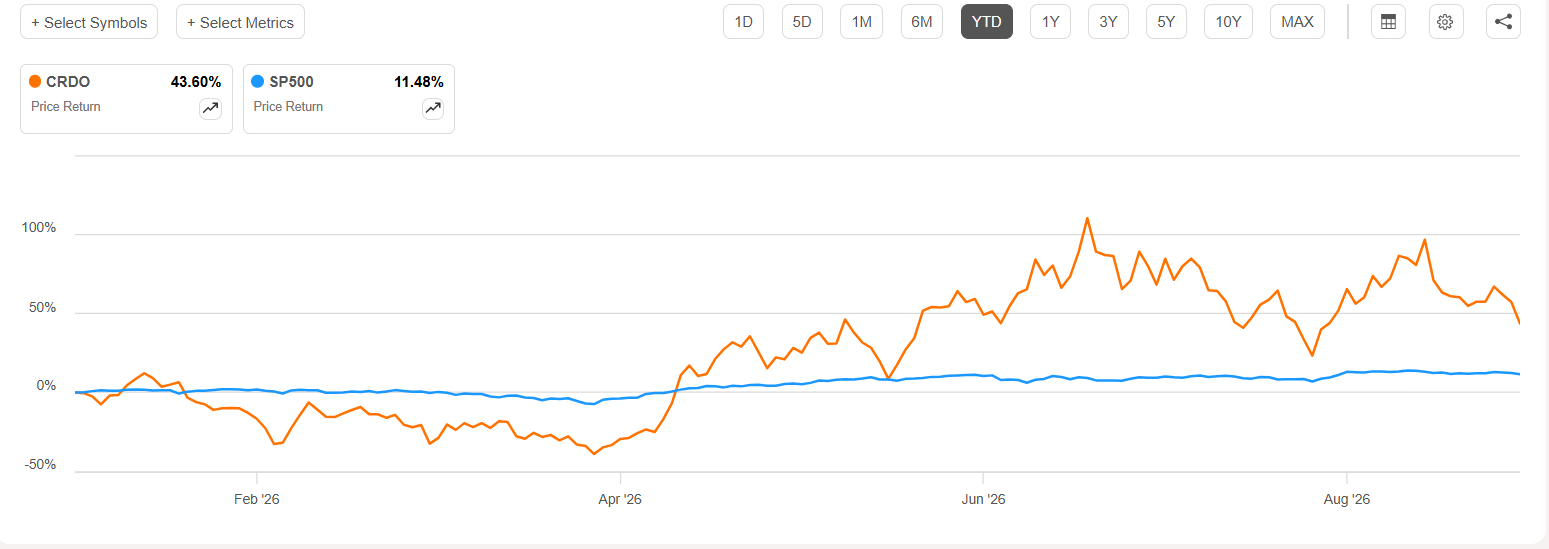
However, with Credo's stock price falling even after announcing strong results and revenue prospects, the investment level can no longer be viewed separately from gross profit margin, customer concentration, and new product delivery. The company's revenue for the first quarter of fiscal year 2027 was $479 million, up 114.7% year over year; adjusted earnings per share were $1.20 million, higher than market expectations of $1.17 million; revenue guidance for the second quarter was $525 million to $535 million. The stock price still fell after the results were announced — it once plummeted by more than 10% to around $186, which is enough to reflect that market capital is no longer satisfied with rapid revenue and quarterly revenue forecasts, but is beginning to test the quality of growth, product structure, and profit margins.
As Nvidia once again announces strong performance that has surpassed expectations and an unusually explosive performance outlook, the AI computing power theme trading hotspot is likely to not only revolve around Nvidia's GPU computing power clusters, but may also further accelerate its spread to the entire AI computing power industry chain, including HBM/DRAM/NAND, advanced COWS/3D packaging, data center CPUs, high-performance network infrastructure, high-speed copper/optical interconnection, and data center power chain infrastructure.
Wall Street financial giants such as Citibank, Goldman Sachs, and Morgan Stanley are all optimistic about Nvidia's overall demand for Vera Rubin's next-generation computing power architecture, the growth visibility of GPU clusters in 2027 and beyond, and the expansion of AI infrastructure. Their unanimous bullish judgment is that AI computing power demand continues to be strong, and Vera Rubin's capacity and Nvidia's comprehensive software and hardware platform advantages are still being strengthened. This is why 19 Wall Street analysts gave Credo an average target price of about $268.39, and Wall Street's highest target price was as high as $350.