
IDC: The real bottleneck in AI transformation in the insurance industry is not technology but value boundary reshaping
The Zhitong Finance App learned that IDC Consulting published an article saying that when many people talk about generative AI in the insurance industry, their first response is “saving manpower, improving efficiency, and reducing costs,” using it as an operation optimization tool in the inventory cycle. But IDC's core judgment is that this is a serious underestimation of the value of the technology. What is truly reshaping generative AI has never been the efficiency of a single point of operation, but rather the value boundary of the insurance industry's entire value chain — it is driving the industry's transition from a “risk backer” with passive payments to a “value creator” that actively intervenes in risk.
2026 is a key inflection point for large-scale implementation. In the end, the competition was not the technical ability of the big model, but the ability to find the right scene and follow the right pace. This article breaks down this ongoing industrial paradigm shift from the three dimensions of market logic, value penetration, implementation misunderstandings, and suggestions.
Generative AI is one of the few technology investments in the insurance industry that can calculate ROI under the inventory cycle
Many people think that the current digital investment in the insurance industry is completely shrinking, but the truth IDC sees is that budgets are not falling, but are being accurately divided.
In 2025, China's insurance industry stood at a critical juncture of deep transformation. The triple pressure of continuous decline in interest rates, high compensation expenses, and rising labor costs has not been resolved, and the business logic of the industry has shifted from large-scale expansion to refined operation. The most prominent characteristic of this stage is that digital investment is fully “under pressure” — investment in projects that can reduce costs and meet regulatory requirements remains stable, projects that cannot quantify benefits are strictly controlled, the industry shifts from “passive contraction” to “active trade-offs”, and the input-output ratio has become the core standard for selecting IT projects.
Looking at market fundamentals, the “China Insurance Industry IT Solution Market Share, 2025” report recently released by International Data Corporation (IDC) shows that the IT solutions market for China's insurance industry reached 10.06 billion yuan in 2025. The decline has narrowed markedly, and has officially entered a new stage of steady differentiation and stock competition. The market presents a “Super Plus Long Tail” pattern: on the one hand, the concentration of leading companies continues to increase, and the barriers to customers, products and services of leading manufacturers are constantly growing; on the other hand, the long-tail market is still huge, and there is still plenty of room for vertical segmentation and technological innovation applications.
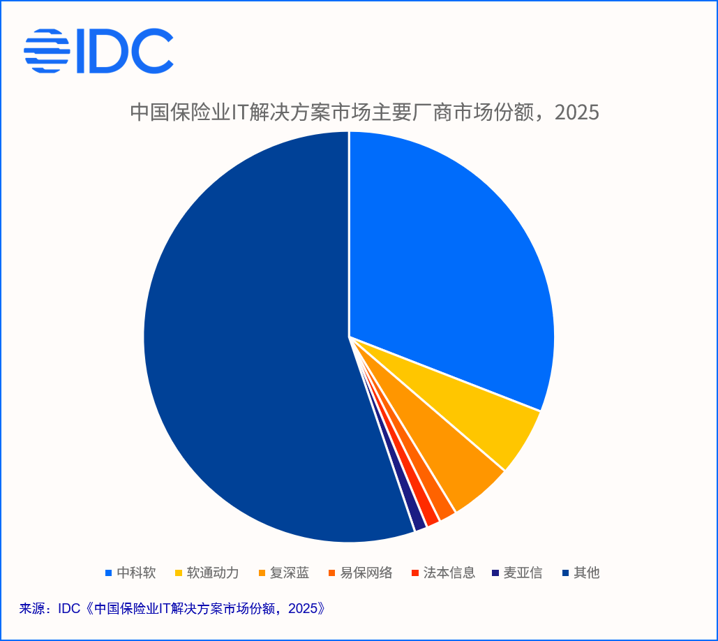
In such a cycle, generative AI has become one of the few technical directions that can not only meet the main line of “risk prevention, promotion of compliance, cost reduction, and quality improvement” of supervision, but also energize output value. As the premium growth rate slows down and the scale of manpower shrinks, increasing per capita production capacity, optimizing operating costs, and innovating service models through AI has become a core strategy for insurers to get through the cycle, not an option.
The 7.5-fold growth rate is by no means a concept bubble; generative AI has changed from a “pilot product” to a “hard just needed”
There are still voices in the market that generative AI is still a gimmick, with more investment and less output, but the IDC report shows that in 2025, the IT investment scale of China's insurance industry reached 51.73 billion yuan, with a significant increase in the hardware sector, and the core driving force comes from independent innovation and AI infrastructure construction. In the long run, IT investment in China's insurance industry will reach 80.55 billion yuan in 2030, with a compound annual growth rate of 9.3%.
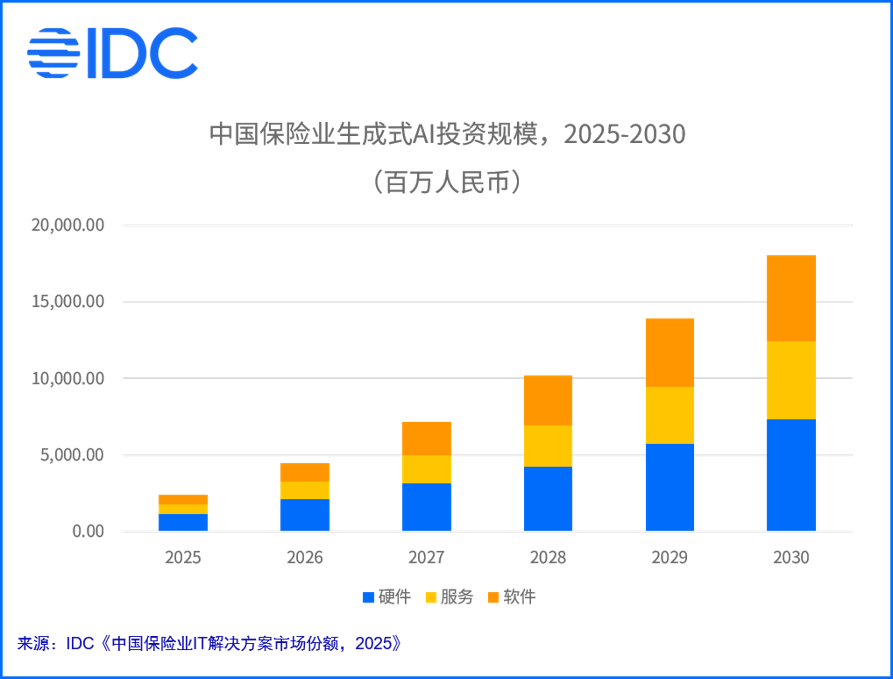
The growth in the field of generative AI far exceeds the overall market: the investment scale rose from 2,422 billion yuan in 2025 to 18.05 billion yuan in 2030, an increase of nearly 7.5 times in five years, with a compound annual growth rate of over 49%. This means that generative AI has completely gone beyond the proof-of-concept stage and officially entered the large-scale investment cycle. It is currently the most definitive growth engine in the insurtech sector.
AI penetrates the entire value chain and rewrites the value definition of each link
Many people's perception of the value of AI in the insurance industry is still limited to “customer service robots” and “automatic underwriting saves working hours,” but IDC believes that the transformation of generative AI is deep in the bone marrow — it is rewriting every underlying logic of pricing, underwriting, claims, service, and risk control, evolving from auxiliary tools to core production systems, expanding the value boundaries of the industry in every step. 2026 will be a critical year for the insurance industry to move from “pilot” to “large-scale,” and AI capabilities built into insurance IT systems will become standard in the industry.
Product pricing: from static actuarial to individual real-time risk control
Traditional pricing relies on historical data and static models. Essentially, risk sharing at the group level is difficult to reflect dynamic changes in individual risk. Generative AI is turning pricing into a variable that fluctuates in real time with individual behavior: the car insurance UBI model uses connected vehicle data to price driving behavior, and health insurance links premiums to health management through wearable devices. The future core competitiveness will be dynamic pricing capabilities based on real-time customer behavior and external risk signals to drive the industry's evolution from “group pricing” to “individual pricing”.
Nuclear Factoring Claims: Intelligent Decisions Reconstruct the Dual Foundation of Efficiency and Trust
The real change in underwriting claims with generative AI is turning risk judgments that rely on human experience into standardized and traceable intelligent decisions. The intelligent underwriting system automatically analyzes medical records and medical examination reports, and reduces manual underwriting for several hours to the minute level; image recognition automatically determines damage, OCR quickly extracts medical bills, and a large model assists in determining responsibility. This not only drastically shortens the claims processing cycle and reduces investigation costs, but also reduces the root cause of human operation space and fraud risk, and reconstructs the trust mechanism between policyholders and claimants.
Customer service marketing: conversational AI turns channel systems into capacity amplifiers
IDC predicts that by 2026, over 60% of interactions between insurers and policyholders will be completed in real time through digital self-service. Intelligent customer service has been upgraded to conversational AI with multi-round conversations, intent recognition, and sentiment analysis capabilities, greatly improving service experience and response efficiency. The change on the marketing side is reshaping the operating model: generative AI generates personalized guarantee plans based on customer portraits, and intelligent questioning allows business personnel to query business data through natural language. The value of channel IT systems changed from “supporting operation” to “capacity amplifiers.”
Risk reduction: driving the industry from passive compensation to active value creation
The end point of value in the traditional insurance industry is insurance compensation, which is essentially a “risk underwriter.” But generative AI is moving the industry's value boundaries forward. The agricultural sector uses meteorological big data and satellite remote sensing to guide disaster prevention and mitigation, the financial insurance sector uses the Internet of Things to monitor safe production, and the health insurance sector uses platforms to guide health management. Big models play a central role in this — real-time analysis of massive data, dynamic iteration of risk models, and accurate push of warning signals all rely on generative AI's ability to push the industry from “ex post facto compensation” to “pre-prevention” and truly become a “value creator”.
The real bottlenecks to transformation aren't technology, but three overrated challenges
The large-scale implementation of generative AI is not an easy path. Data governance, organizational capacity, and compliance risk control are recognized as the three major challenges. However, according to IDC, not all challenges are long-term barriers. Among them are short-term breakers, false propositions that have been overampled, and incremental opportunities that have been overlooked.
First, data governance: “Governance first, then implementation” is the biggest false proposition of transformation. Data governance is not a precondition for AI implementation, but rather a long-term project that is mutually driven by the implementation of AI scenarios. IDC suggests prioritizing improving data quality, data lineage, and metadata management capabilities in the short term, giving priority to ensuring the consistency and trustworthiness of AI output in core scenarios, quickly verifying value using small-cut scenarios; and promoting data architecture restructuring through strategic cooperation in the medium to long term. However, the full implementation of IFRS 17 and the implementation of generative AI scenarios is itself a powerful driving force for the acceleration of data governance.
Second, organizational transformation: Organizational restructuring and the “closed loop of ROI” are the real challenges. The misalignment of technology and organization is a major contradiction — most insurance institutions are clearly lagging behind the pace of technological evolution in terms of organizational restructuring, process redesign and construction. The real organizational challenge is how to establish organizational trust, design a man-machine division of labor model, and cultivate human-robot collaboration capabilities for all employees. According to IDC, 40% of insurance workers will need to master human-robot collaboration skills by 2029. Furthermore, under existing competition, generative AI is one of the few technical directions that can clearly quantify ROI. Insurers need to treat AI as “the ability to directly bind business results”, not just the use of tools.
Third, compliance risk control: Regulation is not a stumbling block; it is a barrier to differentiation and a new racetrack. Many people regard strong regulation as the biggest obstacle to the implementation of AI. However, we believe that compliance is a competitive barrier to screening players, and even a new incremental circuit. IDC suggests promoting responsible AI (RAI) construction at the four levels of data, model, process, and talent in the short term, embedding compliance requirements into the entire AI process to establish a firm bottom line; comprehensively reforming the governance, risk and compliance framework in the medium to long term to meet the management needs of large-scale AI applications.
IDC Summary and Outlook
For the insurance industry, generative AI is not a tool upgrade; it is value reshaping. 2026 is a watershed moment for large-scale implementation — technical ability is no longer a threshold; the real competition is: who can take the lead in identifying the scenario, get through the closed loop of ROI, and complete organizational adaptation.
According to IDC's judgment, the industry will be clearly divided in the next three years: leading insurers will use AI to restructure the full chain of pricing, underwriting, and risk control to turn “risk management” into core competitiveness; bystanders will be stuck at a shallow level of cost reduction and efficiency, and will miss the window period for value transition. This transformation is not comparable to computing power and models, but to the speed and determination to expand value boundaries.