
Nvidia and SpaceX sign a “match made in heaven”! Rubin's computing power flies to space orbit Musk anchors SpaceX valuation to Kardashov Type II civilization
The Zhitong Finance App learned that just after Nvidia (NVDA.US), the “AI chip superpower”, just announced a strong performance report that continues to raise global AI capital expenditure expectations and a new round of AI computing power industry chain bull market, Musk is trying to push the boundaries of AI infrastructure expansion from the ground to space orbit—SpaceX (SPCX.US), which he founded and helmed, plans to launch the first batch of AI data center satellites in the fourth quarter of 2027 using Nvidia's next-generation computing power clusters — Vera RubinAI GPU-led clusters , and will form a “significant scale” in 2028. This does not mean that terrestrial data centers will be quickly replaced, but rather that space orbital computing power can bypass major bottlenecks such as terrestrial power grids, land, and water, and become an additional supply layer for AI computing power.
For Nvidia, this is an extension of Vera Rubin's potential market from a “terrestrial AI factory” to an “orbital AI factory”; for SpaceX, it integrates starship launches, orbital energy, satellite networks, and AI cloud computing into a vertically integrated platform. However, Wall Street financial institutions such as Evercore expect actual revenue data to reach the 2029 fiscal year as early as fiscal year 2029, and cooling, radiation, collision, and regulation are still key constraints that determine whether they can be commercialized.
Nvidia and SpaceX sign a “match made in heaven” and plan to put Vera Rubin into orbit
In a parallel universe, Nvidia CEO Hwang In-hoon and “Mr. Omnipotent” and the world's richest man Elon Musk may be a pair of cosmic superheroes. However, in this universe and world, they are still planning a seemingly incredible space AI supermap — Nvidia provides the core of computing power, and SpaceX provides launch and orbital infrastructure to jointly expand the physical boundaries of AI computing. Vera Rubin and Starship form a closed loop of space software and hardware systems and infrastructure, but the current valuation mainly reflects forward options rather than recent cash flow.
This project is part of an increasingly close partnership between Nvidia and SpaceX. At Nvidia's August 26 earnings conference call, Chief Financial Officer Colette Kress said that the Vera Rubin system has been fully put into operation, and core shipping targets include Oracle (ORCL.US), Amazon (AMZN.US), AWS, and SpaceX (SPCX.US), a leader in AI cloud computing and computing power leasing.
“We believe that Nvidia's clear listing of SpaceXAI as one of its key partners further proves the depth of the relationship and that SpaceXAI is among the earliest Vera-Rubin customers,” a team of analysts from Evercore ISI said in an investor report. “This relationship also goes both ways: Nvidia disclosed that it holds 122.8 million SpaceX shares, making Nvidia both an important supplier and a significant shareholder of SpaceX.”
According to the latest results announced by Nvidia, revenue for the second quarter of fiscal year 2027 was US$96.22 billion, up 106% year on year; data center revenue was US$89 billion, up 117% year on year; and adjusted earnings per share were US$2.22. The company expects third-quarter revenue of about US$108 billion, fluctuating 2% up and down, and rarely forecasts a 70% increase in revenue for the 2028 fiscal year, far exceeding Wall Street's previous 44% expectations; Nvidia management said at the performance conference that Vera Rubin has been fully put into production and delivery, which largely means that Nvidia's growth constraints are still mainly due to bottlenecks in memory production capacity and TSMC's advanced manufacturing capacity, rather than insufficient orders.
After Nvidia announced its results, Wall Street raised its target price one after another. As of last Friday, Nvidia's stock price closed at $217.55. Citi raised its target price from $300 to $315, maintaining a “buy” rating; Goldman Sachs raised its target price from $285 to $300, and Morgan Stanley raised its target price from $288 to $300. Their unanimous bullish judgment is that demand for AI computing power continues to be strong, and Vera Rubin's capacity and Nvidia's comprehensive software and hardware platform advantages are still being strengthened.
Musk said that the data center designed by SpaceX will run entirely on Nvidia AI GPU accelerators. Furthermore, in August, SpaceX completed an all-stock acquisition of Cursor with a total value of about 60 billion US dollars. In a recent PPT presentation, Huang Renxun said that Cursor is already being used throughout Nvidia. According to the latest third-party statistics, the annual revenue operating rate of this artificial intelligence programming assistant has exceeded 1 billion US dollars.
As far as commercialization of the space AI data center that Musk and Hwang In-hoon are focusing on, Evercore anticipates that the project will not bring any substantial contribution to SpaceX until at least fiscal year 2029.
“Notably, we haven't included any orbital computing revenue data for 2026 or 2027, and we expect the first 1 gigawatt space AI orbital computing power to go live in the 2029 fiscal year; by the end of this fiscal year, the orbital computing power capacity will reach 8 gigawatts, while the terrestrial computing power capacity will be 10 gigawatts,” Evercore said. “If the track construction originally scheduled for FY2029 is brought forward to 2028, it will significantly release the demand for inference side AI computing power resources; according to the economic calculation of $30 to $50 per watt discussed by Musk, it may give our predictions significant upside.”
Evercore gave SpaceX an “outperforming market” rating, and the target price was set at $230. As of the US stock close on Friday, SpaceX shares closed at $141.50.
“The key question is what Musk's so-called 'significant scale' in 2028 actually means — does it represent the scale of computing power that can generate revenue data, or a broader technical verification stage before commercialization,” Evercore added.
However, according to a recent report published by the Brookings Institution, deploying data centers in space faces major technical hurdles.
“The ground data center uses both air cooling and server liquid cooling systems to dissipate heat through heat transfer and convection,” the Washington, D.C., think tank said. “They first transfer heat from the chip to the liquid coolant, and then transfer heat from the coolant to the atmosphere surrounding the facility. For data centers floating in a vacuum of space, this cooling strategy is almost impossible to implement because there is no atmosphere that can absorb heat. In fact, thermal radiation may be the only way to dissipate heat generated by orbital data centers, but some scientists have calculated that to properly exhaust heat generated by a single orbital data center using this method, an astonishing 2.15 million square foot radiators are required.” The Brookings Institution said in a report.
Other problems include equipment damage due to continued exposure to the most direct and intense UV radiation from the Sun, and the increasing probability of orbital collisions as the number of satellites continues to increase. Regulatory approvals may also be an issue.
Is AI data center undergoing an upgrade? The AI gigafactory is poised to move from ground to track
The SpaceX prospectus clearly defines “building a space civilization that continues to expand, and eventually moving towards a Type II civilization that can use all of the Sun's energy” as a long-term paradigm shift; Musk himself has stated that the lunar satellite factory, Mass Driver (Mass Driver), and AI hardware deployment of more than 100 terawatts per year will push humans to make “non-trivial progress” towards Type II civilization. Therefore, the orbital AI data center is not an isolated project, but a first-tier infrastructure connecting “Earth's limited computing power — solar system-level energy — multi-planetary civilization.”
The so-called Kardashev Type II Civilization (Kardashev Type II Civilization) is capable of using all of this star's energy, while Type III has to control the energy of the entire Milky Way, far exceeding SpaceX's current narrative.
SpaceX's $28.5 trillion serviceable market (TAM) further capitalizes on this civilized vision: the traditional space business is only 370 billion US dollars, the high-speed connectivity business dominated by Starlink is 1.6 trillion US dollars, while the AI integrated business has reached 26.5 trillion US dollars, accounting for about 93% of the total scale, including $2.4 trillion of AI integrated computing infrastructure, 760 billion US dollars of consumer subscriptions, and $22.7 trillion in digital advertising, and 22.7 trillion US dollars Enterprise applications.
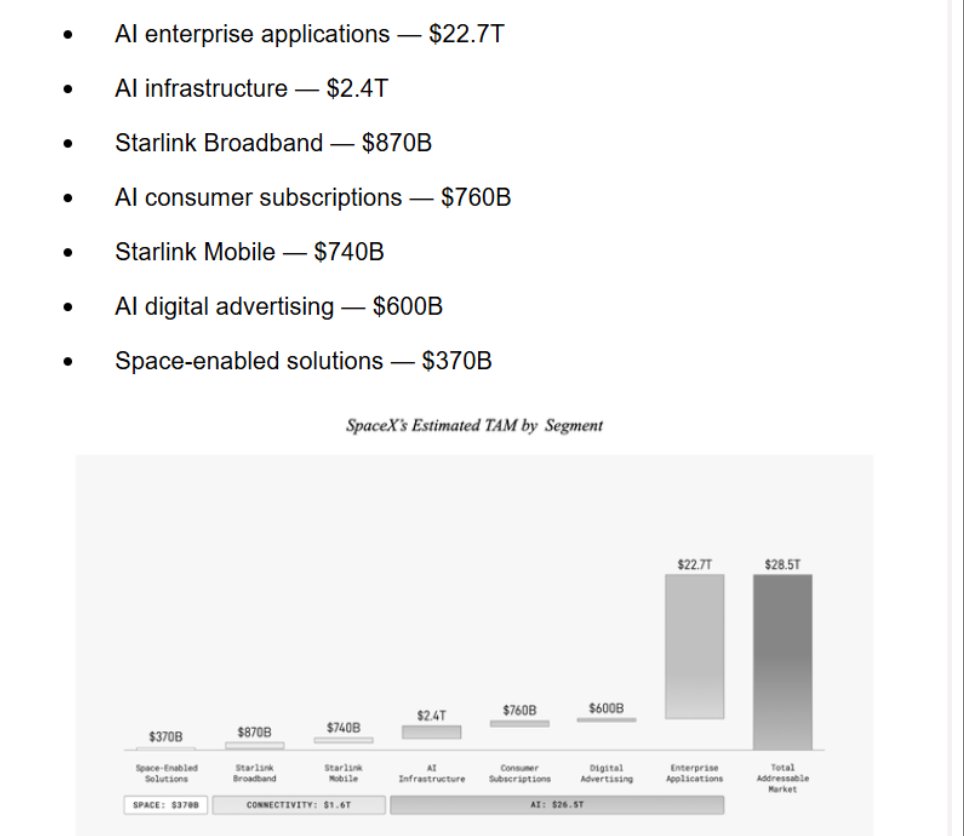
The bottom judgment of SpaceX's top management, such as Musk, is that global data center computing power requirements may reach 235 gigawatts in 2030, 70% of which will be used for AI, while the Earth's power grid, land, approval, and environmental capacity are difficult to support terawatt expansion; the Sun accounts for about 99.8% of the solar system's energy. As a result, SpaceX plans to begin commercializing modular orbital computing power at the end of this decade. The long-term goal is to deploy 100 gigawatts of AI computing capacity to orbit every year — if it operates continuously throughout the year, its energy consumption is about one-fifth of the US's annual power generation in 2025.
However, from an investment perspective, $28.5 trillion is a theoretical market boundary; it is by no means a revenue or profit forecast; orbital AI is still essentially a technology option with an extremely long term and high degree of convexity. Achieving 100 gigawatt-year deployment requires the Starship to complete thousands of launches per year, put about 1 million tons of equipment into orbit, and address the problems of radiation dissipation, inability to repair chips after failure, and mass satellite manufacturing and supervision.
At the same time, SpaceX's AI business has already reached 12.727 billion US dollars in capital expenditure in 2025, adjusted EBITDA loss of 1,237 billion US dollars, capital expenditure in the first quarter of 2026 further reached 7.723 billion US dollars, and adjusted EBITDA losses of 609 million US dollars. The company also acknowledged that continuous profit would require a multi-year investment cycle. Therefore, recent valuations should be based on launch and Starlink cash flow, and orbital AI contributes to long-term upward flexibility; what investors really need to track is the Starship unit's orbital entry cost, launch frequency, computing power per ton, cooling reliability, and computing power utilization rate, rather than directly using $28.5 trillion to endorse the current valuation.