
CINNO Research: Investment in China's optoelectronic display industry fell by about 80.3% year-on-year in the first half of the year
The Zhitong Finance App learned that according to CINNO Research statistics, China's (including Taiwan Province of China) invested about 17.8 billion yuan in the first half of 2026, a year-on-year decrease of 80.3%, and the scale of investment declined markedly from the same period last year. This change is mainly affected by a combination of factors: the recovery in consumer electronics terminal demand is weak, panel prices have stabilized after experiencing an early rise, and the overall pace of industry expansion has slowed; at the same time, LCD/OLED production lines, which were invested heavily in the previous two years, have entered the production capacity release stage one after another, demand for new factory construction has declined markedly, and the industry's capital expenditure has entered a phased contraction window.
Despite a sharp decline in total volume, the investment structure showed distinct characteristics of targeted concentration. The precise flow of industry capital to the core link of high technology barriers and high domestic replacement urgency shows that the optoelectronic display industry has moved from a “scale-driven” stage to a “technology-driven” stage.
Funding is highly concentrated in the two core areas of optoelectronic materials and MLED
In the first half of 2026, the structural differentiation of investment in the optoelectronic display industry in China (including Taiwan Province of China) was remarkable, and capital flows showed a highly concentrated pattern. According to CINNO Research statistics, the field of optoelectronic materials ranked first with an investment scale of 8.9 billion yuan, accounting for 49.8%; the Mini/Micro LED (MLED) sector received an investment of 7.2 billion yuan, accounting for 40.7%; and the investment in optoelectronic module projects was only 700 million yuan, accounting for 3.9%.
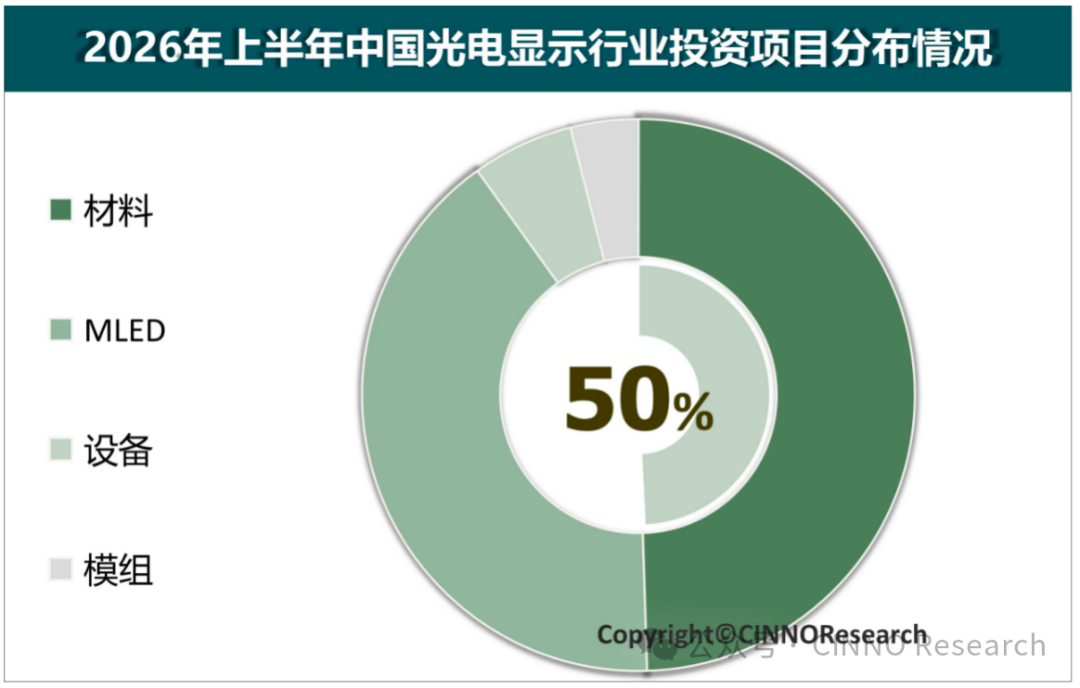
Illustration: Distribution of investment projects in the optoelectronic display industry in China (including Taiwan Province of China) in the first half of 2026. Source: CINNO Research
Optoelectronic materials: core consumables and high-end film materials become the main battleground for investment
The field of optoelectronic materials steadily ranked first with nearly half of the investment, reflecting the strategic importance that industrial capital attaches to domestic substitution of basic materials. In terms of categories, optical films ranked first in the materials segment with an investment scale of 3.3 billion yuan, but the year-on-year decline was 56.4%, confirming that investment in this field has entered the rational adjustment stage; investment in the electronic chemicals sector was about 1 billion yuan, down 14.5% year on year, the smallest decline among all categories.
This change in investment structure reflects that the optoelectronic display materials industry is in a critical transformation stage of technological upgrading and product iteration. As domestic replacement demand for high-end film materials continues to strengthen — optical grade polyester substrates, polarizer release films, etc., domestic companies are speeding up breakthroughs. At the same time, the localization rate of supporting materials such as light-emitting materials and PSPI required for the AMOLED industry has also ushered in rapid growth, and material localization substitution is expanding from the middle to low end categories.
MLED: Commercialization is accelerating, and capital is competing for the next generation of display technology
Judging from the global industrial context, the display panel market showed a differentiated trend in the first half of 2026. Driven by sporting event stocking and the industry's “on-demand production” strategy, prices of TV products of all mainstream sizes rose across the board from January to April, and stabilized with the end of the preparation cycle from May to June; IT panel prices rose moderately, and NB panel prices continued to stabilize. However, demand for terminals in the AMOLED field is under pressure, and the growth pace of flexible AMOLEDs in the mobile phone field is slowing down.
According to CINNO Research statistics, the penetration rate of mini LED TVs in China has reached about 32.6% in 2025. From the perspective of the industrial chain, MLED investment covers various aspects such as chip manufacturing, advanced packaging, display modules, and terminal applications. Since 2026, several LED display-related projects have made phased progress. Huike Co., Ltd. has invested about 10 billion yuan to build a new full-color MLED display chip base. The main building has been sealed, and the first phase is expected to be put into operation in October; BOE Huacan Optoelectronics Zhangjiagang base has invested 970 million yuan to focus on in-vehicle intelligent display and AR near-eye display tracks; MegaChi Crystal launched the second phase of the COB packaging production line, with plans to expand the COB packaging production line from 3,000 to 8,100; TCL Huaxing Suzhou MLED production base moved in PH2 core process equipment and COB directly showed monthly production capacity Expected Achieve double. The MLED industry has entered the “large-scale mass production” stage, and the large-scale influx of capital is essentially a strategic card for the industry's sovereignty over the next generation of display technology.
Investment is highly concentrated in Hubei, and domestic capital is absolutely dominant
According to CINNO Research statistics, investment in the optoelectronic display industry in China (including Taiwan Province of China) in the first half of 2026 showed distinct regional agglomeration characteristics. Among the country's 8 provinces (including municipalities directly under the Central Government), the top three investment regions concentrated 64.9% of the capital. Among them, Hubei led the country with an investment scale of 6.3 billion yuan, accounting for 35.4%.
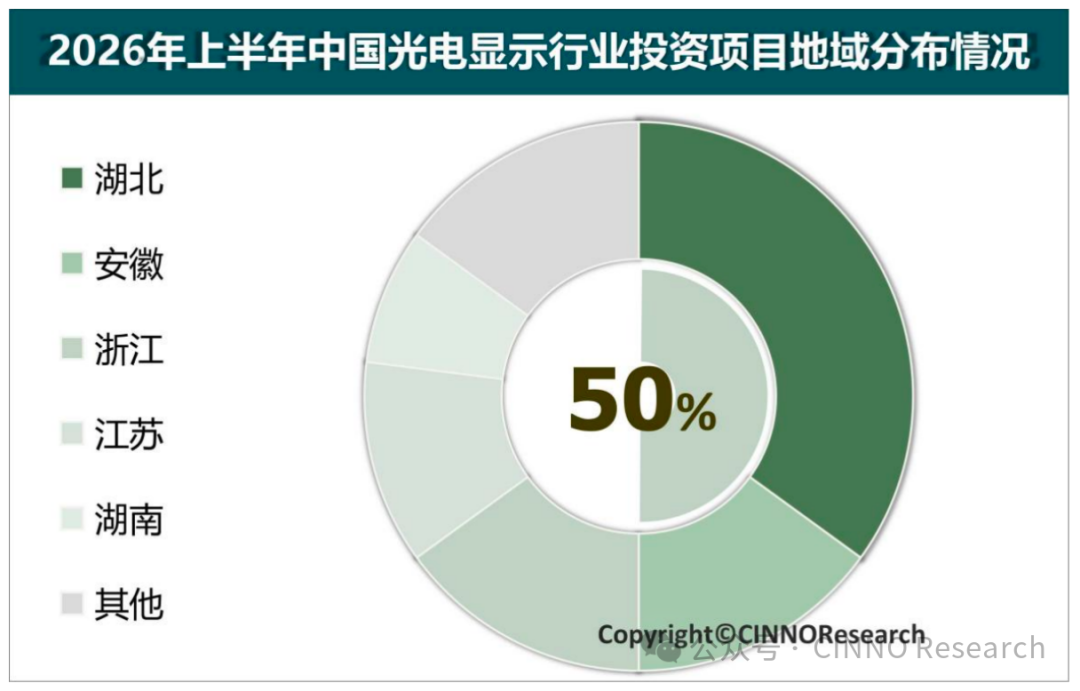
Figure: Geographical distribution of investment projects in the optoelectronic display industry in China (including Taiwan Province of China) in the first half of 2026. Source: CINNO Research
Hubei's leading position mainly benefits from Wuhan as a major center in the domestic display panel industry. Leading panel companies such as BOE (000725.SZ), Huaxing Optoelectronics, and Tianma have formed a complete industrial cluster from panel manufacturing to material support, thereby promoting the placement of upstream materials and supporting links nearby, reducing industrial chain collaboration costs, and forming a closed regional “panel+material+module”. In terms of funding sources, domestic capital has an absolute dominant position, reflecting the development trend of localization support in the optoelectronic display industry and the core competitive advantage of the central and western regions in undertaking industrial transfers.
The investment logic shifts from “scale expansion” to “technological attack”
The structural characteristics of the optoelectronic display industry investment data for the first half of 2026 clearly outline the deep transformation path of the industry. Total volume contraction is not a sign of industry decline, but rather a normal sign of the industry's transition from the “construction period” to the “operation period” — high-generation LCD production lines and flexible AMOLED production lines, which were concentrated in previous years, have entered the mass production stage one after another, large-scale plant construction investment has come to an end, and the focus of capital expenditure has naturally shifted to “intensive cultivation” processes such as material support and technology upgrades.
The industry competition pattern has changed from “capacity scale competition” to “technological ecological competition”. Panel giants such as BOE are relying on the three core advantages of display technology, glass-based processing, and intelligent manufacturing capabilities to expand to new racetracks such as glass-based sealed loading boards, perovskite photovoltaics, and optical connectivity. It shows that industrial boundaries are being redefined, and capital investment is spreading accordingly from single display manufacturing to the “pan-semiconductor” field.
Looking ahead to the second half of 2026 and beyond, there is a deep recovery in total industry investment. China's optoelectronic display industry is moving from the first half of “winning by scale” to the second half of “winning by technology”.