
7 years earlier than Wall Street's best predictions! Musk personally “corrects” Damascus: SpaceX (SPCX.US) can achieve annual revenue of 3.5 trillion US dollars by 2033
The Zhitong Finance App learned that after Morgan Stanley sang multiple SpaceX (SPCX.US) in high profile, Elon Musk recently personally stepped down and gave a more aggressive schedule than Wall Street. Musk said on social media platform X that the time point for SpaceX to achieve annual revenue of about 3.5 trillion US dollars may be around 2033, about seven years earlier than the 2040 predicted by Morgan Stanley.
According to information, Morgan Stanley earlier reaffirmed the “overstock” rating of SpaceX shares and a target price of 300 US dollars, and predicted that the company's revenue in 2040 would reach 3.5 trillion US dollars. The bank's star analyst Adam Jonas believes that investors still don't really understand SpaceX's grand plans surrounding the Starship rocket and the new launch site in Louisiana. The current stock price is near the IPO price, which instead provides a “unique opportunity.”
“Investors are unaware of the scale of SpaceX's Starship Program”
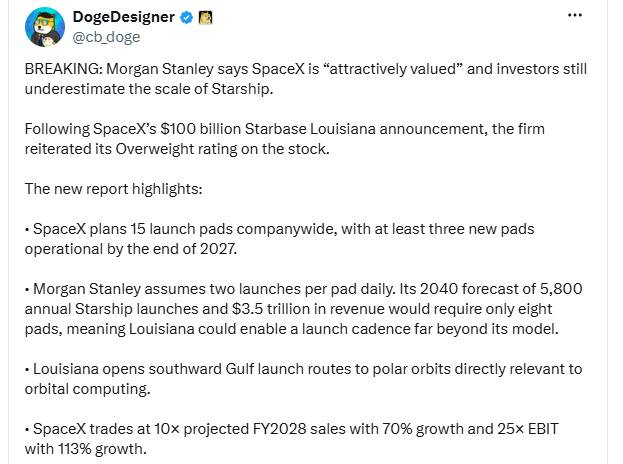
The beginning of the incident was a Morgan Stanley Investor Report. Jonas wrote in a report released on Wednesday: “We don't think investors are fully aware of the scale of SpaceX's plans on the Starship.” The report follows SpaceX's disclosure that it will spend $100 billion to build a new “Starbase” (Starbase) in Louisiana.
According to the disclosure, SpaceX plans to build a new Starship launch site in Vermilion Parish (Vermilion Parish) in Louisiana. Construction of the base is expected to begin in 2027, and the first Starship launch will take place in 2029. According to the plan, the base will eventually have 15 launchers, far higher than the 3 launchers currently operated by SpaceX; it is expected that 3 more launchers will be fully operational by the end of 2027.
Jonas believes that the scale of this expansion itself shows that the market is not sufficiently pricing the pace of SpaceX's launch. Morgan Stanley's model currently conservatively assumes that each launch pad only performs 2 launches per day. According to this rhythm, SpaceX will launch about 5,800 starships a year by 2040. In fact, it will only require 8 launchers, which is lower than the 15 planned by the company. In other words, even if the Louisiana base is not fully completed, SpaceX is capable of meeting Morgan Stanley's 2040 launch forecast.
Jonas also specifically pointed out that Louisiana's geographical location has unique advantages. The base allows rockets to be launched south over the Gulf of Mexico without directly passing through populated areas like those launched from Florida, Texas, or California. This enabled SpaceX to expand launch capabilities to the “Dawn-Dusk Sun-Synchrotron Orbit”, which is “directly related to orbital computation.” According to Jonas, this is part of SpaceX's long story of combining space launches, Starlink communications, and artificial intelligence computing power.
Musk responds to Damo: My best guess is 2033
On the X platform, user “DogeDesigner” immediately shared a report from the bank. In the tweet, he highlighted SpaceX's “attractive valuation” and believed that investors underestimated Starship's potential for scale.
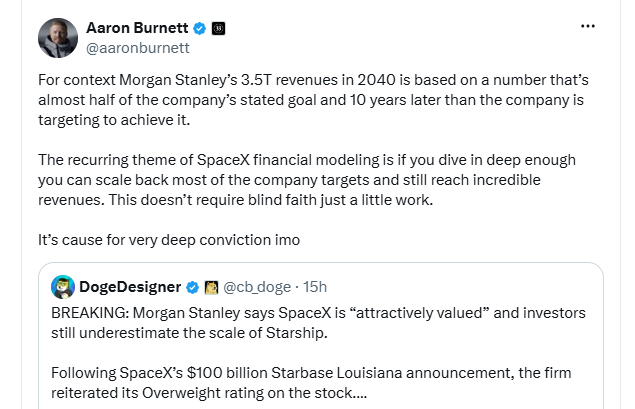
Aaron Burnett, CEO of investment agency Mach 33, later retweeted and commented that Morgan Stanley's estimate “is almost half of the company's stated target, and it is ten years behind the company's own target.”
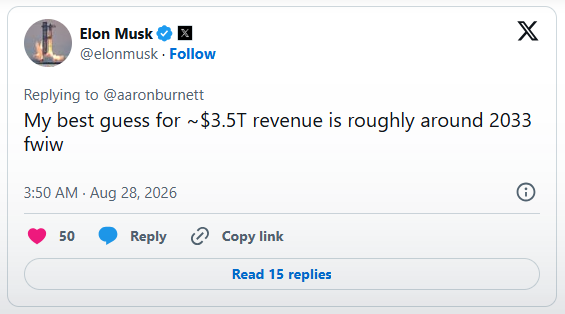
The comment also drew a response from Musk himself. He wrote, “In my opinion, the time to reach about $3.5 trillion in revenue is probably around 2033.”
This means that Musk believes SpaceX will reach $3.5 trillion in revenue seven years ahead of Morgan Stanley's forecast. Notably, Musk previously publicly predicted that SpaceX would achieve $1 trillion in revenue by 2030.
Musk's response further highlighted the gap between SpaceX's internal goals and the Wall Street model. According to SpaceX's own plans, the company even plans to launch 10,000 starships a year by 2030. This goal is partly driven by US President Trump's new space policy, which aims to increase NASA's launch frequency.
From Starship to K3 Civilization: Musk's Farther Narrative
In addition to direct revenue forecasting, Musk also drew a bigger picture with the Louisiana Interstellar Base project. He said the base will make Tesla's (TSLA.US) Optimus humanoid robot the first “von Neumann machine” in history. In Musk's narrative, the starship development and launch infrastructure promoted by SpaceX will help “civilization expand throughout the galaxy and reach the K3 level.”
A “von Neumann machine” usually refers to a system that can replicate itself. Musk linked this to the large-scale launch capabilities of Optimus robots and Starships, implying that in the future, humans can use Starships to send manufacturing capabilities into space to achieve self-replication and expansion outside the Earth. K3 points to a third-level civilization in the Kardashov hierarchy, that is, a civilization that can utilize the energy of the entire galaxy. This statement continues Musk's narrative style of consistently positioning SpaceX as “making humans a multi-planetary species” or even an “interplanetary civilization.”
Judging from the short-term pace of launches, SpaceX is indeed rapidly advancing Starship tests. Musk revealed that the upcoming 14th Starship flight test will attempt to capture the upper stage of the rocket. If successful, this would be another key breakthrough for SpaceX in the field of fully reusable rockets, following booster capture.
The stock price is still below the high point, and the long and short differences are obvious
Morgan Stanley has set a target price of $300 for SpaceX. Based on Thursday's closing price, this target price corresponds to an upward margin of about 114%. Jonas believes that based on the bank's 2028 fiscal year forecast, SpaceX's stock price is only equivalent to 10 times the market sales rate (corresponding to a 70% growth rate) and 25 times profit before interest and tax (corresponding to a 113% growth rate).
“We believe investors have a unique opportunity to 're-examine' SPCX shares near the IPO price, and the fundamental momentum in space, connectivity, and enterprise AI is even stronger,” Jonas wrote.
SpaceX stock has struggled since its public listing. The stock had a market value of more than 1 trillion US dollars on the first day of listing, but since then, the stock price has fallen from a high level and has now fallen close to the IPO price. Following the recent release of the second-quarter earnings report, stock prices were further pressured due to rising capital expenditure guidelines.
However, Jonas said that Morgan Stanley's views on SpaceX improved significantly after the earnings report, as investors received more information on the impact of the expiration of the lockdown period, and this factor did not create continuous selling pressure as many people feared.
Jonas previously proposed that SpaceX is a “potential intergenerational compound interest growth stock.” Of his $300 target price, more than half came from the company's AI ambitions through the merger of xAI, and the rest was contributed by launch services and the Starlink satellite internet business.
However, not everyone in the market shares this optimistic judgment. Hedge fund billionaire David Einhorn has a bearish view on SpaceX in a recent letter to investors, arguing that Musk's rocket and AI company is overvalued.