
Wall Street is no longer lying flat for summer! Trading strategies such as steep US bond yield curves, arbitrage, and currency depreciation go hand in hand
The Zhitong Finance App learned that investors have not been able to enjoy the market's usual “summer off-season” this summer because Federal Reserve Chairman Kevin Walsh and US Treasury Secretary Scott Bessent have successively introduced a series of compelling policy decisions, keeping the market busy.
After Walsh took office, there was still much speculation about how the Federal Reserve actually plans to deal with inflation, and Fed observers are hoping that Walsh can answer this question at the central bank's annual meeting in Jackson Hole, Wyoming. Meanwhile, the US Treasury, led by Bezent, unexpectedly interfered with the market to curb long-term borrowing costs.
At the same time, investors also have to deal with the uncertainty brought about by the ongoing war in the Middle East. They began experimenting with new trading strategies and discussing whether policymakers in various countries were adopting new strategies and taking these factors into account. This has resulted in a dazzling array of trading strategies and theories. Here's a summary of some of the hottest topics currently being discussed on Wall Street, including their history, current state, and possible future direction.
Trading with a steeper bond yield curve
Since this year, the US Treasury yield curve has continued to rise over the long term. The reasons include continued stubborn inflation. Market uncertainty about whether the Federal Reserve will raise interest rates to contain inflation has also heightened investors' concerns about holding long-term bonds. Furthermore, the widening US federal budget deficit and the large number of bonds issued by technology companies to fund artificial intelligence (AI) spending are also important factors in the long-term upward trend of the yield curve.
As 30-year US Treasury yields rose to their highest level since 2007, Wall Street further raised expectations that the value of long-term US bonds will decline compared to short-term US bonds — a phenomenon known as a “steeper yield curve.”
Although the US Treasury unexpectedly announced in August that it would at least double the scale of the 10-30 year treasury bond repurchase operation, the view that the US bond yield curve will be steeper still persists. Although long-term US bond yields declined somewhat after the news was announced, market players such as interest rate strategists from Goldman Sachs Group and Wells Fargo still expect long-term US bond yields to remain at a high level.
Arbitrage trading
Arbitrage trading is a high-risk transaction. The basic method is to borrow in a currency at a lower cost from a country with lower interest rates, then exchange these funds for investment in the currency of a country with significantly higher interest rates.
When interest rates in developing countries are at a high level compared to major economies, and emerging market currencies remain stable or appreciate against the most popular financing currencies such as the US dollar, the euro, or the yen, arbitrage trading usually performs well.
The trading strategy has achieved positive returns for seven consecutive quarters, setting the longest continuous profit record since 2008. However, the market for arbitrage trading may also quickly reverse, as happened when the Bank of Japan unexpectedly raised interest rates in the summer of 2024.
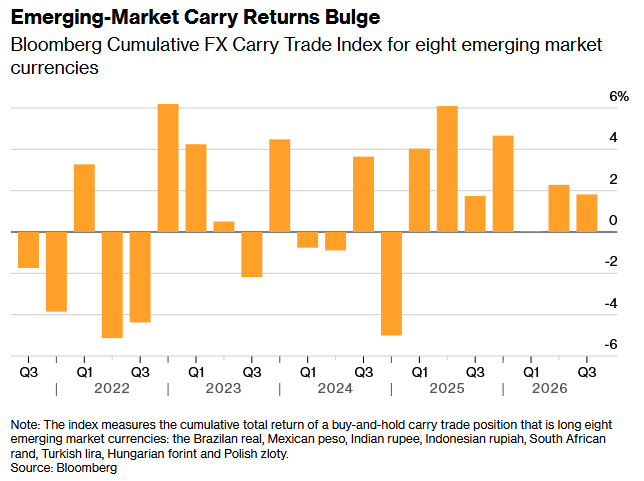
Earnings on arbitrage transactions expand in emerging markets
Currency depreciation transactions
A “currency depreciation transaction” means that investors sell off dollars and switch to assets with limited supply such as gold or Bitcoin due to concerns about the decline in the value of the dollar. This trading strategy was inspired by the historical practices of rulers such as King Henry VIII of England and Emperor Nero of Rome — they used cheaper metals such as copper to dilute gold and silver coins, thereby reducing the actual value of the currency.
A “currency depreciation transaction” in the modern sense means that investors are wary of the US dollar because they are worried that the US debt of more than 40 trillion US dollars and inflation will erode the purchasing power of the US dollar over time. At the same time, the market is also concerned that US policymakers may be implementing policies that intentionally or unintended to weaken the dollar, which is one of the factors driving this deal.
Discussions about “currency depreciation transactions” accelerated in 2025, partly due to US President Trump's tariff policy and the prospect that the US government might shut down. In mid-2026, after Bezent authorized measures to support the yen and long-term US Treasury bonds, the topic once again became a hot topic of discussion on Wall Street.
But every fall in the US dollar does not mean a “currency depreciation transaction.” Global investors still hold a large number of US government bonds, which shows that there is no large-scale abandonment of dollar-denominated assets in the market.
De-dollarization
If “currency depreciation transactions” reflect market concerns about the value of the US dollar, then “de-dollarization” focuses on reducing dependence on the US dollar. This may include the central bank reducing its dollar reserve holdings, companies issuing bonds in currencies other than the US dollar, and global investors shifting capital to markets other than the US.
The share of the US dollar in global foreign exchange reserves has declined sharply from about 70% in 1999, and has fallen below 60% in recent years. Central banks said that in the long run, they plan to reduce their exposure to the US dollar, while the euro and renminbi are seen as attractive alternatives, which further fueled the trend of de-dollarization.
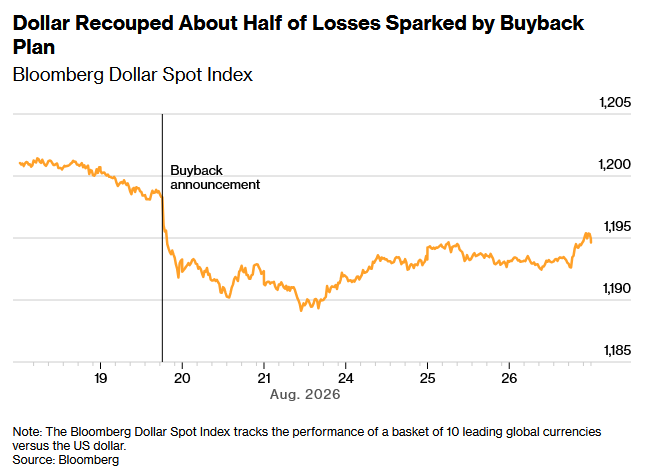
The dollar recovered about half of the decline caused by the US Treasury increasing repurchases of US bonds
After the Russian-Ukrainian conflict broke out in 2022, discussions on de-dollarization have clearly heated up. The US froze Russian assets and restricted Russia's entry into the dollar-based financial system, making Washington's ability to use its financial system and currency as a “weapon” the focus of market attention.
However, US stocks still account for about half of the total market value of the global stock market, and the US bond market is also the world's largest bond market. The dollar's dominance is still supported by factors such as the depth of its financial markets, the size of the US economy, and the lack of a truly credible alternative currency.
Financial repression
The term “financial depression” was proposed by Stanford University economists Ronald McKinnon and Edward Shaw in 1973. It refers to the government's policy of artificially keeping borrowing costs low by directing savings to government debt or other preferred borrowers. After the end of World War II, the US, Europe, and Japan widely adopted such policies, including measures such as capital controls, interest rate caps, and requiring financial institutions to hold government bonds.
Lowering the return on bondholders will help the government reduce its heavy debt burden. For example, during and after World War II, the Federal Reserve limited the yield on short-term government debt until the 1951 Treasury-Federal Reserve Agreement ended this arrangement.
Some investors, including billionaire Stanley Druckenmiller, described Bezent's treasury repurchase program as a form of financial depression aimed at reducing government borrowing costs. Another related term is “fiscal dominance,” where high debt causes central banks to shift from fighting inflation to helping the government borrow at lower costs, which in turn may drive up inflation.
Distorted operation
If Bezent's treasury bond repurchase strategy actually uses short-term treasury bills to replace long-term debt, then this operation is equivalent to the Treasury's version of a “distorted operation” — a policy the Federal Reserve has adopted many times over the past few decades.
The Federal Reserve's version of “distorting operations” includes replacing US Treasury bonds with longer maturing US Treasury bonds with shorter maturities on the central bank's balance sheet, with the aim of reducing long-term borrowing costs and boosting economic growth. Bessent, on the other hand, said that he is carrying out what he calls a “Treasury Department distortion operation.”
George Saravelos, head of global foreign exchange research at Deutsche Bank, wrote after the announcement of the US Treasury's treasury bond repurchase plan: “Distorted operations are here.” “The Ministry of Finance will have to issue more treasury notes to fund long-term removal from the market.” He added that it was actually a “soft form of financial suppression.”
Some market participants refer to this operation as a “Baycent put option.” A put option is an option that gives the buyer the right to sell an asset at a specific price. In this example, traders know that there is a large buyer in the US bond market (that is, the US Treasury), so they don't want to stand on the opposite side of it.
Selling off the US
Increased policy and political uncertainty has prompted some market participants to believe that investors may eventually seek to “sell off America” during Trump's second term. Reasons include Trump's tariff strategy, his actions against the Federal Reserve during the tenure of former Federal Reserve Chairman Jerome Powell (which is thought to damage the independence of the Federal Reserve), and his damage to America's long-term alliance through discussions on taking over Greenland. Furthermore, fundamental weaknesses such as the rising size of America's treasury bonds have also heightened this concern.
US 30-year Treasury yields hit their highest level in nearly 20 years in August. Meanwhile, an indicator that measures the value of the dollar fell about 8% last year. However, the amount of US Treasury bonds held by foreign investors this year has set a record, and the US stock market has also hit record highs many times, driven by advances in AI and other technology fields led by the US.
Yield curve control
The US Treasury's move to increase long-term bond buybacks has been compared by some market participants to the government's actions to artificially reduce borrowing costs (most famous is the Bank of Japan's yield curve control policy) rather than letting market forces determine the level of yield.
Now, some investors, including RBC BlueBay Asset Management, are beginning to think about how much intervention the Trump administration will take if Treasury yields get out of control, and whether it may eventually pressure the Federal Reserve to help lower yields.
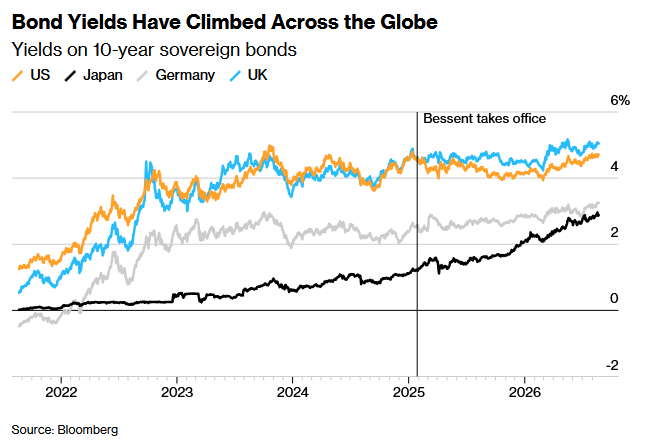
Global bond yields are generally higher
However, the market expects the Federal Reserve to maintain its independence and resist any such pressure. One reason is that Walsh has long questioned the use of asset purchases and the blurring of boundaries between fiscal policy and monetary policy. Without the participation of the Federal Reserve, the US Treasury, led by Bezent, would need to invest a large amount of money to truly curb borrowing costs.
Japan's experience in implementing yield curve control policies from 2016 to 2024 and its mixed results also constituted a cautionary case. At the time, measures taken by Japan to defend the yield on 10-year treasury bonds actually pushed the yen down to a record low.