
Ministry of Industry and Information Technology: Telecom business revenue totaled 1.02 trillion yuan in the first 7 months of 2026, down 2.1% year on year
I. Overall operation
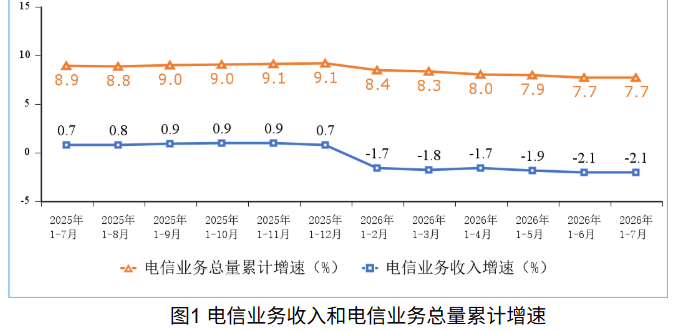
In the first seven months, telecom business revenue totaled 1.02 trillion yuan, a year-on-year decrease of 2.1%. The total telecom business volume, calculated at constant prices for the previous year, increased 7.7% year over year.
II. Development of telecom users
Fixed broadband access subscribers continue to shift to gigabytes. By the end of July, the total number of fixed Internet broadband access users of the three basic telecom companies reached 702 million, a net increase of 11.46 million over the end of the previous year. Among them, there were 671 million fixed Internet broadband access users with an access rate of 100 Mbps and above, accounting for 95.6% of the total number of users; 260 million fixed Internet broadband access users with an access rate of 1000 Mbps and above reached 260 million, a net increase of 21.98 million over the end of the previous year, accounting for 37.1% of the total number of users, an increase of 2.6 percentage points compared to the end of the previous year.
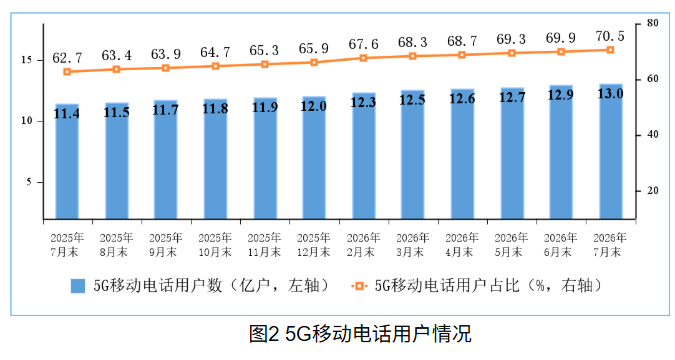
5G mobile phone users account for over 70%. By the end of July, the total number of mobile phone users of the three basic telecom companies and China Radio and Television reached 1,847 billion, a net increase of 20.62 million over the end of the previous year. Among them, 5G mobile phone users reached 1.03 billion, a net increase of 98.75 million over the end of the previous year, accounting for 70.5% of mobile phone users.
Mobile IoT end users are growing rapidly. By the end of July, the three basic telecom companies had developed 2,993 million mobile IoT end users, a net increase of 105 million over the end of the previous year. The number of Internet TV (IPTV, OTT) users reached 409 million, a net increase of 683,000 over the end of the previous year.
III. Telecom service usage
Mobile internet traffic grew rapidly, and the DOU value remained high in July. In the first 7 months, cumulative mobile internet traffic reached 258.7 billion GB, an increase of 17.6% over the previous year. By the end of July, the number of mobile Internet users reached 1,638 million, a net increase of 28.58 million over the end of the previous year. Average household mobile internet traffic (DOU) reached 23.81 GB/household/month in July, up 13.9% year on year, 0.77 GB/household/month higher than the end of the previous year.
The traditional mobile business continues to shrink. In the first seven months, mobile phone inbound call time was 1.1 trillion minutes, a year-on-year decrease of 6.5%; landline callers completed 32.76 billion minutes, a year-on-year decrease of 18.6%. In the first 7 months, the national mobile SMS business volume fell 8.7% year on year; mobile SMS business revenue fell 12.2% year on year.
IV. Status of communication capabilities
The construction of gigabit fiber broadband networks is progressing in an orderly manner. By the end of July, the number of Internet broadband access ports nationwide reached 1.27 billion, a net increase of 21.52 million over the end of the previous year. Among them, the number of optical fiber access (FTTH/O) ports reached 1.23 billion, a net increase of 19.35 million over the end of the previous year, accounting for 96.7% of Internet broadband access ports. By the end of July, the number of 10G PON ports with gigabit network service capabilities reached 33.4 million, a net increase of 1,417,000 over the end of the previous year.
5G network construction is progressing steadily. By the end of July, the total number of 5G base stations reached 5.154 million, a net increase of 316,000 over the end of the previous year, accounting for 39.4% of the total number of mobile base stations, an increase of 0.3 percentage points over the first half of the year.
5. Regional developments
The penetration rate of 5G and gigabit users continues to increase in all regions. By the end of July, the penetration rates of fixed broadband access users of 1000 Mbps and above in the East, Central, West and Northeast regions were 36.4%, 37.8%, 38.5%, and 32.4%, respectively, up 1.8, 3.9, 2.4 and 3.4 percentage points from the end of the previous year; 5G mobile phone user penetration rates were 70%, 71.4%, 70.5%, and 71.2%, respectively, up 4.5, 4.9, 4.6 and 4.7 percentage points from the end of the previous year.
The growth rate of mobile Internet access traffic in all regions has remained at double-digit levels. In the first seven months, mobile Internet access traffic in the East, Central, West and Northeast regions reached 109.9 billion GB, 59.98 billion GB, 73.35 billion GB, and 15.42 billion GB respectively, up 19.3%, 15.7%, 16.4%, and 18.4% year-on-year.
This article was selected from the “Ministry of Industry and Information Technology” official website, Zhitong Finance Editor: Xu Wenqiang.